
Introduction
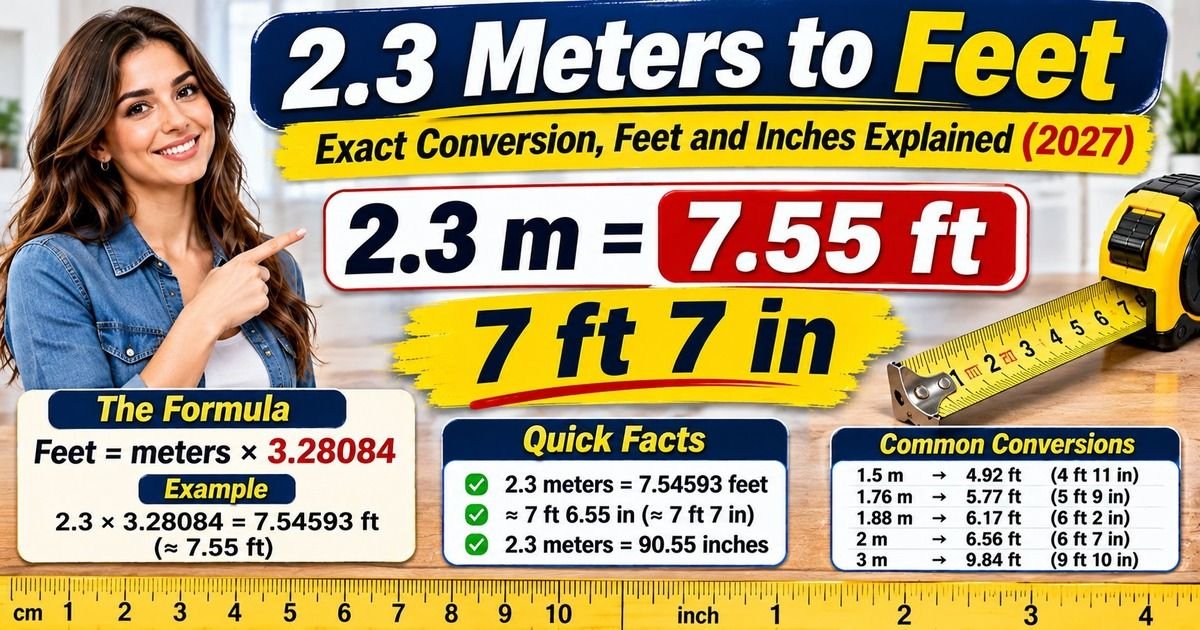
How many feet are in 2.3 meters? The short answer to 2.3 meters to feet is 7.55 feet — just over 7 and a half feet, or about 7 feet 7 inches.
You meet this conversion everywhere: a sofa listing gives its length in meters, a room plan is drawn in meters, or a tall bookshelf is listed as 2.3 m and you think in feet. This guide gives you the exact answer, the simple formula that converts any meters value to feet, the inches equivalent, a quick chart for the values people search for most, and practical room-size comparisons — plus the reverse direction, feet back to meters — so you never have to look it up twice. If you searched for 2.3 meters to feet, you will find the exact answer below, with the formula and a chart.
The Exact Answer
2.3 meters = 7.54593 feet, rounded to 7.55 feet.
In feet and inches, that is 7 feet 6.55 inches, which people round to 7 feet 7 inches. In inches alone, 2.3 meters is 90.55 inches (2.3 × 39.3701).
That is the figure to use in everyday conversation. So the 2.3 meters to feet conversion is 7.54593 feet exactly, rounded to 7.55 feet. If you need precision — for a cut, a fitting, or a technical specification — use 7.54593 feet or 90.55 inches instead of the rounded 7.55 feet.
The Formula: Meters to Feet
Meters and feet are linked by one exact conversion factor:
1 foot = 0.3048 meters (exactly)
So to turn meters into feet, divide by 0.3048 — or, more simply, multiply by 3.28084:
Feet = meters × 3.28084
Worked example for 2.3 meters to feet:
2.3 × 3.28084 = 7.54593 feet, which rounds to 7.55 feet. That is the whole 2.3 meters to feet calculation — one multiplication.
The same formula works for every value in this guide. The factor comes from the official definition of the foot, published by the National Institute of Standards and Technology (NIST). A quick mental shortcut: multiply by 3.28 and you will be within a fraction of an inch for everyday use — but for exact work, use 3.28084.
Meters to Feet Conversion Chart
Meters to Feet Chart
| Meters | Feet | Feet and inches |
|---|---|---|
| 1 m | 3.28 ft | 3 ft 3 in |
| 1.5 m | 4.92 ft | 4 ft 11 in |
| 1.76 m | 5.77 ft | 5 ft 9 in |
| 1.79 m | 5.87 ft | 5 ft 10 in |
| 1.88 m | 6.17 ft | 6 ft 2 in |
| 2 m | 6.56 ft | 6 ft 7 in |
| 2.3 m | 7.55 ft | 7 ft 7 in |
| 3 m | 9.84 ft | 9 ft 10 in |
| 5 m | 16.40 ft | 16 ft 5 in |
| 10 m | 32.81 ft | 32 ft 10 in |
| 20 m | 65.62 ft | 65 ft 7 in |
| 55 m | 180.45 ft | 180 ft 5 in |
| 100 m | 328.08 ft | 328 ft 1 in |
Quick tip: Multiply meters by 3.28084 to get feet — 2.3 meters is 7.55 feet.
1.5 Meters to Feet

1.5 meters is 4.92 feet (1.5 × 3.28084 = 4.92126). In feet and inches, that is 4 feet 11.06 inches, rounded to 4 feet 11 inches.
One and a half meters is a handy everyday length: it is twice the height of a dining table, and about the height of a young teenager. Compared with 2.3 meters, it is 0.8 meters shorter — about 2 feet 7 inches less — which is why a 1.5-meter length fits easily where a 2.3-meter length needs real room.
2 Meters to Feet

2 meters is 6.56 feet (2 × 3.28084 = 6.56168). In feet and inches, that is 6 feet 6.74 inches, rounded to 6 feet 7 inches.
Two meters is a useful landmark because it is almost exactly the height of a standard interior door, which is usually about 2.03 meters (80 inches) tall. So if you can picture a doorway, you can picture 2 meters — it reaches just about to the top of the frame. A 2.3-meter length stands about 0.3 meters (almost a foot) taller than that doorway.
1.88 Meters to Feet

1.88 meters is 6.17 feet (1.88 × 3.28084 = 6.16798). In feet and inches, that is 6 feet 2.02 inches, rounded to 6 feet 2 inches.
This is a very common height listing — 1.88 m appears on sports profiles and ID documents, and 6 feet 2 inches is how the same height is written in the United States. The two numbers describe exactly the same person; only the unit changes.
1.76 Meters to Feet

1.76 meters is 5.77 feet (1.76 × 3.28084 = 5.77428). In feet and inches, that is 5 feet 9.29 inches, rounded to 5 feet 9 inches.
Like 1.88 m, this is a height you will see written as centimeters or meters on a form and as feet and inches everywhere else. The gap between 1.76 m and 1.88 m is 12 centimeters — about 4.7 inches — which is why the two heights look close on paper but noticeably different side by side.
1.79 Meters to Feet

1.79 meters is 5.87 feet (1.79 × 3.28084 = 5.87270). In feet and inches, that is 5 feet 10.47 inches, rounded to 5 feet 10 inches.
Like 1.76 m and 1.88 m, 1.79 m is a height you will see on profiles and forms — 5 feet 10 inches is one of the most common adult heights listed in the United States, so the two numbers describe the same person in different units.
20 Meters to Feet

20 meters is 65.62 feet (20 × 3.28084 = 65.6168). That is about 65 feet 7 inches.
Twenty meters is a distance rather than a height, so picture it along the ground: a bowling lane is 18.29 meters from the foul line to the head pin, so 20 meters is a little longer than a full bowling lane. It is also close to the length of two city buses parked end to end, and about one-fifth of a 100-meter running track.
55 Meters to Feet

55 meters is 180.45 feet (55 × 3.28084 = 180.4462). That is about 180 feet 5 inches.
An Olympic swimming pool is 50 meters long, so 55 meters is one pool plus another 5 meters — picture the pool, then add a little more. An American football field is 91.44 meters long, so 55 meters is about 60% of the field. A 55-meter building is roughly 18 stories tall, at about 3 meters per story.
Converting Feet to Meters
The reverse direction uses the same exact factor, the other way around. Since 1 foot is exactly 0.3048 meters:
Meters = feet × 0.3048
Worked examples:
- 1 foot = 1 × 0.3048 = 0.3048 meters
- 5 feet = 5 × 0.3048 = 1.524 meters
- 6 feet = 6 × 0.3048 = 1.829 meters
- 10 feet = 10 × 0.3048 = 3.048 meters
- 100 feet = 100 × 0.3048 = 30.48 meters
A quick check ties the two directions together: 5 feet is 1.524 meters, and converting back, 1.524 × 3.28084 = 5.00 feet. If your round trip does not land back on the number you started with, you multiplied when you should have divided, or the other way around.
The most common mix-up is using 3.28 in the wrong direction. Remember: meters to feet makes the number bigger (multiply by 3.28084), because a foot is shorter than a meter and you need more of them. Feet to meters makes the number smaller (multiply by 0.3048), because a meter is longer and you need fewer of them.
What Does 2.3 Meters Look Like in Real Life?

Numbers are easier to picture when you compare them with familiar things. Here is what the 2.3 meters to feet result — 7.55 feet — looks like in everyday terms.
Against a doorway
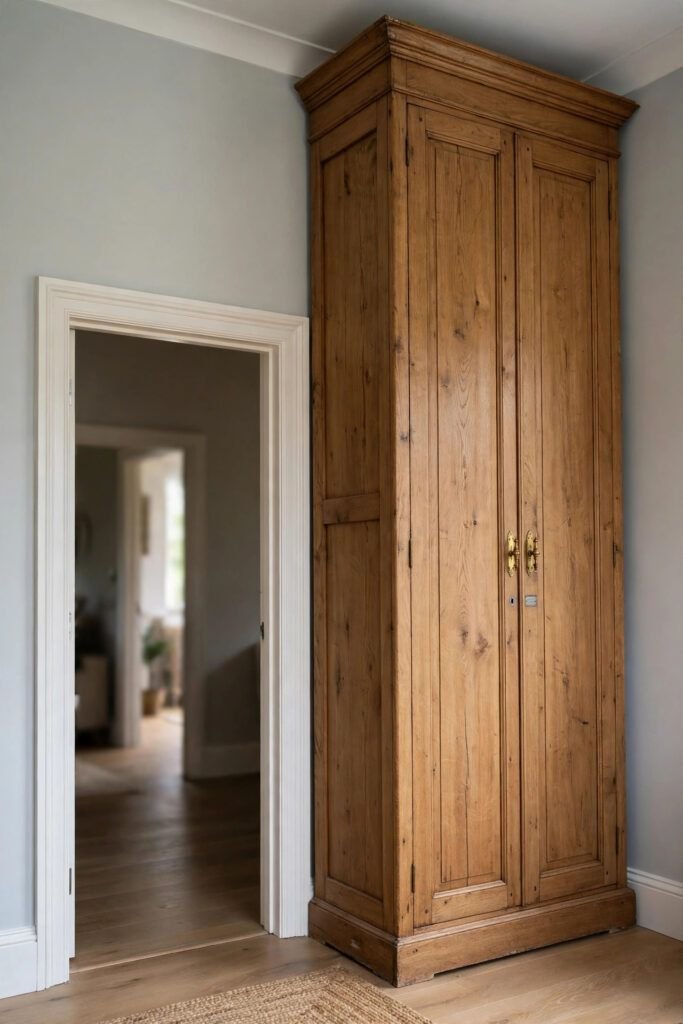
A standard interior door is about 2.03 meters tall. At 2.3 meters, a length stands 0.27 meters — about 10.6 inches — taller than the top of the door frame. A tall wardrobe or bookshelf at 2.3 meters would stick out clearly above any normal doorway in the house.
Against furniture

A 2.3-meter length is a common size for a three-seater sofa, a dining table with chairs, or a tall bookshelf. In feet, 7 feet 7 inches is easier to picture against a room — it is more than half the width of a small bedroom. If you lay a 2.3-meter sofa along a wall, it takes up a good stretch of that wall.
Against a bed and a car

A standard bed is about 2 meters long, so 2.3 meters is 0.3 meters longer than a bed — picture a bed, then add about a foot. A small car is roughly 4 meters long, so 2.3 meters is more than half the car’s length — about the length of the car’s front section plus the doors.
Longer lengths in this guide

The bigger values in the chart are distances, not room sizes: 20 meters is a bowling lane and a bit, 55 meters is an Olympic pool plus a little more, and 100 meters is the full sprint straight on a running track — 328.08 feet of flat-out running.
Common Mistakes When Converting 2.3 Meters to Feet
The conversion is simple, but a few mistakes show up again and again.
Using 3.28 instead of 3.28084 for exact work. For a quick estimate, 3.28 is fine. But over longer distances the small difference adds up: 100 meters × 3.28 = 328 feet, while the exact figure is 328.08 feet. Use the full 3.28084 when the measurement matters.
Multiplying when you should divide. Meters to feet means multiplying by 3.28084, and the answer must be bigger than the number you started with. If your feet answer is smaller than your meters number, you divided by mistake.
Mixing up feet and inches in the answer. 7.55 feet is not 7 feet 55 inches — it is 7 feet plus 0.55 of a foot. Multiply the decimal part by 12 to get inches: 0.55 × 12 = 6.6, so 7.55 feet is 7 feet 7 inches. The same applies to every decimal in the chart.
Confusing meters with yards. A yard is 0.9144 meters, so 2.3 meters is 2.52 yards — not 7.55 of anything. Yards and feet are different units, and only feet use the 3.28084 factor.
Forgetting the unit in the answer. A bare “7.55” means nothing — 7.55 feet and 7.55 meters are wildly different lengths. Always write the unit with the number.
FAQs
What is 2.3 meters to feet?
2.3 meters to feet is 7.55 feet (exactly 7.54593 feet). In feet and inches, that is 7 feet 7 inches.
How many feet is 2 meters?
2 meters is 6.56 feet (exactly 6.56168 feet), or 6 feet 7 inches rounded.
How do you convert meters to feet?
Multiply the number of meters by 3.28084. For a 2.3 meters to feet conversion, 2.3 × 3.28084 = 7.55 feet, and 20 × 3.28084 = 65.62 feet. The factor comes from 1 foot being exactly 0.3048 meters.
How do you convert feet to meters?
Multiply the number of feet by 0.3048. For example, 10 feet × 0.3048 = 3.048 meters, and 6 feet × 0.3048 = 1.829 meters.
How many feet is 55 meters?
55 meters is 180.45 feet (55 × 3.28084 = 180.4462). That is about 180 feet 5 inches — a little longer than an Olympic swimming pool.
Is 2.3 meters the same as 7 feet?
No, not quite. The 2.3 meters to feet answer is 7.55 feet, which is about 6.55 inches more than 7 feet. Seven feet is 2.1336 meters, so 2.3 meters is about 17 centimeters longer than 7 feet.
Conclusion
So, what is 2.3 meters to feet? The answer is 7.55 feet — exactly 7.54593 feet, or 7 feet 7 inches.
The one formula to remember for 2.3 meters to feet — and every other value — is feet = meters × 3.28084. With it, every value in this guide follows: 1.5 meters is 4.92 feet, 2 meters is 6.56 feet, 1.88 meters is 6.17 feet, 1.79 meters is 5.87 feet, 1.76 meters is 5.77 feet, 20 meters is 65.62 feet, and 55 meters is 180.45 feet. Going the other way, meters = feet × 0.3048 — 10 feet is 3.048 meters and 100 feet is 30.48 meters.
The best way to keep the answer in your head is to picture it. Two point three meters is a three-seater sofa, a tall bookshelf, and a length that stands above any doorway. Once you have that picture, the 2.3 meters to feet answer follows on its own: 7.55 feet — 90.55 inches, or 7 feet 7 inches.
Related Guides

Hi, I’m Michael Carter, I write simple, everyday size guides so you can picture any measurement in seconds.