
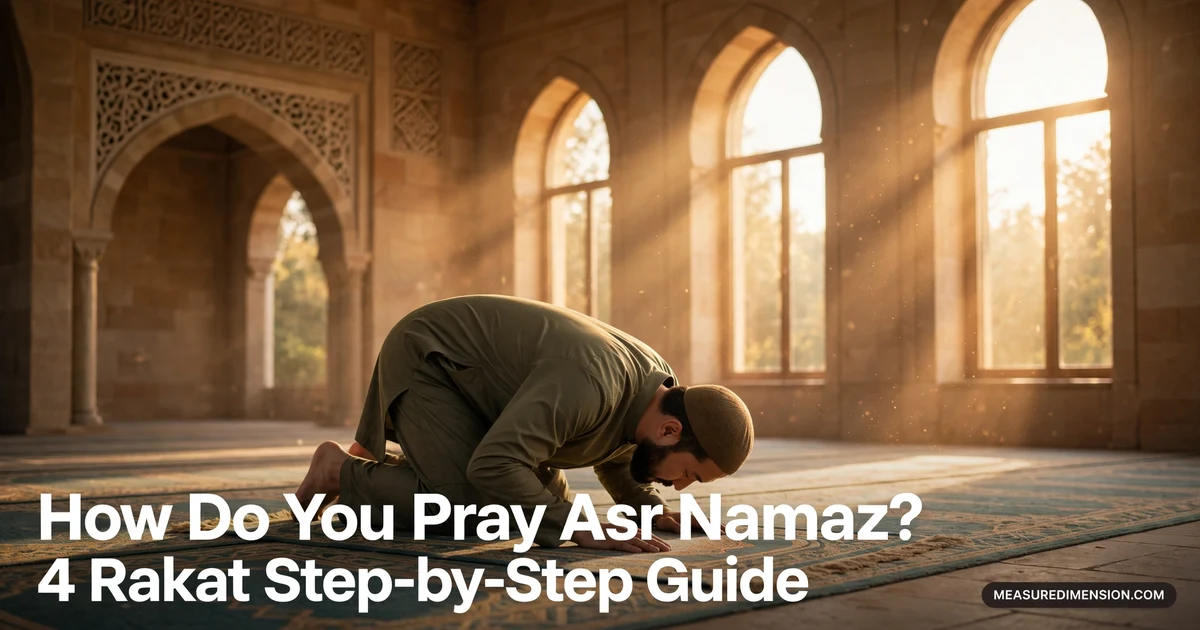
How do you pray Asr namaz? Asr is the afternoon prayer, and it is 4 rakat fard — four obligatory units. You pray it after Dhuhr and before Maghrib, while the sun is still up in the afternoon. There is no emphasized sunnah prayer before Asr, but you may pray 4 optional rakat before it if you wish.
The short answer is this: make wudu, face the qiblah, and make your intention in your heart to pray 4 rakat fard Asr. Start with the takbir and Sana, then pray the first rakat with Surah Al-Fatiha and a short surah, then bow (ruku) and prostrate (sujood). In the second rakat, read Fatiha and another short surah, then sit for the first Tashahhud.
In the third and fourth rakat, read only Surah Al-Fatiha. After the fourth rakat, sit for the final Tashahhud, read Durood-e-Ibrahim and a short dua, then turn your head right and left with the salam. That is the whole Asr prayer, and this guide walks you through every step with the Arabic, transliteration, Urdu and English for each dua.
Why Asr Prayer Matters
Asr is the middle prayer. Allah says in the Quran:
"Guard strictly the prayers, especially the middle prayer, and stand before Allah with obedience."
>
— Quran 2:238
Most scholars say the "middle prayer" in this verse is Asr, because it comes in the middle of the five daily prayers — Fajr and Dhuhr before it, Maghrib and Isha after it. It falls in the busiest part of the day, when work, school and errands are at their peak, so it is easy to delay it or forget it. That is exactly why Allah gave it this special mention.
The Prophet (peace be upon him) warned about missing Asr in the strongest words. He said, "Whoever misses the Asr prayer (intentionally), then it is as if he lost his family and property" (Sahih al-Bukhari 552). In another narration he said, "Whoever leaves the Asr prayer, all his (good) deeds will be annulled" (Sahih al-Bukhari 553). These warnings show how serious Asr is. It is not a prayer to skip or push to the last minute.
Praying Asr on time also brings a special reward. The angels who watch over us at Fajr and Asr report to Allah that they found us praying. So Asr is not only an obligation — it is a moment in the day when your prayer is witnessed and remembered.
Before You Start: Wudu and Niyyah
Before you pray Asr, you must be in a state of wudu (ablution). The steps are simple:
- Wash your hands, then rinse your mouth and nose.
- Wash your face three times.
- Wash your arms up to the elbows, right arm first, then left.
- Wipe your head once with wet hands.
- Wash your feet up to the ankles, right foot first, then left.
Find a clean place to pray and face the qiblah (the direction of the Kaaba in Makkah). Then make your niyyah — your intention — in your heart. You do not need to say it out loud. Simply intend: "I intend to pray 4 rakat fard Asr for the sake of Allah."
If you want, you can also pray 4 optional rakat before the fard Asr. The Prophet (peace be upon him) said, "May Allah show mercy to a man who prays four rak'ahs before the afternoon prayer" (Sunan Abi Dawud 1271; Jami` at-Tirmidhi 430, Hasan). These 4 rakat are sunnah ghair mu'akkadah — recommended but not emphasized — so your Asr is complete even if you skip them.
How Do You Pray Asr Namaz? Step by Step
Follow these six steps to pray the 4 rakat fard Asr.
Step 1: Takbir and Sana
Stand facing the qiblah with your hands at your sides. Raise both hands to your ears and say the takbir:
Arabic:
اللَّهُ أَكْبَرُ
Transliteration: Allahu Akbar.
Translation: "Allah is the Greatest."
Urdu translation: "اللہ سب سے بڑا ہے۔"
Then fold your hands on your chest (right hand over the left) and read Sana, the opening praise:
Arabic:
سُبْحَانَكَ اللَّهُمَّ وَبِحَمْدِكَ وَتَبَارَكَ اسْمُكَ وَتَعَالَى جَدُّكَ وَلَا إِلَهَ غَيْرُكَ
Transliteration: Subhanakallahumma wa bihamdika wa tabarakasmuka wa ta'ala jadduka wa la ilaha ghayruk.
Translation: "Glory be to You, O Allah, and all praise is for You. Blessed is Your name, exalted is Your majesty, and there is no god besides You."
Urdu translation: "پاک ہے تو اے اللہ! اور تمام تعریف تیرے لیے ہے، تیرا نام بابرکت ہے، تیری شان بلند ہے، اور تیرے سوا کوئی معبود نہیں۔"
Step 2: Rakat 1 — Fatiha, a Short Surah, Ruku and Sujood
First, seek refuge from Shaytan (Ta'awwudh) and say Bismillah:
Arabic:
أَعُوذُ بِاللَّهِ مِنَ الشَّيْطَانِ الرَّجِيمِ — بِسْمِ اللَّهِ الرَّحْمَٰنِ الرَّحِيمِ
Transliteration: A'udhu billahi minash-Shaytanir-Rajeem. Bismillahir-Rahmanir-Raheem.
Translation: "I seek refuge in Allah from Shaytan, the accursed. In the name of Allah, the Most Merciful, the Most Compassionate."
Urdu translation: "میں اللہ کی پناہ مانگتا ہوں شیطان مردود سے۔ اللہ کے نام سے جو بڑا مہربان، نہایت رحم والا ہے۔"
Then read Surah Al-Fatiha (Quran 1:1-7):
Arabic:
بِسْمِ اللَّهِ الرَّحْمَٰنِ الرَّحِيمِ (١) الْحَمْدُ لِلَّهِ رَبِّ الْعَالَمِينَ (٢) الرَّحْمَٰنِ الرَّحِيمِ (٣) مَالِكِ يَوْمِ الدِّينِ (٤) إِيَّاكَ نَعْبُدُ وَإِيَّاكَ نَسْتَعِينُ (٥) اهْدِنَا الصِّرَاطَ الْمُسْتَقِيمَ (٦) صِرَاطَ الَّذِينَ أَنْعَمْتَ عَلَيْهِمْ غَيْرِ الْمَغْضُوبِ عَلَيْهِمْ وَلَا الضَّالِّينَ (٧)
Transliteration: Bismillahir-Rahmanir-Raheem. Alhamdu lillahi Rabbil-'alameen. Ar-Rahmanir-Raheem. Maliki yawmid-deen. Iyyaka na'budu wa iyyaka nasta'een. Ihdinas-siratal-mustaqeem. Siratal-ladhina an'amta 'alayhim, ghayril-maghdubi 'alayhim wa lad-dallin. Ameen.
Translation: "In the name of Allah, the Most Merciful, the Most Compassionate. All praise is for Allah, Lord of all the worlds. The Most Merciful, the Most Compassionate. Master of the Day of Judgement. You alone we worship, and You alone we ask for help. Guide us to the straight path — the path of those You have blessed, not of those who earned Your anger, nor of those who went astray." (Quran 1:1-7)
Urdu translation: "اللہ کے نام سے جو بڑا مہربان، نہایت رحم والا ہے۔ تمام تعریف اللہ کے لیے ہے جو تمام جہانوں کا رب ہے۔ بڑا مہربان، نہایت رحم والا۔ جزا کے دن کا مالک۔ ہم تیری ہی عبادت کرتے ہیں اور تجھی سے مدد مانگتے ہیں۔ ہمیں سیدھا راستہ دکھا، ان لوگوں کا راستہ جن پر تو نے انعام کیا، نہ ان کا جن پر تیرا غضب ہوا اور نہ گمراہوں کا۔"
Then read a short surah. In the first rakat, read Surah Al-Ikhlas (Chapter 112):
Arabic:
قُلْ هُوَ اللَّهُ أَحَدٌ (١) اللَّهُ الصَّمَدُ (٢) لَمْ يَلِدْ وَلَمْ يُولَدْ (٣) وَلَمْ يَكُن لَّهُ كُفُوًا أَحَدٌ (٤)
Transliteration: Qul huwallahu ahad. Allahus-Samad. Lam yalid wa lam yulad. Wa lam yakul-lahu kufuwan ahad.
Translation: "Say: He is Allah, the One. Allah, the Eternal Refuge. He neither begets nor is born, nor is there to Him any equivalent."
Urdu translation: "کہہ دو: وہ اللہ ایک ہے۔ اللہ بے نیاز ہے۔ نہ اس نے کسی کو جنا اور نہ وہ جنا گیا۔ اور اس کا کوئی ہمسر نہیں۔"
Now go into ruku (bowing). Say "Allahu Akbar", bow with your hands on your knees and your back straight, and say three times:
Arabic:
سُبْحَانَ رَبِّيَ الْعَظِيمِ
Transliteration: Subhana Rabbiyal-Adheem.
Translation: "Glory be to my Lord, the Most Great."
Urdu translation: "پاک ہے میرا رب جو عظمت والا ہے۔"
Stand up straight and say "Sami'allahu liman hamidah, Rabbana lakal-hamd" (Allah hears the one who praises Him; our Lord, all praise is for You). Then say "Allahu Akbar" and go into sujood (prostration), with your forehead, nose, hands, knees and toes on the ground, and say three times:
Arabic:
سُبْحَانَ رَبِّيَ الْأَعْلَى
Transliteration: Subhana Rabbiyal-A'la.
Translation: "Glory be to my Lord, the Most High."
Urdu translation: "پاک ہے میرا رب جو سب سے بلند ہے۔"
Sit up briefly and say "Rabbighfir li" (My Lord, forgive me), then go into a second sujood and say "Subhana Rabbiyal-A'la" three times again. Then stand up for the second rakat. This completes the first rakat.
Step 3: Rakat 2 — Fatiha, a Short Surah, Then the First Tashahhud
In the second rakat, start with Bismillah and read Surah Al-Fatiha again, in full, just as in the first rakat. Then read another short surah. Read Surah Al-Falaq (Chapter 113):
Arabic:
قُلْ أَعُوذُ بِرَبِّ الْفَلَقِ (١) مِن شَرِّ مَا خَلَقَ (٢) وَمِن شَرِّ غَاسِقٍ إِذَا وَقَبَ (٣) وَمِن شَرِّ النَّفَّاثَاتِ فِي الْعُقَدِ (٤) وَمِن شَرِّ حَاسِدٍ إِذَا حَسَدَ (٥)
Transliteration: Qul a'udhu bi Rabbil-falaq. Min sharri ma khalaq. Wa min sharri ghasiqin idha waqab. Wa min sharrin-naffathati fil-'uqad. Wa min sharri hasidin idha hasad.
Translation: "Say: I seek refuge in the Lord of daybreak, from the evil of what He created, from the evil of darkness when it settles, from the evil of those who blow on knots, and from the evil of an envier when he envies."
Urdu translation: "کہہ دو: میں صبح کے رب کی پناہ مانگتا ہوں، ہر اس چیز کے شر سے جو اس نے پیدا کی، اور اندھیری رات کے شر سے جب وہ چھا جائے، اور گرہوں میں پھونک مارنے والیوں کے شر سے، اور حسد کرنے والے کے شر سے جب وہ حسد کرے۔"
You can also read Surah An-Nas (Chapter 114) instead of Al-Falaq if you prefer. Then do ruku and two sujood exactly as in the first rakat, saying "Subhana Rabbiyal-Adheem" three times in ruku and "Subhana Rabbiyal-A'la" three times in each sujood.
After the second sujood, sit down for the first Tashahhud and read:
Arabic:
التَّحِيَّاتُ لِلَّهِ وَالصَّلَوَاتُ وَالطَّيِّبَاتُ، السَّلَامُ عَلَيْكَ أَيُّهَا النَّبِيُّ وَرَحْمَةُ اللَّهِ وَبَرَكَاتُهُ، السَّلَامُ عَلَيْنَا وَعَلَى عِبَادِ اللَّهِ الصَّالِحِينَ، أَشْهَدُ أَنْ لَا إِلَهَ إِلَّا اللَّهُ وَأَشْهَدُ أَنَّ مُحَمَّدًا عَبْدُهُ وَرَسُولُهُ
Transliteration: Attahiyyatu lillahi was-salawatu wat-tayyibat. Assalamu 'alayka ayyuhan-Nabiyyu wa rahmatullahi wa barakatuh. Assalamu 'alayna wa 'ala 'ibadillahis-saliheen. Ash-hadu an la ilaha illallahu wa ash-hadu anna Muhammadan 'abduhu wa rasuluh.
Translation: "All greetings, prayers and good words belong to Allah. Peace be upon you, O Prophet, and the mercy of Allah and His blessings. Peace be upon us and upon the righteous servants of Allah. I bear witness that there is no god but Allah, and I bear witness that Muhammad is His servant and Messenger."
Urdu translation: "تمام سلام، نمازیں اور پاکیزہ کلمات اللہ کے لیے ہیں۔ اے نبی! آپ پر سلام ہو، اور اللہ کی رحمت اور اس کی برکتیں۔ ہم پر اور اللہ کے نیک بندوں پر سلام ہو۔ میں گواہی دیتا ہوں کہ اللہ کے سوا کوئی معبود نہیں، اور میں گواہی دیتا ہوں کہ محمد اللہ کے بندے اور اس کے رسول ہیں۔"
Then stand up for the third rakat. Do not read Durood here — that comes only in the final sitting.
Step 4: Rakat 3 — Fatiha Only, Then Ruku and Sujood
In the third rakat, read only Surah Al-Fatiha — no second surah. Read Bismillah, then Fatiha in full, just as in the first two rakat. Then say "Allahu Akbar" and do ruku, saying "Subhana Rabbiyal-Adheem" three times, then stand up, then do two sujood, saying "Subhana Rabbiyal-A'la" three times in each.
After the second sujood, stand up straight away for the fourth rakat. There is no sitting and no Tashahhud after the third rakat.
Step 5: Rakat 4 — Fatiha Only, Then the Final Tashahhud and Durood
In the fourth rakat, read only Surah Al-Fatiha again — no second surah. Then do ruku and two sujood exactly as before. After the second sujood, sit down for the final Tashahhud and read the full Tashahhud again:
Arabic:
التَّحِيَّاتُ لِلَّهِ وَالصَّلَوَاتُ وَالطَّيِّبَاتُ، السَّلَامُ عَلَيْكَ أَيُّهَا النَّبِيُّ وَرَحْمَةُ اللَّهِ وَبَرَكَاتُهُ، السَّلَامُ عَلَيْنَا وَعَلَى عِبَادِ اللَّهِ الصَّالِحِينَ، أَشْهَدُ أَنْ لَا إِلَهَ إِلَّا اللَّهُ وَأَشْهَدُ أَنَّ مُحَمَّدًا عَبْدُهُ وَرَسُولُهُ
Transliteration: Attahiyyatu lillahi was-salawatu wat-tayyibat. Assalamu 'alayka ayyuhan-Nabiyyu wa rahmatullahi wa barakatuh. Assalamu 'alayna wa 'ala 'ibadillahis-saliheen. Ash-hadu an la ilaha illallahu wa ash-hadu anna Muhammadan 'abduhu wa rasuluh.
Translation: "All greetings, prayers and good words belong to Allah. Peace be upon you, O Prophet, and the mercy of Allah and His blessings. Peace be upon us and upon the righteous servants of Allah. I bear witness that there is no god but Allah, and I bear witness that Muhammad is His servant and Messenger."
Urdu translation: "تمام سلام، نمازیں اور پاکیزہ کلمات اللہ کے لیے ہیں۔ اے نبی! آپ پر سلام ہو، اور اللہ کی رحمت اور اس کی برکتیں۔ ہم پر اور اللہ کے نیک بندوں پر سلام ہو۔ میں گواہی دیتا ہوں کہ اللہ کے سوا کوئی معبود نہیں، اور میں گواہی دیتا ہوں کہ محمد اللہ کے بندے اور اس کے رسول ہیں۔"
Then read Durood-e-Ibrahim, the blessings upon the Prophet (peace be upon him):
Arabic:
اللَّهُمَّ صَلِّ عَلَى مُحَمَّدٍ وَعَلَى آلِ مُحَمَّدٍ كَمَا صَلَّيْتَ عَلَى إِبْرَاهِيمَ وَعَلَى آلِ إِبْرَاهِيمَ إِنَّكَ حَمِيدٌ مَجِيدٌ، اللَّهُمَّ بَارِكْ عَلَى مُحَمَّدٍ وَعَلَى آلِ مُحَمَّدٍ كَمَا بَارَكْتَ عَلَى إِبْرَاهِيمَ وَعَلَى آلِ إِبْرَاهِيمَ إِنَّكَ حَمِيدٌ مَجِيدٌ
Transliteration: Allahumma salli 'ala Muhammadin wa 'ala ali Muhammadin kama sallayta 'ala Ibrahima wa 'ala ali Ibrahima innaka Hamidum-Majeed. Allahumma barik 'ala Muhammadin wa 'ala ali Muhammadin kama barakta 'ala Ibrahima wa 'ala ali Ibrahima innaka Hamidum-Majeed.
Translation: "O Allah, send blessings upon Muhammad and upon the family of Muhammad, as You sent blessings upon Ibrahim and upon the family of Ibrahim. Indeed, You are Praiseworthy and Glorious. O Allah, bless Muhammad and the family of Muhammad, as You blessed Ibrahim and the family of Ibrahim. Indeed, You are Praiseworthy and Glorious."
Urdu translation: "اے اللہ! محمد پر اور محمد کی آل پر رحمت نازل فرما، جیسا کہ تو نے ابراہیم پر اور ابراہیم کی آل پر رحمت نازل فرمائی۔ بے شک تو تعریف کے لائق اور بزرگی والا ہے۔ اے اللہ! محمد پر اور محمد کی آل پر برکت نازل فرما، جیسا کہ تو نے ابراہیم پر اور ابراہیم کی آل پر برکت نازل فرمائی۔ بے شک تو تعریف کے لائق اور بزرگی والا ہے۔"
Then read a short dua before the salam. Read the dua for refuge:
Arabic:
اللَّهُمَّ إِنِّي أَعُوذُ بِكَ مِنْ عَذَابِ جَهَنَّمَ، وَمِنْ عَذَابِ الْقَبْرِ، وَمِنْ فِتْنَةِ الْمَحْيَا وَالْمَمَاتِ، وَمِنْ شَرِّ فِتْنَةِ الْمَسِيحِ الدَّجَّالِ
Transliteration: Allahumma inni a'udhu bika min 'adhabi jahannam, wa min 'adhabil-qabr, wa min fitnatil-mahya wal-mamat, wa min sharri fitnatil-Masihid-Dajjal.
Translation: "O Allah, I seek refuge with You from the torment of Hell, and from the torment of the grave, and from the trials of life and death, and from the evil of the tribulation of the Masih Ad-Dajjal (the Antichrist)."
Urdu translation: "اے اللہ! میں تیری پناہ مانگتا ہوں جہنم کے عذاب سے، قبر کے عذاب سے، زندگی اور موت کی آزمائشوں سے، اور مسیح دجال کے فتنے کے شر سے۔"
Source: Sahih al-Bukhari. The Prophet (peace be upon him) said this dua can be recited after the Tashahhud and before the salam.
Step 6: Salam to the Right and Left
Now end the prayer with the salam. Turn your head to the right and say:
Arabic:
السَّلَامُ عَلَيْكُمْ وَرَحْمَةُ اللَّهِ
Transliteration: Assalamu 'alaikum wa rahmatullah.
Translation: "Peace and the mercy of Allah be upon you."
Urdu translation: "تم پر سلام ہو اور اللہ کی رحمت ہو۔"
Then turn your head to the left and say the same words again: "Assalamu 'alaikum wa rahmatullah." Your Asr prayer is now complete.
Duas After Asr
After the salam, stay in your place for a minute or two and read the duas the Prophet (peace be upon him) read after every fard prayer. The full guide with all twelve duas is in our Sunni Dua After Namaz: 12 Best Step-by-Step Duas & Zikr article. Here are the three most important ones after Asr:
First, say Astaghfirullah (I seek Allah's forgiveness) three times. Then read:
Arabic:
اللَّهُمَّ أَنْتَ السَّلَامُ وَمِنْكَ السَّلَامُ، تَبَارَكْتَ يَا ذَا الْجَلَالِ وَالْإِكْرَامِ
Transliteration: Allahumma Antas-Salam wa minkas-Salam, tabarakta ya Dhal-Jalali wal-Ikram.
Translation: "O Allah, You are Peace, and from You comes peace. Blessed are You, O Possessor of Majesty and Honor."
Urdu translation: "اے اللہ! تو ہی سلامتی ہے اور تجھی سے سلامتی ہے۔ تو بابرکت ہے، اے جلال و اکرام والے!"
Source: Sahih Muslim 591. Thawban (may Allah be pleased with him) reported that when the Messenger of Allah (peace be upon him) finished his prayer, he would ask for forgiveness three times and then say this dua.
Next, read Ayat al-Kursi, verse 255 of Surah Al-Baqarah:
Arabic:
اللَّهُ لَا إِلَٰهَ إِلَّا هُوَ الْحَيُّ الْقَيُّومُ ۚ لَا تَأْخُذُهُ سِنَةٌ وَلَا نَوْمٌ ۚ لَّهُ مَا فِي السَّمَاوَاتِ وَمَا فِي الْأَرْضِ ۗ مَن ذَا الَّذِي يَشْفَعُ عِندَهُ إِلَّا بِإِذْنِهِ ۚ يَعْلَمُ مَا بَيْنَ أَيْدِيهِمْ وَمَا خَلْفَهُمْ ۖ وَلَا يُحِيطُونَ بِشَيْءٍ مِّنْ عِلْمِهِ إِلَّا بِمَا شَاءَ ۚ وَسِعَ كُرْسِيُّهُ السَّمَاوَاتِ وَالْأَرْضَ ۖ وَلَا يَئُودُهُ حِفْظُهُمَا ۚ وَهُوَ الْعَلِيُّ الْعَظِيمُ
Transliteration: Allahu la ilaha illa Huwal-Hayyul-Qayyum, la ta'khudhuhu sinatun wa la nawm, lahu ma fis-samawati wa ma fil-ard, man dhalladhi yashfa'u 'indahu illa bi-idhnih, ya'lamu ma bayna aydihim wa ma khalfahum, wa la yuhituna bi shay'im-min 'ilmihi illa bima sha', wasi'a kursiyyuhus-samawati wal-ard, wa la ya'uduhu hifdhuhuma, wa Huwal-'Aliyyul-'Adhim.
Translation: "Allah — there is no god but He, the Ever-Living, the Sustainer of all existence. Neither drowsiness nor sleep overtakes Him. To Him belongs whatever is in the heavens and whatever is on the earth. Who is it that can intercede with Him except by His permission? He knows what is before them and what is behind them, and they encompass not a thing of His knowledge except for what He wills. His Kursi extends over the heavens and the earth, and their preservation tires Him not. And He is the Most High, the Most Great." (Quran 2:255)
Urdu translation: "اللہ، اس کے سوا کوئی معبود نہیں، وہ زندہ ہے، سب کو قائم رکھنے والا ہے۔ اسے نہ اونگھ آتی ہے نہ نیند۔ آسمانوں اور زمین میں جو کچھ ہے سب اسی کا ہے۔ کون ہے جو اس کی اجازت کے بغیر اس کے پاس سفارش کر سکے؟ وہ جانتا ہے جو ان کے سامنے ہے اور جو ان کے پیچھے ہے، اور وہ اس کے علم میں سے کسی چیز کا احاطہ نہیں کر سکتے مگر جتنا وہ چاہے۔ اس کی کرسی آسمانوں اور زمین پر محیط ہے، اور ان کی حفاظت اسے تھکاتی نہیں، اور وہ بلند و برتر، عظیم ہے۔"
Source: Sunan an-Nasa'i 992. The Prophet (peace be upon him) said that whoever recites Ayat al-Kursi after every prescribed prayer, nothing stands between him and Paradise except death.
Finally, read Tasbih Fatimah — SubhanAllah 33 times, Alhamdulillah 33 times, and Allahu Akbar 34 times:
Arabic:
سُبْحَانَ اللَّهِ (33 times) — الْحَمْدُ لِلَّهِ (33 times) — اللَّهُ أَكْبَرُ (34 times)
Transliteration: SubhanAllah (33 times), Alhamdulillah (33 times), Allahu Akbar (34 times).
Translation: "Glory be to Allah" (33 times), "All praise is for Allah" (33 times), "Allah is the Greatest" (34 times).
Urdu translation: "پاک ہے اللہ" (33 بار)، "تمام تعریف اللہ کے لیے ہے" (33 بار)، "اللہ سب سے بڑا ہے" (34 بار)۔
Source: Sahih Muslim 597. The Prophet (peace be upon him) said that whoever glorifies Allah thirty-three times, praises Allah thirty-three times, and declares Allah's greatness thirty-four times after every prayer — making one hundred in total — his sins will be forgiven, even if they are as much as the foam of the sea.
Common Mistakes to Avoid
1. Rushing through the prayer. Asr is often prayed in a hurry because the day is busy. Slow down. Read Fatiha calmly, pause in ruku and sujood, and let each position settle before you move to the next one.
2. Missing Asr altogether. Asr is the prayer most often missed because it falls in the middle of work or school. The Prophet (peace be upon him) said that whoever misses Asr loses as if he lost his family and property (Sahih al-Bukhari 552). Set an alarm for Asr time so you never miss it.
3. Delaying Asr until sunset. Asr must be prayed before the sun sets. Praying it in the last few minutes before sunset, when the sun is low and yellow, is disliked. Pray Asr early in its time, not at the very end.
4. Praying the wrong number of rakat. Asr fard is 4 rakat — no more, no less. Some people pray 2 by mistake, or add extra rakat to the fard. Count carefully: Fatiha + surah in rakat 1 and 2, Fatiha only in rakat 3 and 4, Tashahhud after rakat 2 and after rakat 4.
5. Skipping the first Tashahhud. After the second rakat, you must sit and read the Tashahhud before standing up for the third rakat. If you stand up by mistake, sit back down and read it if you have not yet stood fully straight.
6. Praying without wudu. Wudu is a condition for prayer. If your wudu breaks before or during Asr, stop, renew your wudu, and pray again. A prayer without wudu is not valid.
7. Reading the duas too loudly. The recitation in Asr is silent (sirri) — you read Fatiha and the surahs quietly, to yourself, so that only you can hear them. Do not recite out loud, and do not disturb others praying near you.
Frequently Asked Questions
How many rakat is Asr?
Asr is 4 rakat fard (obligatory). There is no emphasized sunnah before or after it, but you may pray 4 optional rakat before the fard Asr. The Prophet (peace be upon him) said, "May Allah show mercy to a man who prays four rak'ahs before the afternoon prayer" (Sunan Abi Dawud 1271; Jami` at-Tirmidhi 430).
What time is Asr?
Asr is prayed in the afternoon, after Dhuhr and before Maghrib. Its time starts when the shadow of an object becomes equal to its length (plus the midday shadow), and it ends at sunset. The exact time changes every day and depends on where you live, so check your local timetable. If you live in Baltimore, you can check today's live Asr time on our Baltimore Namaz Time Today: 5 Prayers, Best Timetable page.
Is there sunnah before Asr?
There is no sunnah mu'akkadah (emphasized sunnah) before Asr. But there are 4 optional rakat — sunnah ghair mu'akkadah — that you may pray before the fard Asr. They carry reward, and the Prophet (peace be upon him) prayed them, but they are not required, and your Asr is complete without them.
What should I read in the 3rd and 4th rakat?
In the 3rd and 4th rakat of Asr, read only Surah Al-Fatiha. Do not read a second surah after it. The second surah (like Al-Ikhlas or Al-Falaq) is read only in the first and second rakat.
What if I miss Asr?
If you miss Asr, pray it as soon as you remember — this is called qada (make-up prayer). Pray the same 4 rakat fard, with the same steps as in this guide. Do not delay it further, and make a firm intention not to miss it again. The Prophet (peace be upon him) warned that whoever leaves Asr loses his good deeds (Sahih al-Bukhari 553), so treat a missed Asr seriously and make it up right away.
Final Thoughts
Asr is the prayer of the afternoon, and it is also the prayer of the middle of the day — the moment when work, school and daily life pull hardest at your attention. That is why Allah called it the middle prayer in the Quran, and why the Prophet (peace be upon him) warned so strongly about missing it. When you stop in the middle of your busiest hours to pray Asr, you are telling yourself, and Allah, that nothing in the day matters more than Him.
You do not need to memorise everything in this guide at once. Start with the structure: 4 rakat, Fatiha plus a short surah in the first two, Fatiha only in the last two, Tashahhud after the second and fourth. Then add the Arabic of each dua, one at a time, until the whole prayer flows without looking at a guide.
Make Asr a fixed part of your afternoon, every day, at the same time. A prayer prayed on time, with a calm heart, is worth more than a prayer rushed at sunset. Keep it simple, keep it steady, and let Asr be the pause that brings your whole day back to Allah.
Related Guides
- Sunni Dua After Namaz: 12 Best Step-by-Step Duas & Zikr
- Baltimore Namaz Time Today: 5 Prayers, Best Timetable
- Namaz Time Queens Today: Fajr, Dhuhr, Asr, Maghrib & Isha
- Namaz Time Edison NJ Today: Fajr, Asr, Maghrib & Isha
- Namaz Time in Connecticut (CT) Today: All 5 Prayer Times
- Atlanta Namaz Time Today: Fajr, Dhuhr, Asr, Maghrib & Isha
- Chicago Namaz Timing Today: Fajr, Dhuhr, Asr, Maghrib & Isha

Hi, I’m Michael Carter, I write simple, everyday size guides so you can picture any measurement in seconds.