
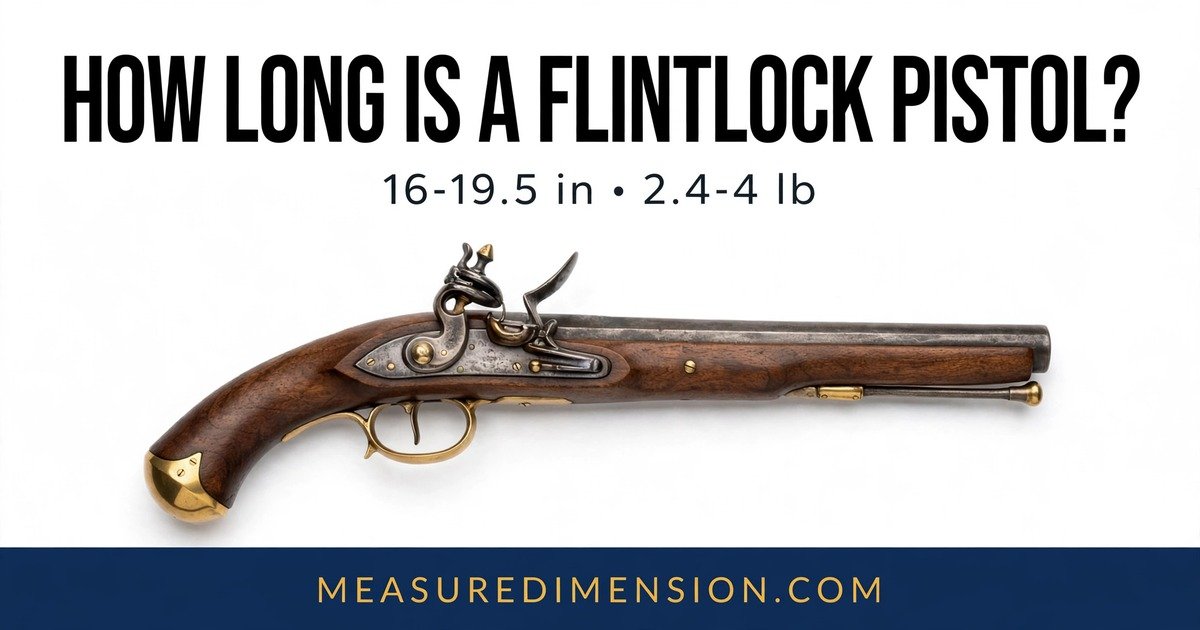
How long is a flintlock pistol? A military flintlock holster pistol is 16 to 19.5 inches long (40.64 to 49.53 cm), with a 9 to 12 inch barrel and a weight of 2.4 to 4 pounds (1.10 to 1.81 kg). The French Model 1763 and US Model 1805 both measure about 16.25 inches.
The flintlock pistol was the standard military sidearm of the 1700s and early 1800s, carried by cavalrymen in saddle holsters, by naval officers and by gentlemen for personal protection. It is a single-shot, muzzle-loading pistol: the shooter poured black powder and a lead ball down the barrel, primed the pan with a pinch of powder, and pulled the trigger. A piece of flint clamped in the cock struck the steel frizzen, the sparks fell into the pan, and the flash travelled through a small touch hole to fire the main charge. That mechanism ruled the battlefield for about 200 years, from the mid-1600s until percussion caps replaced it in the 1840s.
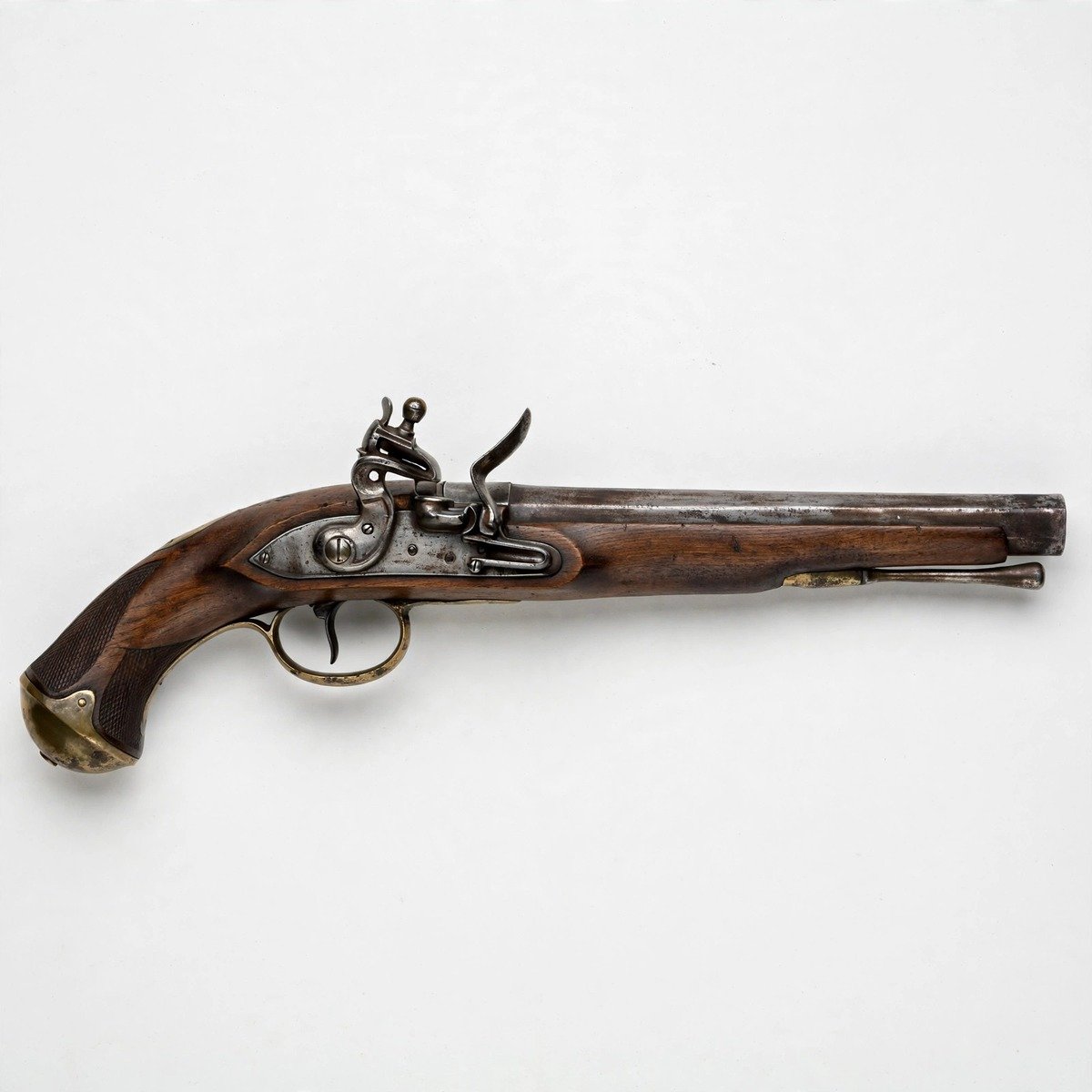
Unlike a modern pistol, a flintlock pistol was never built to one fixed size. Every army had its own pattern, and every gunsmith worked slightly differently, so lengths varied by maker and pattern. The figures in this guide come from named historical patterns — the British Heavy Dragoon, the French Model 1763 and the US Model 1805 — so you can see the real range instead of one made-up number.
Flintlock Pistol Length at a Glance
| Measurement | Inches | Centimeters | Millimeters |
|---|---|---|---|
| Overall length, typical holster pistol | 16–19.5 in | 40.64–49.53 cm | 406.4–495.3 mm |
| Overall length, French Model 1763 | 16.25 in | 41.28 cm | 412.8 mm |
| Overall length, US Model 1805 | 16–16.25 in | 40.64–41.28 cm | 406.4–412.8 mm |
| Overall length, British Heavy Dragoon | 19.25–19.5 in | 48.90–49.53 cm | 489.0–495.3 mm |
| Overall length, French Model 1733 | 18 in | 45.72 cm | 457.2 mm |
| Overall length, Queen Anne pocket pistol | 6–13 in | 15.24–33.02 cm | 152.4–330.2 mm |
| Barrel length, British Heavy Dragoon | 12 in | 30.48 cm | 304.8 mm |
| Barrel length, French Model 1763 | 9 in | 22.86 cm | 228.6 mm |
| Barrel length, US Model 1805 | 10.06 in | 25.56 cm | 255.6 mm |
| Weight, British Heavy Dragoon | 4 lb | — | 1.81 kg |
| Weight, US Model 1805 | 2.42–2.5 lb | — | 1.10–1.13 kg |
| Calibre (bore), holster pistols | .54–.69 in | 1.37–1.75 cm | 13.7–17.5 mm |
Quick tip: lengths varied by maker because every flintlock pistol was largely handmade, and surviving examples of the same pattern differ by fractions of an inch. Always check the listed overall length for the exact pattern and maker rather than trusting a single round number.
How Long Is a Flintlock Holster Pistol?
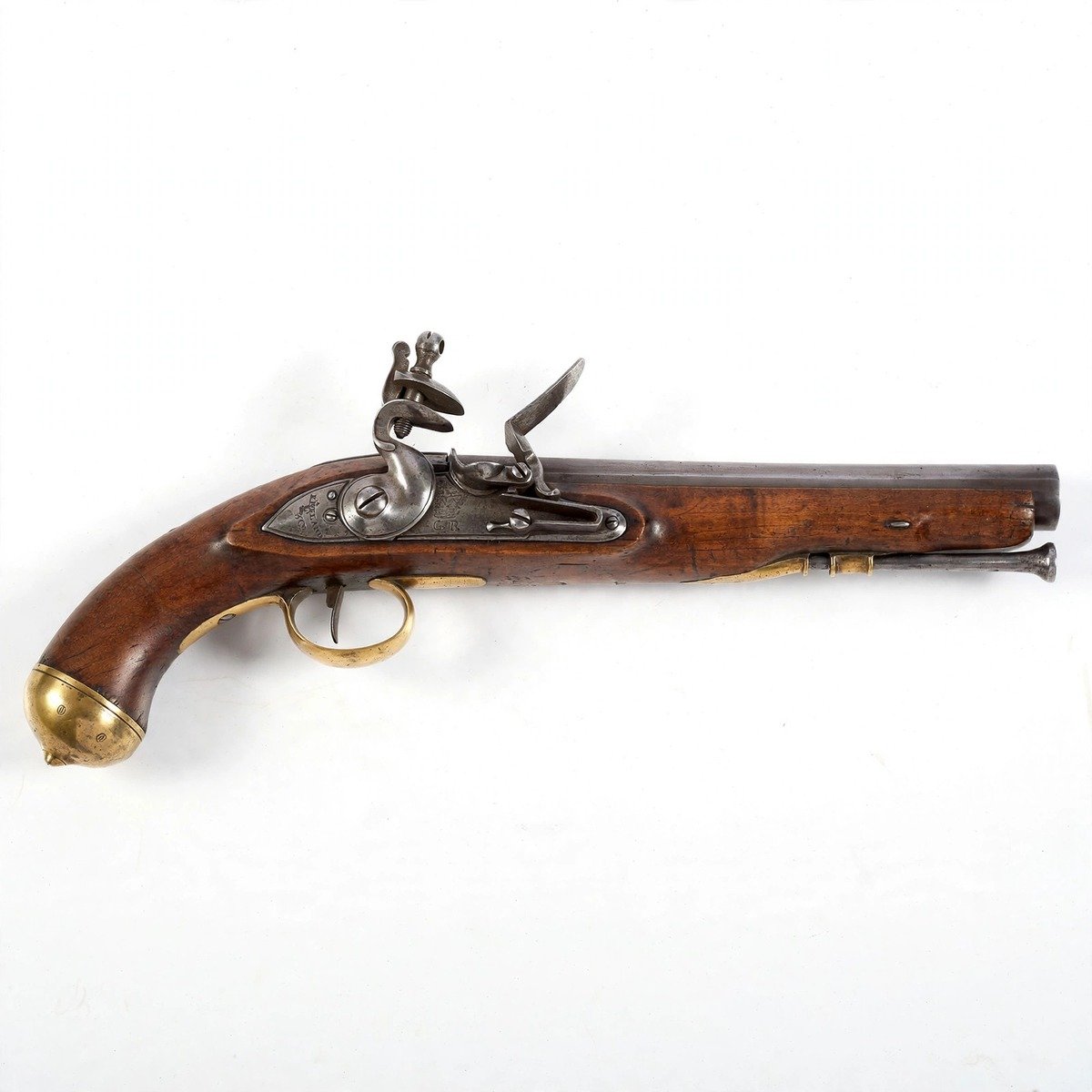
A flintlock holster pistol — the big military pistol carried in pairs in saddle holsters — is 16 to 19.5 inches long. That is 40.64 to 49.53 centimeters, or 1.33 to 1.63 feet. The barrel makes up most of that length: 9 to 12 inches of it, with the lock, grip and brass butt cap adding the rest. Compared with a modern pistol, it is enormous — about twice as long as a full-size 1911, which measures 8.25 to 8.7 inches, and more than twice as long as a Glock 19 at 7.28 inches.
Here is how the best-known military patterns compare:
- British Pattern 1738 Land Service Heavy Dragoon: the longest of the common holster pistols. It has a 12-inch barrel (30.48 cm) and measures 19.25 to 19.5 inches overall (48.90 to 49.53 cm) — one surviving example dated 1742 measures 19 3/8 inches (49.21 cm). It was the first standardized cavalry pistol in British service, adopted in 1738 for the heavy dragoon regiments, and it stayed in use through the French and Indian War and the American Revolution. A shorter version introduced by Colonel Elliot in 1759 became known as the light dragoon pistol.
- French Model 1763: the standard French cavalry pistol of the Revolutionary War era. It has a 9-inch barrel (22.86 cm) and measures 16.25 inches overall (41.28 cm), with surviving examples running just under 16 inches to 16.25 inches. Thousands were shipped to America during the Revolutionary War, and American soldiers carried them alongside British pistols.
- French Model 1733: the earlier French pattern, and the first standardized pistol in France. It has an 11.5-inch barrel (29.21 cm) and measures 18 inches overall (45.72 cm).
- US Model 1805 Harpers Ferry: the first pistol ever made at a US government arsenal. It has a 10 1/16-inch barrel (25.56 cm) and measures 16 to 16.25 inches overall (40.64 to 41.28 cm). Only 4,096 were made between 1806 and 1808, and they were issued in matched pairs with the same serial number on each gun. It was built mainly for naval officers and saw service in the War of 1812.
The British Sea Service pistol, carried by Royal Navy officers and sailors, also used a 12-inch barrel like the dragoon pistol. In the 1790s the East India Company shortened its barrel to 9 inches to make it handier for fighting on a ship’s deck.
Flintlock Pistol Barrel Lengths: 9 Inches, 10 Inches and 12 Inches

A flintlock pistol’s barrel length is what sets its overall length, because these are all single-shot pistols with the same basic layout: a long barrel, a wooden stock running most of its length, and a grip behind the lock. Every step up in barrel length adds roughly the same amount to the overall length.
- 12-inch barrel (British Heavy Dragoon and Sea Service): the longest standard pistol barrel. Overall length is 19.25 to 19.5 inches (48.90 to 49.53 cm). A 12-inch barrel is 30.48 cm (304.8 mm) long, and the extra length gave the heavy ball a little more speed and made the pistol useful as a club when it was empty.
- 11.5-inch barrel (French Model 1733): the earlier French cavalry barrel. Overall length is 18 inches (45.72 cm). An 11.5-inch barrel is 29.21 cm (292.1 mm) long.
- 10-inch barrel (US Model 1805): the American pattern. Surviving examples measure 10 to 10 1/8 inches (25.4 to 25.72 cm), and overall length is 16 to 16.25 inches (40.64 to 41.28 cm).
- 9-inch barrel (French Model 1763 and shortened Sea Service): the shortest standard military barrel. Overall length is 16.25 inches (41.28 cm) on the French Model 1763. A 9-inch barrel is 22.86 cm (228.6 mm) long.
- Pocket barrels (2.5 to 7.81 inches): civilian pocket and Queen Anne pistols used much shorter barrels. The smallest boxlock pistols had barrels of only 2.5 inches (6.35 cm), while the larger Queen Anne turn-off barrel pistols ran up to 7 13/16 inches (19.84 cm).
The barrel was almost always smoothbore, not rifled. A smooth bore was faster to load from horseback or on a rolling ship, and at the short ranges a pistol was used, rifling added little. A few Model 1805 pistols were made with rifled barrels, but the standard issue was smoothbore.
How Much Does a Flintlock Pistol Weigh?
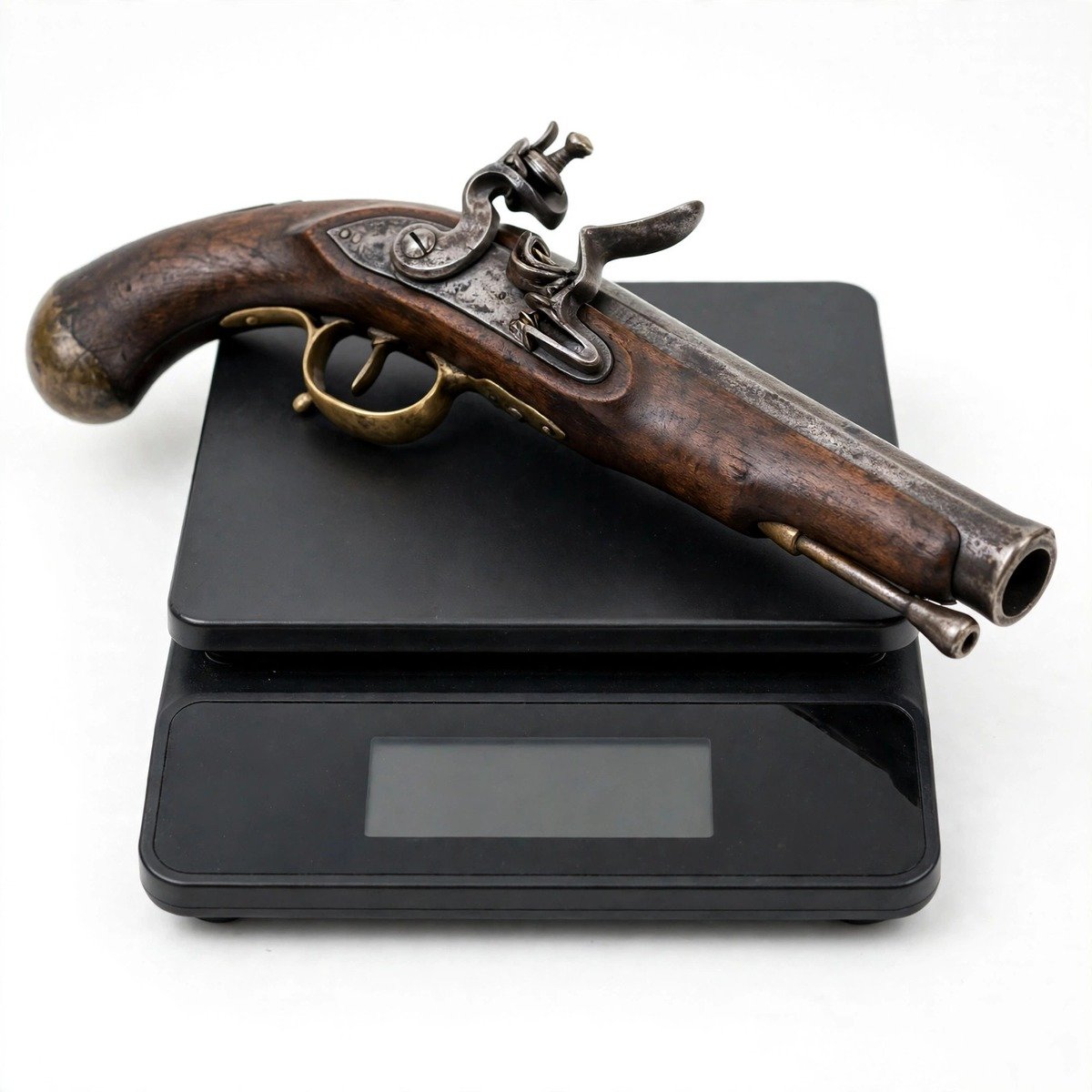
A military flintlock holster pistol weighs about 2.4 to 4 pounds (1.10 to 1.81 kg) unloaded, which is 38.7 to 64 ounces. The exact weight depends on the pattern, the barrel length and how much brass furniture it carries. The British Heavy Dragoon is the heaviest at about 4 pounds (1.81 kg, 64 ounces), because of its long 12-inch barrel and heavy brass butt cap with elongated ears. The US Model 1805 is lighter at 2.42 to 2.5 pounds (1.10 to 1.13 kg, 38.7 to 40 ounces). A 13-inch Queen Anne reproduction weighs 2.2 pounds (1.00 kg, 35.2 ounces), and the little 6 to 8 inch boxlock pocket pistols were lighter still.
That is heavy for a handgun. A full-size steel 1911 weighs 38 to 39 ounces, so a Model 1805 at about 40 ounces is roughly the same weight — but the Heavy Dragoon at 64 ounces is about 2.7 times as heavy as a Glock 19, which weighs 23.63 ounces. The weight came from solid steel and brass, a thick wooden stock and a long barrel, and it was part of the design: a holster pistol was expected to double as a club in a fight, and its weight is what made that work. A loaded pistol weighed only a little more than an empty one, because a single lead ball and a charge of black powder add only about an ounce.
How Big Is the Flintlock Ball?
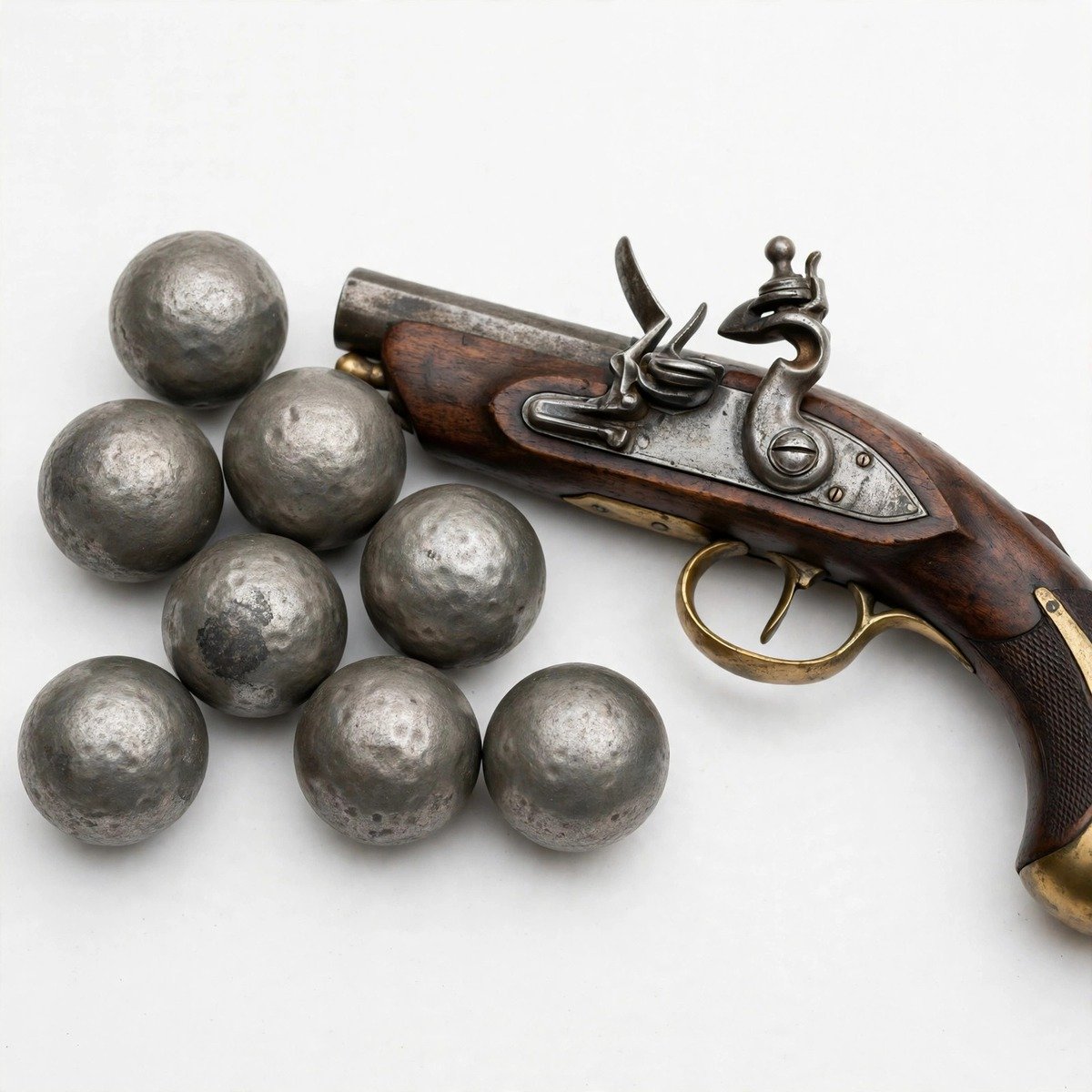
A flintlock pistol fired a round lead ball, loaded from the muzzle with a charge of black powder behind it. There was no cartridge case and no magazine — one shot, then a slow reload of powder, ball, wadding and priming.
- Bore diameter (holster pistols): .54 to .69 inches (13.7 to 17.5 mm). The US Model 1805 is .54 inches (13.7 mm), the French Model 1763 is about .68 to .72 inches (17.3 to 18.3 mm), and the British Heavy Dragoon was specified in two bores — .56 inches (14.2 mm) pistol bore and .65 inches (16.5 mm) carbine bore — with surviving examples measuring .58 to .69 inches.
- Bore diameter (pocket pistols): .44 to .60 inches (11.2 to 15.2 mm). Small boxlock pistols ran .44 to .49 inches, while larger Queen Anne pistols ran .59 to .60 inches.
- Ball size: the ball was cast slightly smaller than the bore so it would slide down a fouled barrel — the famous Brown Bess musket, for example, had a .75-inch bore but fired a .69-inch ball. Flintlock pistol balls followed the same rule, running a few hundredths of an inch under the bore.
- Single shot: every flintlock pistol held one round. There was no cylinder and no magazine. After firing, the shooter had to pour in powder, ram a ball down the barrel, prime the pan and cock the flint — a practiced man could manage about two or three shots a minute.
- Range: a holster pistol was a close-range weapon, useful at a few paces. The smoothbore barrel, the tiny sights and the slow, arching ball meant that past a short distance, hitting anything was a matter of luck rather than aim.
The ball itself was big by modern standards. A .69-inch lead ball weighs about 1.1 ounces (around 480 grains), roughly three times the weight of a modern 9mm bullet, which is why a flintlock pistol hit so hard at close range despite its low velocity.
Flintlock Pistol vs Flintlock Musket: How Much Shorter Is a Flintlock Pistol?
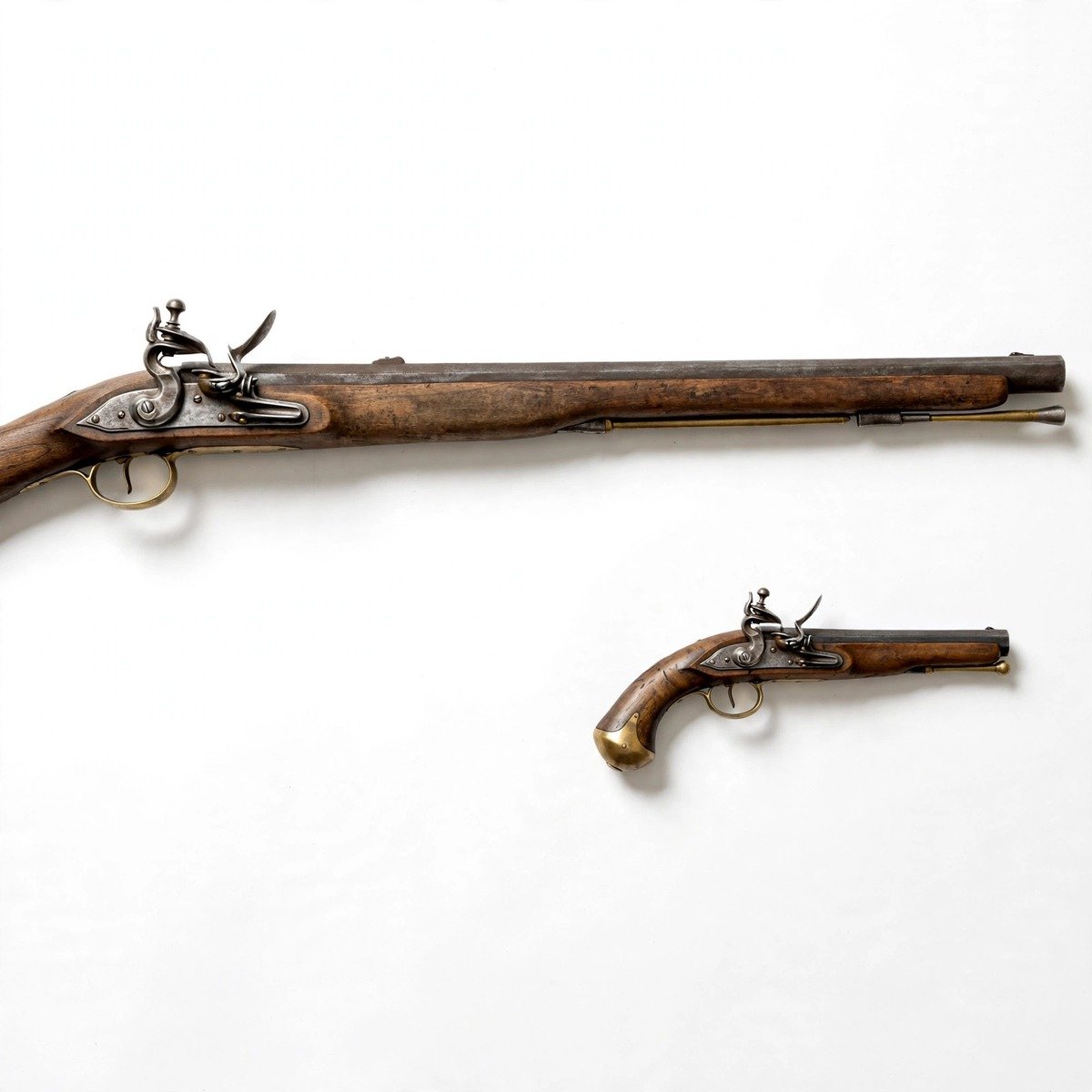
The flintlock pistol and the flintlock musket used the same ignition system, the same black powder and the same loading drill — but they were built for different jobs, and the size difference is enormous. The musket was an infantry weapon meant to be fired in volleys at 50 to 100 yards; the pistol was a cavalry and officer’s weapon meant for a few paces.
The best-known musket of the era is the British Brown Bess. The Long Land Pattern has a 46-inch barrel (116.84 cm), an overall length of 62.5 inches (158.75 cm) and a weight of 10.4 pounds (4.72 kg), with a .75-inch bore firing a .69-inch ball. The Short Land Pattern has a 42-inch barrel (106.68 cm), an overall length of 58.5 inches (148.59 cm) and a weight of 10.5 pounds (4.76 kg). The French Charleville Model 1763 musket is similar, with a barrel just under 45 inches (114.3 cm) and a weight of about 9.5 pounds (4.31 kg).
Against those muskets, the pistol is a fraction of the size:
- Length: a 16.25-inch French Model 1763 pistol is only 26 percent as long as a 62.5-inch Long Land Pattern musket, and a 19.5-inch Heavy Dragoon is only 33 percent as long as a 58.5-inch Short Land Pattern musket. The pistol is about one-quarter to one-third the length of the musket.
- Weight: a 4-pound Heavy Dragoon is 38 percent of a 10.4-pound musket’s weight, and a 2.5-pound Model 1805 is only 24 percent. The pistol weighs about one-quarter to just over one-third as much as the musket.
- Barrel: the pistol’s 9 to 12 inch barrel is about one-quarter of the musket’s 42 to 46 inch barrel. The musket’s barrel alone is more than twice as long as the whole pistol.
- Calibre: the musket’s .75-inch bore is bigger than any pistol bore, though the pistol’s .69-inch ball matches the musket ball in size.
With its 17-inch bayonet fitted, a Long Land Pattern musket reached about 79.5 inches (201.93 cm) — nearly five times the length of a French Model 1763 pistol. The pistol was never meant to compete with that. It was a backup weapon for a horseman or an officer whose real weapon was a sword, a carbine or a musket, and its size reflects that job: long enough to hit hard at arm’s length, short enough to draw from a holster on horseback.
Everyday Size Comparisons: How Long Is a Flintlock Pistol Really?
A number like 16.25 inches is hard to picture on its own. Here is how a typical military holster flintlock pistol, at 16 to 16.25 inches long, compares with things you already know.
Hardcover Book
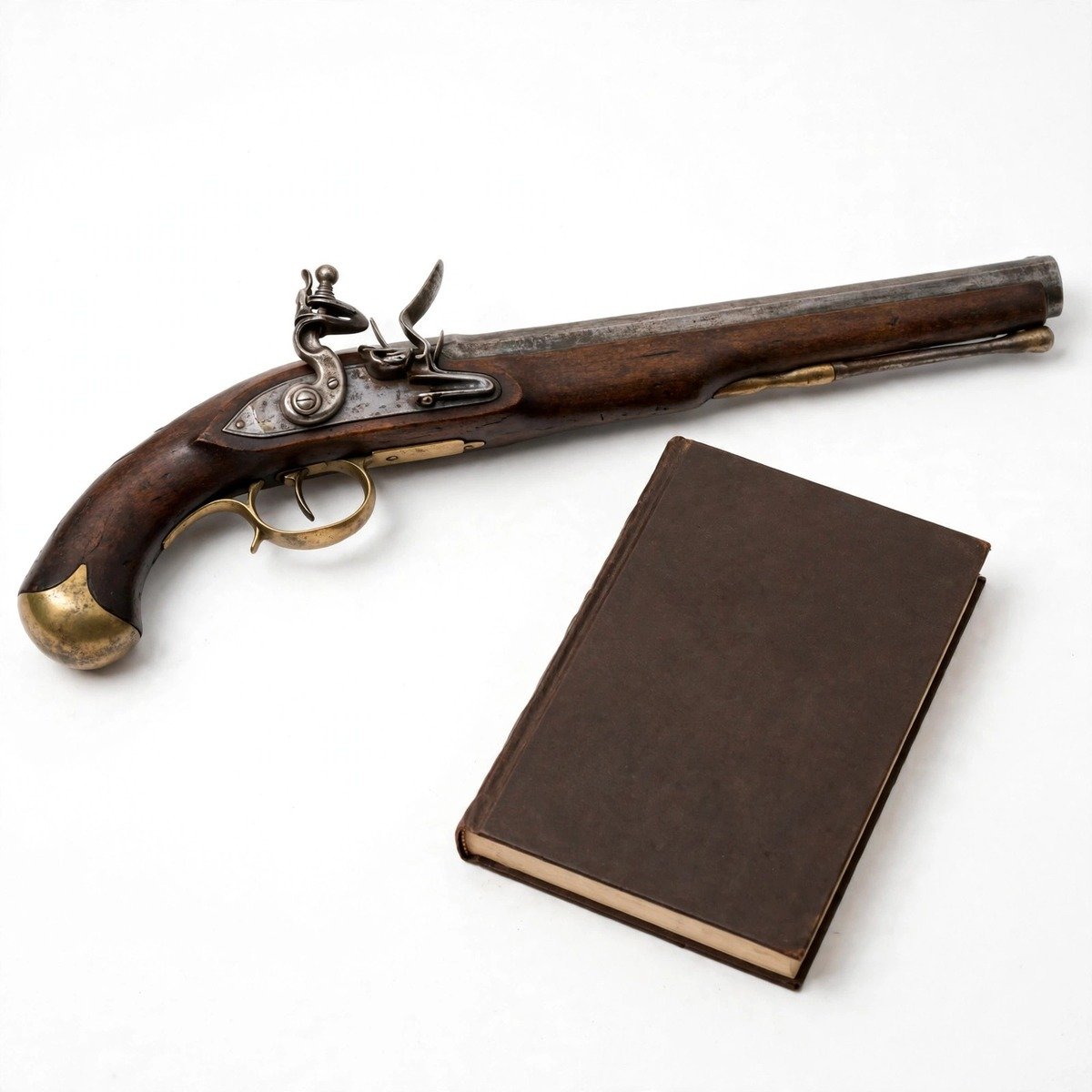
A standard hardcover book is about 10 inches long (25.4 cm). A flintlock holster pistol is 6 to 6.25 inches longer than a hardcover book, or about 1.6 times as long. Two hardcover books end to end would be 20 inches, about 3.75 to 4 inches longer than one pistol.
Laptop
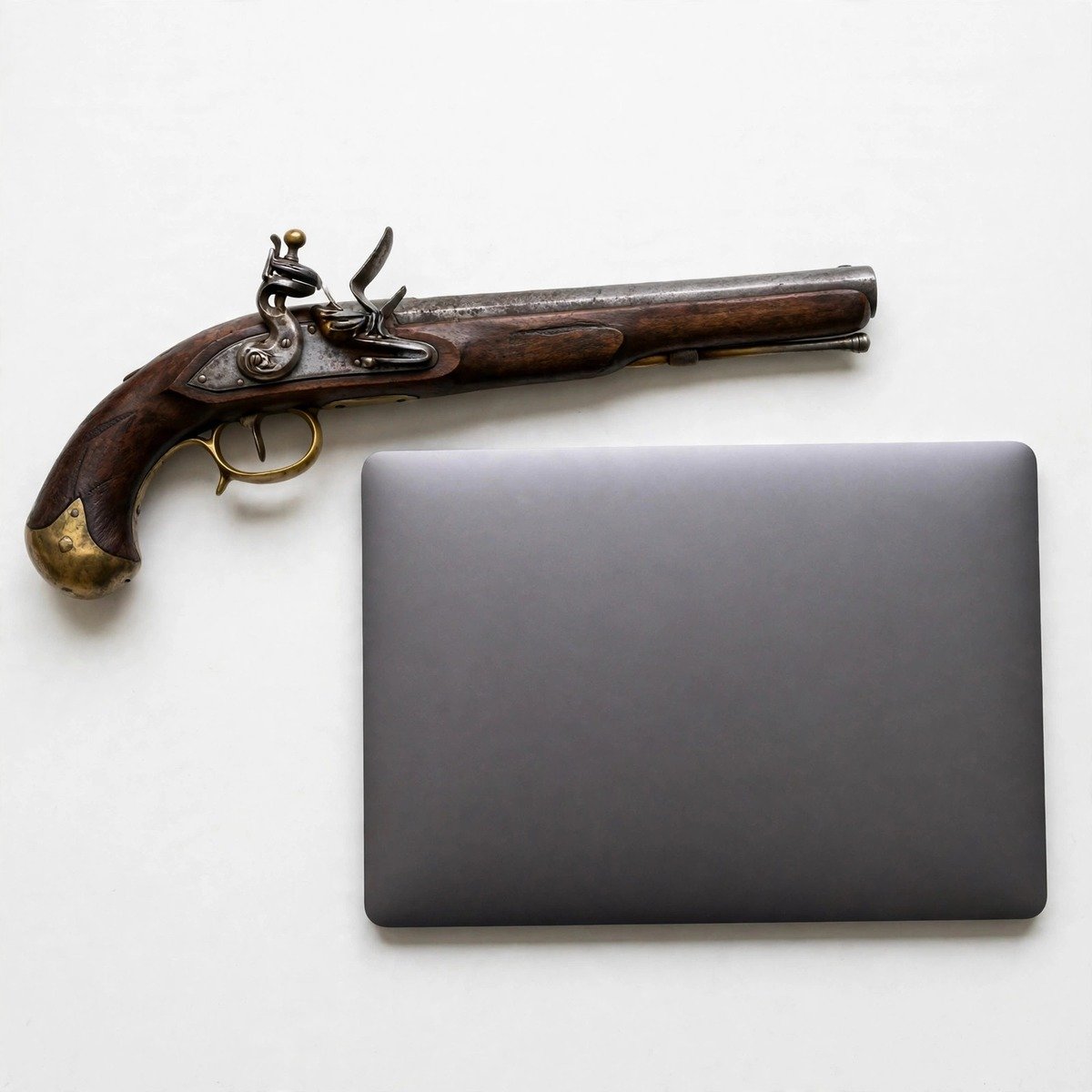
A standard laptop is about 13.5 inches wide (34.29 cm). A flintlock holster pistol is 2.5 to 2.75 inches longer than a laptop is wide, or about 1.2 times as long. Lay the pistol across a closed laptop and the muzzle and the butt cap both stick out past the edges.
Tablet
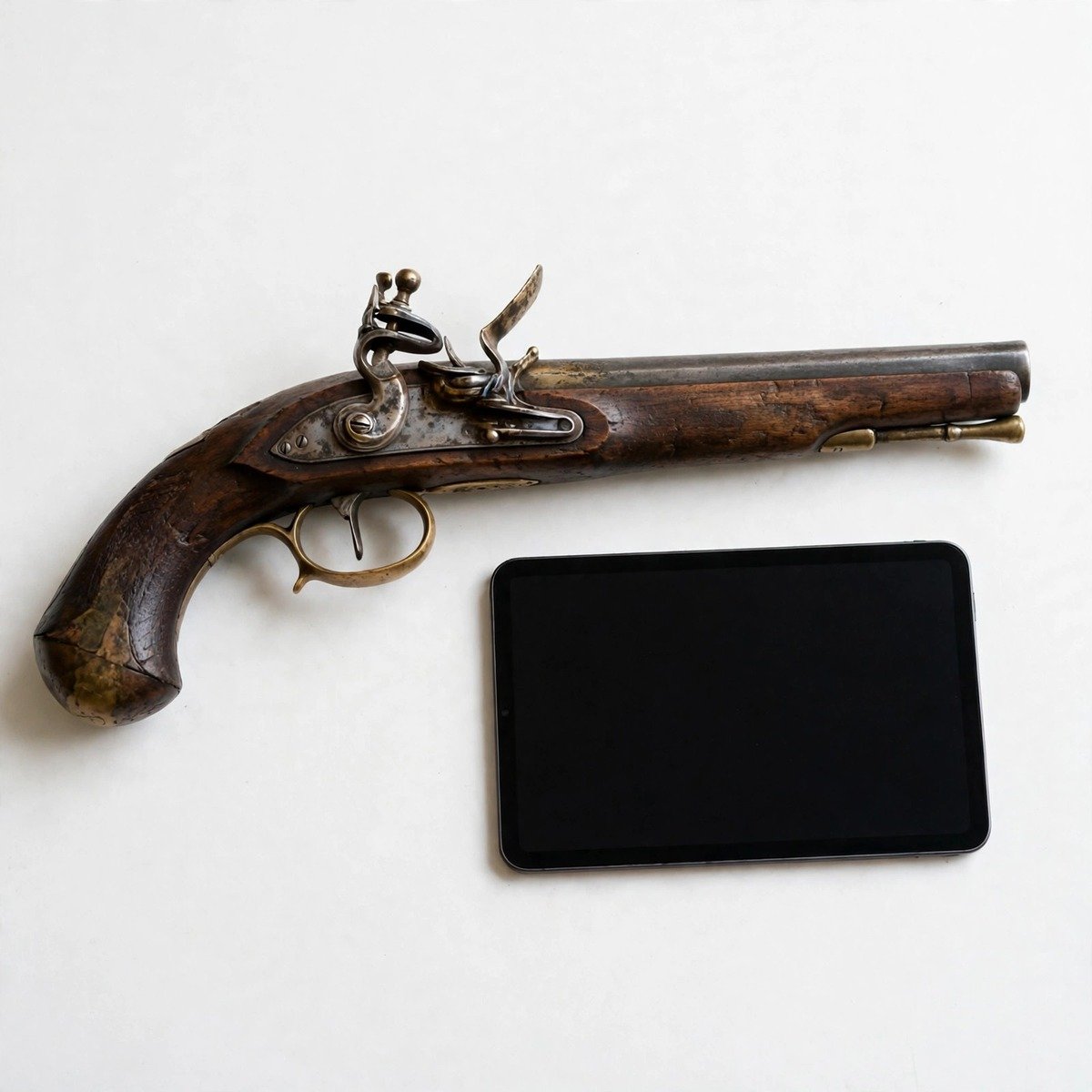
A standard tablet is about 10 inches long (25.4 cm). A flintlock holster pistol is 6 to 6.25 inches longer than a tablet, or about 1.6 times as long. The pistol’s 10-inch barrel alone is about the same length as the whole tablet.
Frisbee

A standard flying disc is about 11 inches across (27.94 cm). A flintlock holster pistol is 5 to 5.25 inches longer than a Frisbee is wide, or about 1.5 times the disc’s diameter. The pistol’s barrel alone, at 9 to 10 inches, is almost as long as the Frisbee is wide.
Wine Bottle

A standard wine bottle is about 12 inches tall (30.48 cm). A flintlock holster pistol is 4 to 4.25 inches longer than a wine bottle is tall, or about 1.35 times as long. Stand the pistol next to the bottle and the muzzle ends a hand’s width above the cork.
Rolling Pin
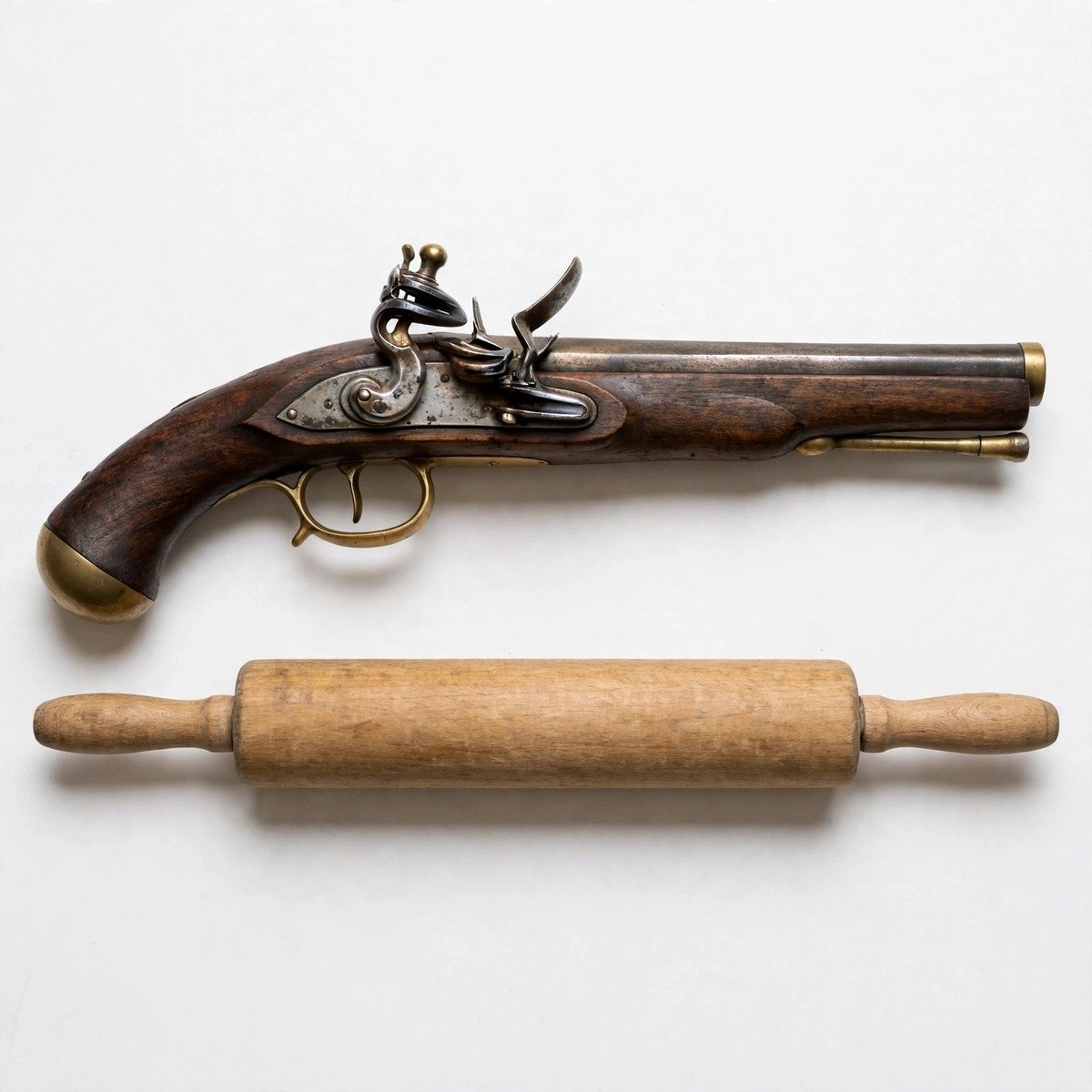
A standard rolling pin is about 17 inches long (43.18 cm). A flintlock holster pistol is 0.75 to 1 inch shorter than a rolling pin, or about 94 to 96 percent of its length. The two are so close in size that the pistol runs almost exactly from one end of the rolling pin to the other.
Frequently Asked Questions
How long is a flintlock pistol?
A military flintlock holster pistol is 16 to 19.5 inches long (40.64 to 49.53 cm), depending on the pattern. The French Model 1763 and the US Model 1805 both measure about 16.25 inches, the French Model 1733 measures 18 inches, and the British Heavy Dragoon is the longest at 19.25 to 19.5 inches. Small pocket pistols are much shorter, at 6 to 13 inches overall.
How long is the barrel on a flintlock pistol?
A military holster pistol has a barrel of 9 to 12 inches (22.86 to 30.48 cm): 9 inches on the French Model 1763, 10 1/16 inches on the US Model 1805, 11.5 inches on the French Model 1733, and 12 inches on the British Heavy Dragoon. Pocket pistols have much shorter barrels, from 2.5 inches on the smallest boxlock pistols to 7 13/16 inches on the larger Queen Anne pistols.
How much does a flintlock pistol weigh?
A military flintlock holster pistol weighs about 2.4 to 4 pounds (1.10 to 1.81 kg) unloaded. The British Heavy Dragoon is the heaviest at about 4 pounds, the US Model 1805 weighs 2.42 to 2.5 pounds, and a 13-inch Queen Anne pistol weighs about 2.2 pounds. The little boxlock pocket pistols were lighter still.
What calibre is a flintlock pistol?
Military holster pistols were bored between .54 and .69 inches (13.7 to 17.5 mm): the US Model 1805 is .54 inches, the French Model 1763 is about .68 to .72 inches, and the British Heavy Dragoon was specified at .56 inches pistol bore or .65 inches carbine bore. Pocket pistols were smaller, at .44 to .60 inches.
Is a flintlock pistol longer than a modern pistol?
Yes, much longer. A 16.25-inch French Model 1763 is about twice as long as a full-size 1911, which measures 8.25 to 8.7 inches, and about 2.2 times as long as a Glock 19 at 7.28 inches. Even the smallest military flintlock pistol is longer than any standard modern service pistol.
Conclusion
A flintlock pistol in military holster form is 16 to 19.5 inches long (40.64 to 49.53 cm) with a 9 to 12 inch barrel (22.86 to 30.48 cm) and weighs about 2.4 to 4 pounds (1.10 to 1.81 kg). That makes it about 1.6 times as long as a hardcover book, a little longer than a laptop is wide, about 1.35 times as tall as a wine bottle, and just short of a rolling pin. The French Model 1763 and the US Model 1805 sit at the short end at about 16.25 inches, the British Heavy Dragoon stretches to 19.5 inches, and the little Queen Anne pocket pistols shrink to 6 to 13 inches. Its real character is not its size but its mechanism: a piece of flint, a steel frizzen and a pinch of black powder, firing one big lead ball at a time. If you are picturing one, picture a rolling pin with a pistol grip — that is how long a flintlock pistol is.
Related Guides
- How Long Is a 1911 Pistol? Length, Barrel & Size Guide
- How Long Is a 9mm Pistol? Length, Barrel & Size Guide
- How Long Is a 2011 Pistol? Length, Barrel & Size Guide
- How Long Is an AR Pistol? Length, Barrel & Size Guide
- How Long Is a Glock 19 Gen 6? Length, Barrel & Size Guide

Hi, I’m Michael Carter, I write simple, everyday size guides so you can picture any measurement in seconds.