
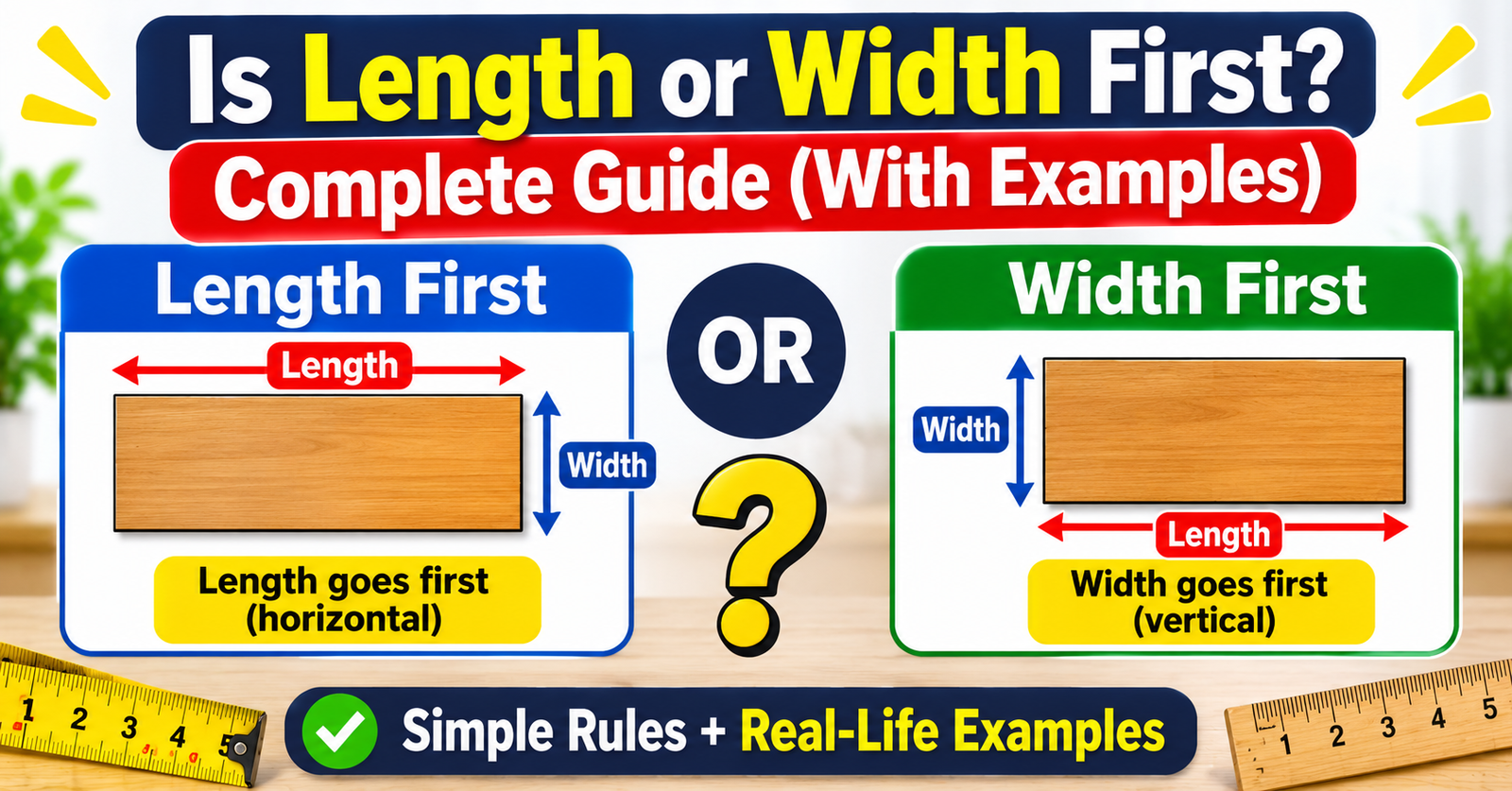
Is length or width first? Length comes first. In the standard order used on product labels, in construction, in shipping, and in most size guides, you write length first, then width, then height — L × W × H. So a box listed as 12 × 8 × 6 inches is 12 inches long, 8 inches wide, and 6 inches tall. That order never changes in the standard system: the first number is always the length, the second number is always the width, and the third number is always the height.
The question “is length or width first” comes up because the rule is not the same everywhere. Furniture makers list width first. Paper and envelopes list width first too. Room sizes are often written width first. And a TV is not measured by length or width at all — it is measured diagonally. So the short answer is simple, but the full answer depends on what you are measuring. This guide gives you the standard rule, every common exception, and real examples with sizes in inches and centimeters, so you never have to guess again.
Is Length or Width First? At a Glance
| Item (Length × Width) | Inches | Centimeters | Millimeters |
|---|---|---|---|
| Standard order | Length × Width × Height | Length × Width × Height | Length × Width × Height |
| US Letter paper | 8.5 × 11 in | 21.59 × 27.94 cm | 215.9 × 279.4 mm |
| A4 paper | 8.27 × 11.69 in | 21.0 × 29.7 cm | 210 × 297 mm |
| Dining table | 72 × 36 in | 182.88 × 91.44 cm | 1828.8 × 914.4 mm |
| Area rug | 96 × 60 in | 243.84 × 152.4 cm | 2438.4 × 1524 mm |
| Bath towel | 54 × 30 in | 137.16 × 76.2 cm | 1371.6 × 762 mm |
| Office desk | 48 × 24 in | 121.92 × 60.96 cm | 1219.2 × 609.6 mm |
| Bookshelf | 36 × 12 in | 91.44 × 30.48 cm | 914.4 × 304.8 mm |
| Picture frame | 20 × 16 in | 50.8 × 40.64 cm | 508 × 406.4 mm |
Quick tip: length is the longest side of an object. If you are not sure which number is which, find the longest side first — that is the length, and it always goes first in the standard L × W × H order.
What Comes First, Length or Width?

When someone asks what comes first, length or width, the answer is length. The standard order is length first, width second, height third, written as L × W × H. This is the order used by manufacturers, retailers, shippers, and builders in the United States, and it is the order this site uses in every size guide. If you see a product listed as 48 × 24 × 30 inches, it is 48 inches long, 24 inches wide, and 30 inches tall. People also type “what comes first length or width” into Google — and the answer is the same.
The reason length goes first is simple: length is the longest side, and the longest side is the measurement you need to check first when fitting something into a space. A 72-inch dining table needs 72 inches of room along the wall, so the length comes first. The width matters next, because it tells you how far the object sticks out from the wall, and the height comes last. The rule is simple, and once you learn it you will never ask “is length or width first” again.
So, is length or width first when you write down a size? Length is first. Is length or width first on a shipping label? Length is first, and the shipping company defines the length as the longest side of the package. Is length or width first in a product listing? Length is first, unless the product is furniture or paper, which are the two big exceptions covered below.
Here is how the standard order works on real examples. A moving box listed as 18 × 18 × 24 inches is 18 inches long, 18 inches wide, and 24 inches tall. A bookshelf listed as 36 × 12 × 72 inches is 36 inches long, 12 inches deep, and 72 inches tall. A rug listed as 96 × 60 inches is 96 inches long and 60 inches wide, which is 8 feet by 5 feet. Whenever you are unsure, ask yourself: is length or width first? The answer is always the same — length first, width second.
Does Width Come Before Length?
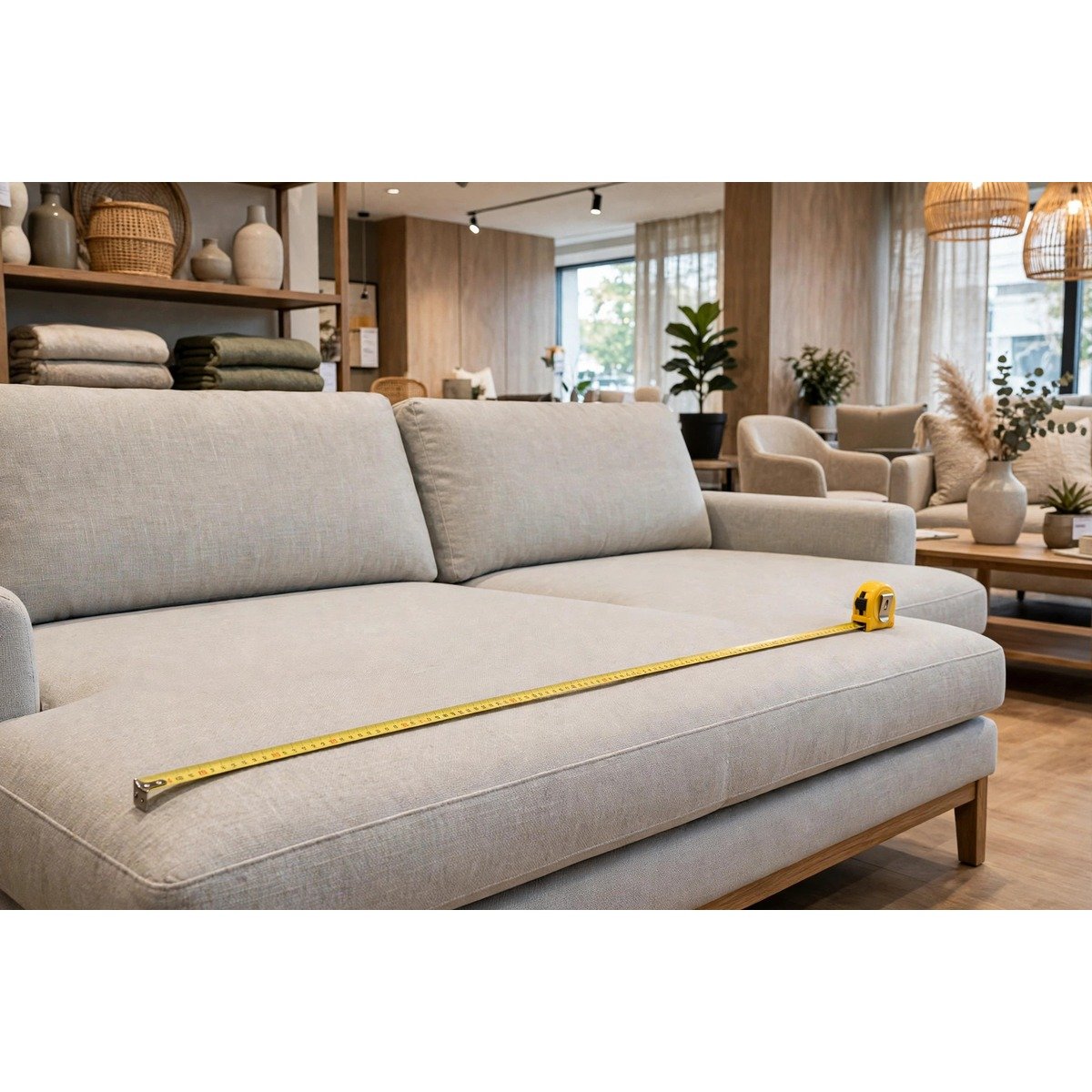
Does width come before length? In the standard L × W × H order, no — width never comes before length. But there are four common cases where width does come first, and they cause most of the confusion. If you know these four exceptions, you will never read a size the wrong way.
Furniture lists width first. A sofa, a dresser, or a TV stand is usually listed as width × depth × height (W × D × H). The width is the front-facing side, the side you see when you stand in front of the piece. A sofa listed as 84 × 38 × 36 inches is 84 inches wide across the front, 38 inches deep from front to back, and 36 inches tall. So for furniture, the answer to “is length or width first” is different: the width comes first, because the front of the furniture is what you measure against your wall.
Paper and envelopes list width first. Paper is measured as width × height. A US Letter sheet is 8.5 × 11 inches, which means 8.5 inches wide (21.59 cm) and 11 inches tall (27.94 cm). An A4 sheet is 210 × 297 mm, which is 8.27 × 11.69 inches. A standard business envelope is 9.5 × 4.125 inches, 9.5 inches wide and 4.125 inches tall. So for paper, width does come before length — or more exactly, width comes before height, because paper is flat.
Rooms are often listed width first. A room described as 12 × 15 feet is usually 12 feet wide and 15 feet long, with the width being the shorter wall you face when you walk in. This is a loose convention, not a strict rule. So if you wonder “is length or width first” for a room, the honest answer is that it depends on the listing — if it just says “12 × 15 ft room” with no labels, ask which wall is which before you buy furniture for it.
TVs are measured diagonally, not by length or width. A 55-inch TV is 55 inches from one corner of the screen to the opposite corner, measured diagonally. Its actual width is about 48 inches (121.92 cm) and its height is about 27 inches (68.58 cm), but the size on the box is the diagonal. For a TV, “is length or width first” is the wrong question — the diagonal is the only number that matters.
Shipping is worth a special note. UPS, USPS, and FedEx all define the length of a package as its longest side, and they require the length first. A package that is 20 × 14 × 10 inches has a length of 20 inches, because 20 is the longest side. If you write the numbers in the wrong order, the carrier may charge you for a larger box than you shipped.
Length vs Width vs Height: What’s the Difference?

When people ask “is length or width first,” a table is the best example to picture. The table is 72 inches long (182.88 cm) from one end to the other — that is the length, the longest side. It is 36 inches wide (91.44 cm) from the front edge to the back edge — that is the width, measured at a right angle to the length. It is about 30 inches tall (76.2 cm) from the floor to the tabletop — that is the height. So the table is written as 72 × 36 × 30 inches, or L × W × H.
Now think of a bookshelf. A standard bookshelf is 36 inches long (91.44 cm) from side to side, 12 inches wide (30.48 cm) from front to back, and 72 inches tall (182.88 cm) from the floor to the top. The height is the biggest number here, and that is fine — height is vertical, not horizontal. The rule for length is about the horizontal sides: length is the longer of the two horizontal measurements, and width is the shorter one. That is why the answer to “is length or width first” never changes for boxes, tables, and shelves — length first.
The difference between width and depth causes the most confusion. Depth is the same measurement as width, seen from a different side. For a bookshelf, the 12-inch width is also called the depth, because it is how deep the shelf is from front to back. So when a furniture listing says W × D × H, the D (depth) is playing the role of the width. A simple way to remember it: length runs left to right, width runs front to back, and height runs bottom to top. If you stand in front of an object and ask “is length or width first,” the length is the side you see first — so it goes first.
How to Measure Length and Width Correctly

Measuring length and width correctly takes less than a minute, and it saves you from buying furniture that does not fit or shipping a box in the wrong size. Here is the method, step by step.
Step 1: Find the longest side. Lay the object flat or stand in front of it, and look for the longest horizontal side. That side is the length. On a table, it is the long edge. On a box, it is the longest edge. On a rug, it is the long side. This step answers “is length or width first” before you even pick up the tape: the longest side is the length, and it goes first.
Step 2: Measure the length. Run a tape measure along the longest side, from one end to the other, keeping the tape straight and flat. A 72-inch table is 182.88 cm long (72 × 2.54 = 182.88).
Step 3: Measure the width at a right angle. Turn the tape 90 degrees and measure the shorter horizontal side, from the front edge to the back edge. This is the width. A 36-inch table width is 91.44 cm (36 × 2.54 = 91.44). If you measure diagonally, the number will be too big — so always measure at a right angle to the length.
Step 4: Measure the height if you need it. Stand the tape upright and measure from the bottom of the object to the top. A standard dining table is about 30 inches tall (76.2 cm).
Step 5: Write it down as L × W × H. A table that is 72 inches long, 36 inches wide, and 30 inches tall is written as 72 × 36 × 30 inches. This is the moment the question “is length or width first” is decided — the length goes first on the page, just as it came first on the tape. If you are measuring furniture, write it as W × D × H instead — but label it clearly so nobody reads it as the standard order.
Two mistakes are worth avoiding. The first is measuring the width along the same direction as the length, which gives you the same number twice. The second is measuring from the wrong points on a round object — always measure from the farthest points on each side. And if you are measuring something for shipping, remember that the carrier calls the longest side the length, no matter which way the object faces.
Everyday Size Comparisons: What Length × Width Looks Like in Real Life
Numbers like 72 × 36 inches are hard to picture on their own. Here is what length and width look like on six everyday objects, with the length first and the width second in every case.
Dining Table
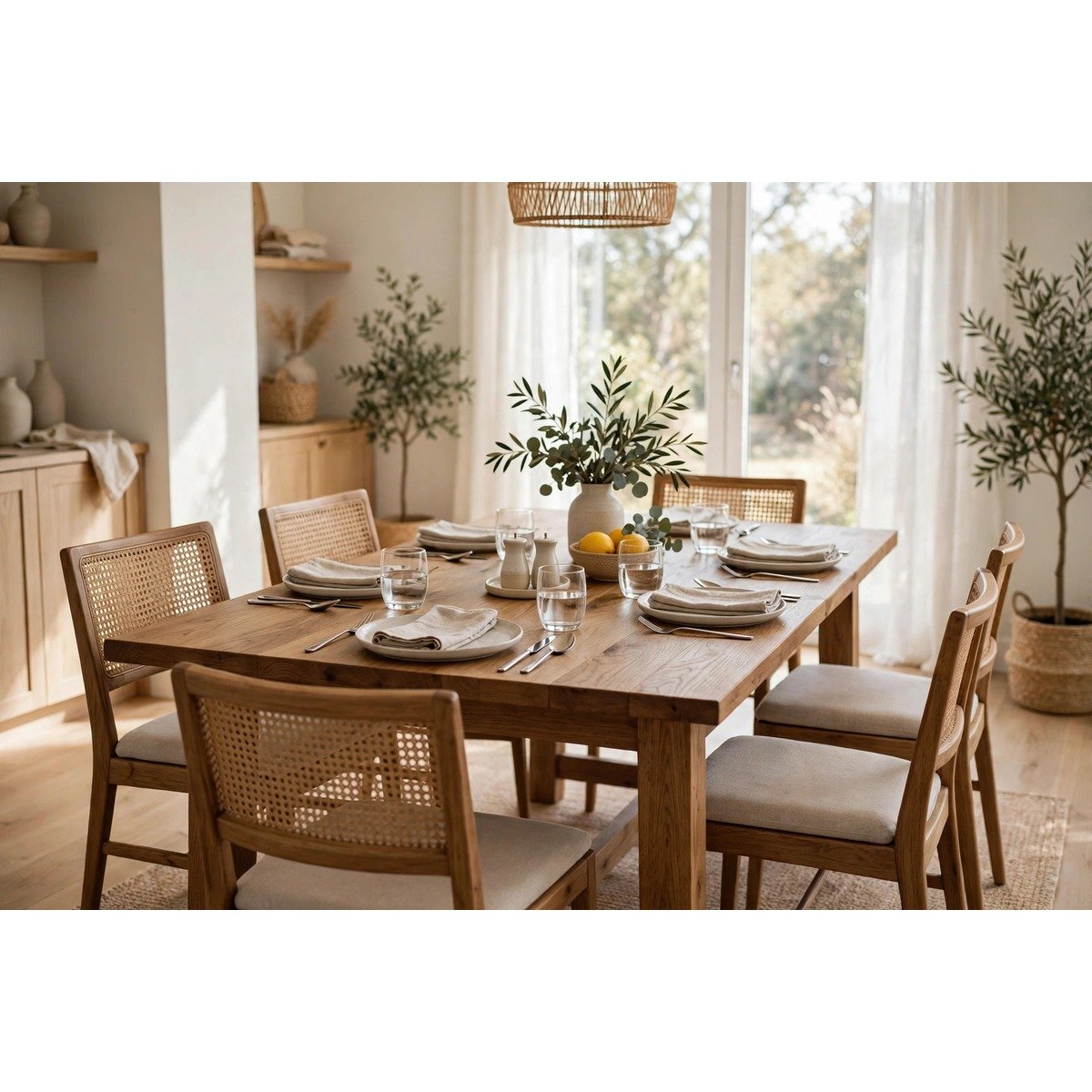
A standard dining table for six people is 72 inches long and 36 inches wide (182.88 × 91.44 cm). The length is exactly twice the width, so the table is twice as long as it is wide — a ratio of 2 to 1. The tabletop covers 18 square feet (72 × 36 = 2,592 square inches, and 2,592 ÷ 144 = 18). When you walk into a dining room, the 72-inch length is the side that runs along the wall, and the 36-inch width is how far the table sticks out into the room. If you ask “is length or width first” about a dining table, the length comes first because it is the side you need the most room for.
Area Rug
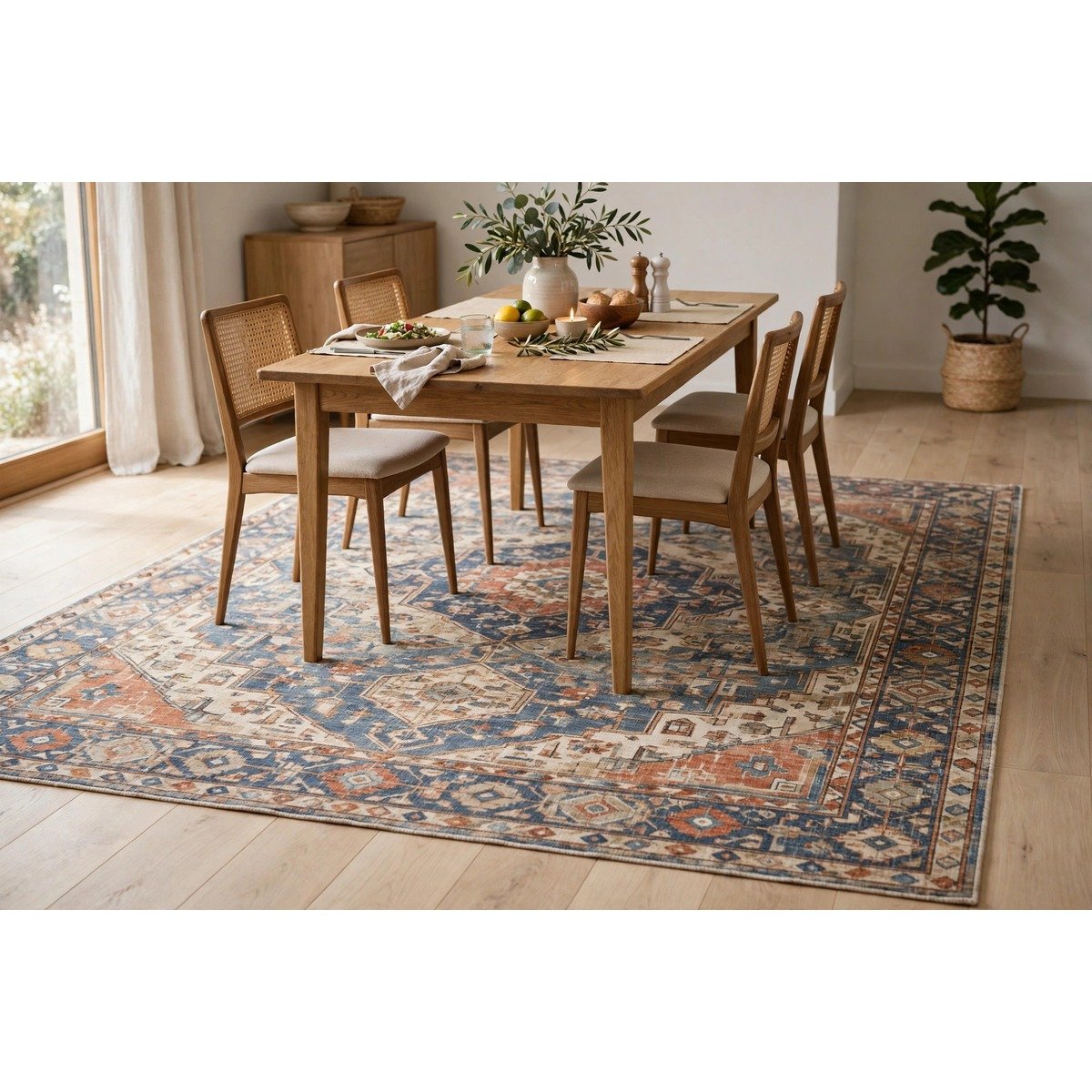
A large area rug is 96 inches long and 60 inches wide (243.84 × 152.4 cm), which is 8 feet by 5 feet. The length is 1.6 times the width (96 ÷ 60 = 1.6), so the rug is a little more than half again as long as it is wide. It covers 40 square feet (96 × 60 = 5,760 square inches, and 5,760 ÷ 144 = 40). Under a dining table, the rug’s 96-inch length runs the same way as the table’s 72-inch length, with 12 inches of rug sticking out past each end of the table.
Bath Towel
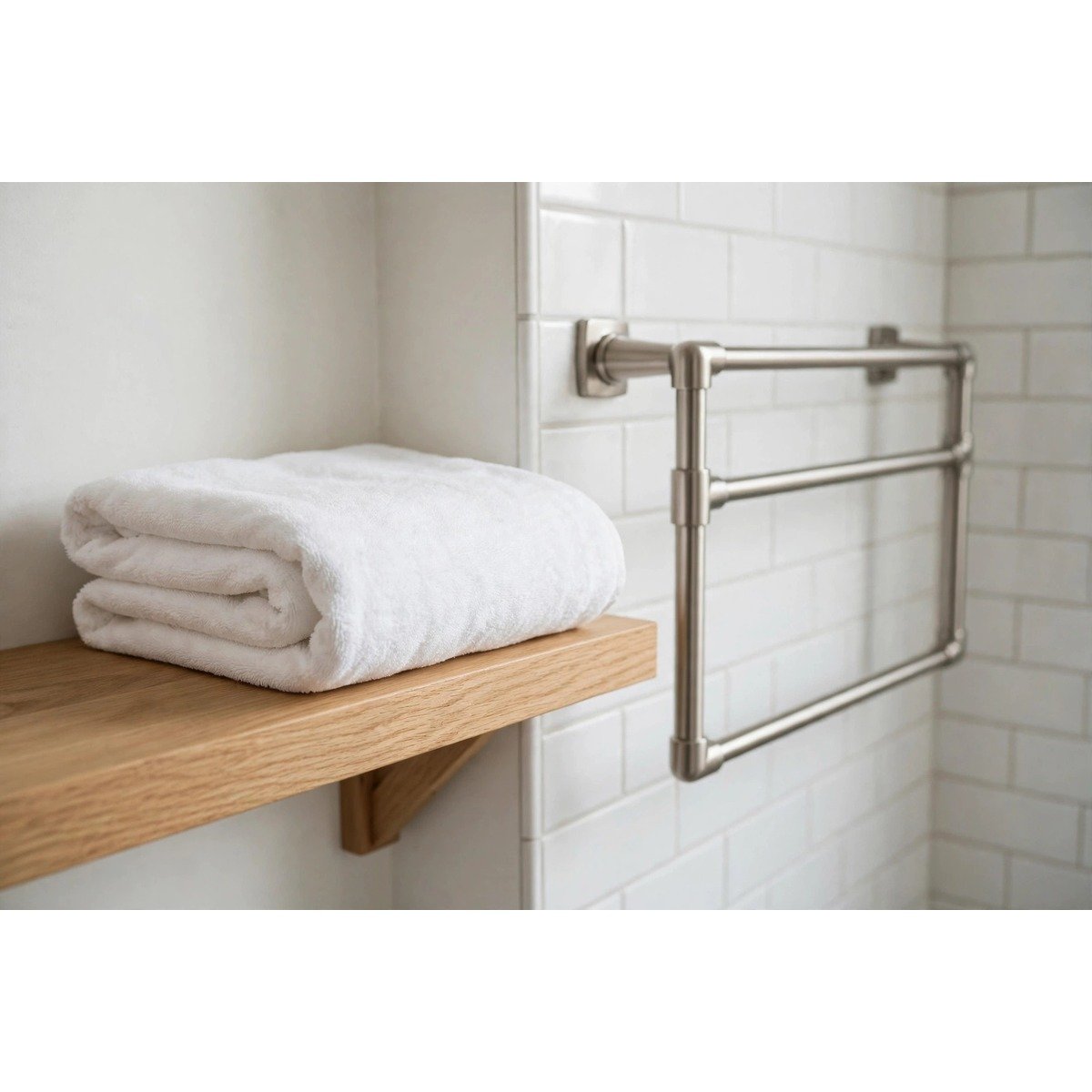
A standard bath towel is 54 inches long and 30 inches wide (137.16 × 76.2 cm). The length is 1.8 times the width (54 ÷ 30 = 1.8), so the towel is nearly twice as long as it is wide. It covers 11.25 square feet (54 × 30 = 1,620 square inches, and 1,620 ÷ 144 = 11.25). When you hang a towel on a rack, the 54-inch length hangs down and the 30-inch width runs across the bar. A bath sheet is bigger at 60 × 36 inches (152.4 × 91.44 cm), and a hand towel is smaller at 30 × 16 inches (76.2 × 40.64 cm) — but in every case, the length is the longer side and it goes first.
Office Desk

A standard office desk is 48 inches long and 24 inches wide (121.92 × 60.96 cm). The length is exactly twice the width, a ratio of 2 to 1, just like the dining table. The desktop covers 8 square feet (48 × 24 = 1,152 square inches, and 1,152 ÷ 144 = 8). The 48-inch length is the side that faces you when you sit at the desk, and the 24-inch width is how deep the desk is from front to back. That 24-inch depth is the reason a desk fits against a wall with room for a chair: the width is only 2 feet (60.96 cm), while the length gives you 4 feet (121.92 cm) of workspace.
Bookshelf

A standard bookshelf is 36 inches long and 12 inches wide (91.44 × 30.48 cm), and about 72 inches tall (182.88 cm). The length is three times the width, a ratio of 3 to 1 — the widest ratio of any object in this guide. Each shelf covers 3 square feet (36 × 12 = 432 square inches, and 432 ÷ 144 = 3). The 12-inch width is the depth of the shelf, and it is the reason a bookshelf fits books: a standard book is about 9 inches tall and 6 inches deep, so a 12-inch-deep shelf holds a row of books with 3 inches to spare. A bookshelf is the clearest proof of the rule: ask “is length or width first” and the tape gives you 36 × 12 — length first.
Picture Frame

A picture frame sold as 16 × 20 inches is 16 inches wide and 20 inches tall — frames are sold as width × height, like paper. In length × width terms, the same frame is 20 inches long and 16 inches wide (50.8 × 40.64 cm), because the length is always the longest side. The length is 1.25 times the width (20 ÷ 16 = 1.25), and the frame covers 2.22 square feet (20 × 16 = 320 square inches, and 320 ÷ 144 = 2.22). This frame is a good test of the rule: if you see “16 × 20” on a frame, the width comes first because it is a frame — but ask “is length or width first” in the standard order, and the answer is 20 × 16, length first.
Frequently Asked Questions
Is length or width first?
Is length or width first? Length is first. The standard order is length × width × height (L × W × H), so a box listed as 12 × 8 × 6 inches is 12 inches long, 8 inches wide, and 6 inches tall. The only common exceptions are furniture, which lists width × depth × height, and paper and envelopes, which list width × height.
What comes first, length or width?
What comes first, length or width? Length comes first in the standard order. The length is the longest side of the object, and it is written first, followed by the width, which is the shorter side measured at a right angle to the length. So a 48 × 24 inch desk is 48 inches long and 24 inches wide — and if you ask “is length or width first” about a desk or a box, the answer is the same. Furniture and paper are the exceptions — they list the width first.
Does width come before length?
Does width come before length? Not in the standard order, but yes in four cases: furniture (width × depth × height), paper and envelopes (width × height), rooms (often width × length), and picture frames (width × height). In every other case — boxes, tables, rugs, shelves, and shipping packages — the length comes first and the width comes second.
Is length the longest side?
Yes, length is the longest side of an object. That is the rule that tells you which measurement is the length: measure all the horizontal sides, and the longest one is the length. The width is the shorter horizontal side, measured at a right angle to the length. The only measurement that can be bigger than the length is the height, which is vertical — a bookshelf can be 72 inches tall while its length is only 36 inches.
How do you write length × width × height?
You write it as L × W × H, with the length first, the width second, and the height third, separated by the × symbol. For example, a box that is 12 inches long, 8 inches wide, and 6 inches tall is written as 12 × 8 × 6 inches, which is 30.48 × 20.32 × 15.24 cm. For furniture, write it as W × D × H instead — for example, a sofa that is 84 inches wide, 38 inches deep, and 36 inches tall is written as 84 × 38 × 36 inches.
Conclusion
Is length or width first? Length is first. The standard order is length × width × height, and it applies to boxes, tables, rugs, shelves, desks, and shipping packages. The length is the longest side, the width is the shorter side at a right angle to it, and the height is the vertical measurement. So a dining table is 72 × 36 inches, a desk is 48 × 24 inches, and a bookshelf is 36 × 12 × 72 inches — length first, every time.
The exceptions are worth remembering: furniture lists width first (W × D × H), paper and envelopes list width × height, rooms are often width × length, and TVs are measured diagonally. So the next time you see a size listed as 48 × 24 inches and wonder “is length or width first,” you already know: length first, width second, height third. Measure the longest side first, write it down first, and the rest follows.
Related Guides
- How Many Centimeters Are in an Inch? Easy Conversion Guide
- How Long Is a 22 ARC Bolt Action Rifle? Length, Barrel & Size Guide
- 12 Common Things That Are 72 Inches Long (With Pictures)
- How Tall Is 6 Feet? Height Conversions Explained (Photos)
- How Long Is a Hunting Rifle? 14 Common Lengths Explained (2026)

Hi, I’m Michael Carter, I write simple, everyday size guides so you can picture any measurement in seconds.