
Introduction
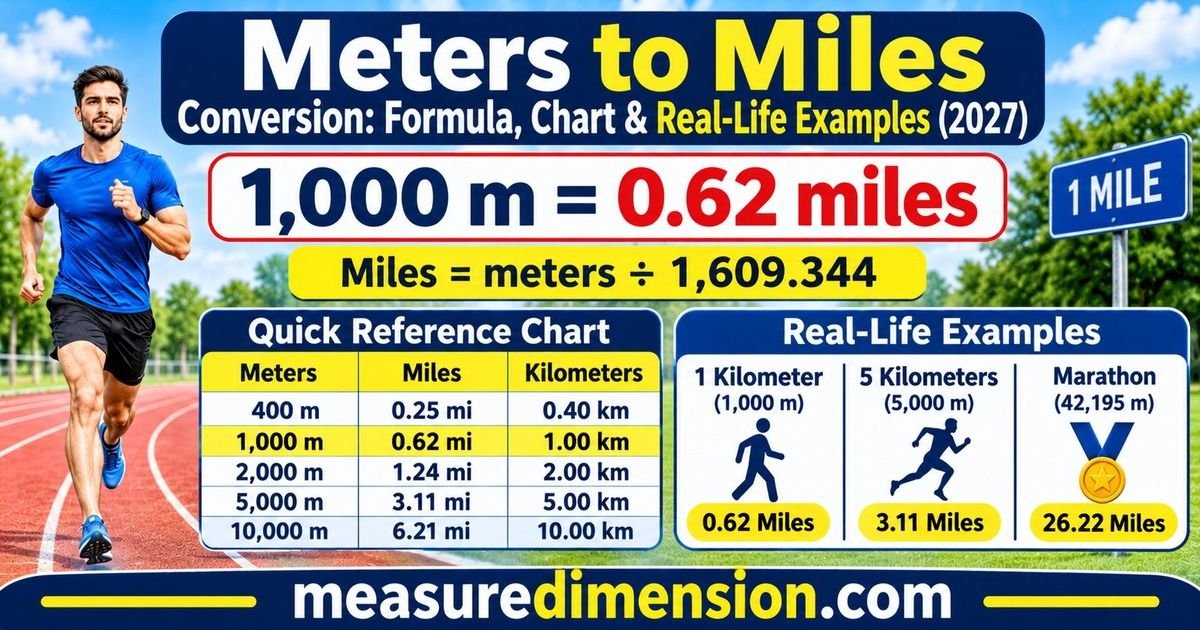
How many miles is a meter distance? The short answer to meters to miles conversion is simple: divide the meters by 1,609.344 — because one mile is exactly 1,609.344 meters long. So 1,000 meters is 0.62 miles, 5,000 meters is 3.11 miles, and a full marathon of 42,195 meters is 26.22 miles.
You meet this conversion everywhere: a race is listed as 5K, a running app shows meters, or a road sign gives a distance in kilometers and you think in miles. This guide gives you the exact formula, a quick chart for the values people search for most, worked examples from 400 meters to the marathon, and the reverse direction — miles back to meters — plus real-life comparisons, so you never have to look it up twice. If you searched for meters to miles conversion, you will find the exact answer below, with the formula and a chart.
The Exact Answer
1 mile = 1,609.344 meters (exactly).
So to turn meters into miles, divide by 1,609.344:
Miles = meters ÷ 1,609.344
The most useful landmark is the kilometer: 1,000 meters is 1 kilometer, and 1,000 ÷ 1,609.344 = 0.621371 miles, which people round to 0.62 miles. So a kilometer is only about six-tenths of a mile — a mile is much longer than a kilometer, and that is why the miles number always comes out smaller than the meters number.
That is the figure to use in everyday conversation. So the meters to miles conversion for 1,000 meters is 0.62 miles, for 5,000 meters it is 3.11 miles, and for a marathon it is 26.22 miles. If you need precision — for a race time, a training plan, or a technical specification — use the full division instead of the rounded figure.
The Formula: Meters to Miles
Meters and miles are linked by one exact conversion factor:
1 mile = 1,609.344 meters (exactly)
So to turn meters into miles, divide by 1,609.344:
Miles = meters ÷ 1,609.344
Worked example for 1,000 meters to miles:
1,000 ÷ 1,609.344 = 0.621371 miles, which rounds to 0.62 miles. That is the whole meters to miles conversion calculation — one division.
The same formula works for every value in this guide. The factor comes from the official definition of the mile, published by the National Institute of Standards and Technology (NIST). A quick mental shortcut: divide by 1,600 and you will be very close for everyday use — but for exact work, use 1,609.344.
Meters to Miles Conversion Chart
Meters to Miles Chart
| Meters | Miles | Kilometers |
|---|---|---|
| 100 m | 0.06 mi | 0.10 km |
| 250 m | 0.16 mi | 0.25 km |
| 400 m | 0.25 mi | 0.40 km |
| 500 m | 0.31 mi | 0.50 km |
| 1,000 m | 0.62 mi | 1.00 km |
| 1,500 m | 0.93 mi | 1.50 km |
| 2,000 m | 1.24 mi | 2.00 km |
| 4,000 m | 2.49 mi | 4.00 km |
| 5,000 m | 3.11 mi | 5.00 km |
| 10,000 m | 6.21 mi | 10.00 km |
| 42,195 m | 26.22 mi | 42.20 km |
Quick tip: Divide meters by 1,609.344 to get miles — 1,000 meters is 0.62 miles.
400 Meters to Miles
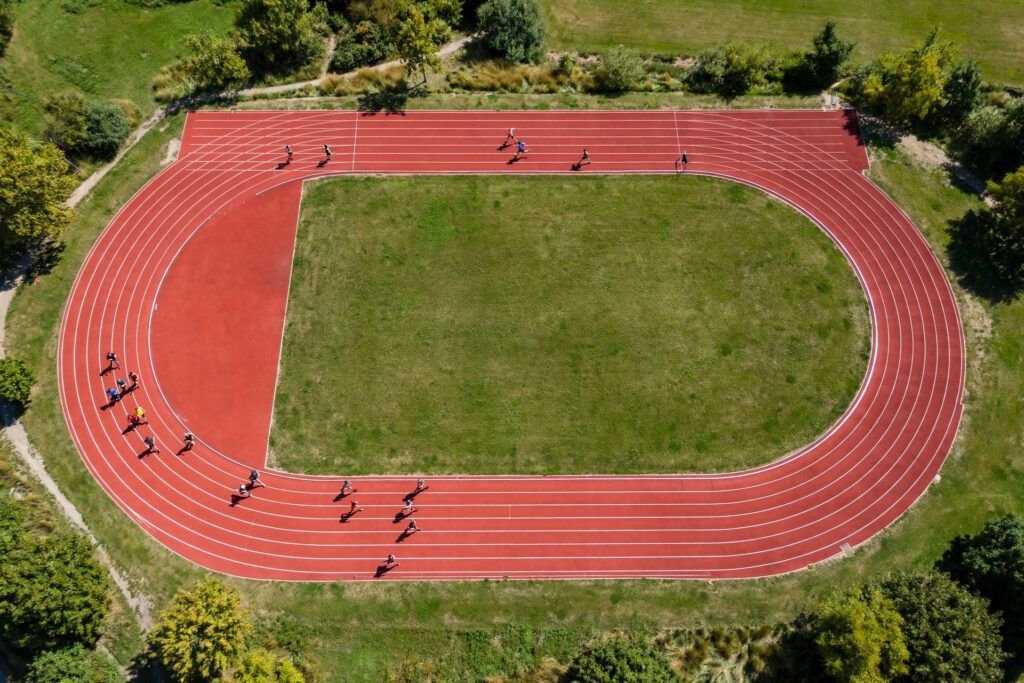
400 meters is 0.25 miles (400 ÷ 1,609.344 = 0.248548). Rounded, that is a quarter of a mile.
Four hundred meters is one lap of a standard running track — the distance every track runner knows by heart. So one lap of the track is a quarter mile, and four laps add up to 1,609.344 meters, which is one mile (four laps is actually 1,600 meters, just 9.344 meters short of a full mile).
500 Meters to Miles

500 meters is 0.31 miles (500 ÷ 1,609.344 = 0.310686). That is just under a third of a mile.
Five hundred meters is half a kilometer, and it is a common distance on a walk or a warm-up jog: at an average walking pace of about 5 kilometers per hour, 500 meters takes roughly 6 minutes on foot. On a running track, 500 meters is one full lap plus another 100 meters.
1,000 Meters to Miles
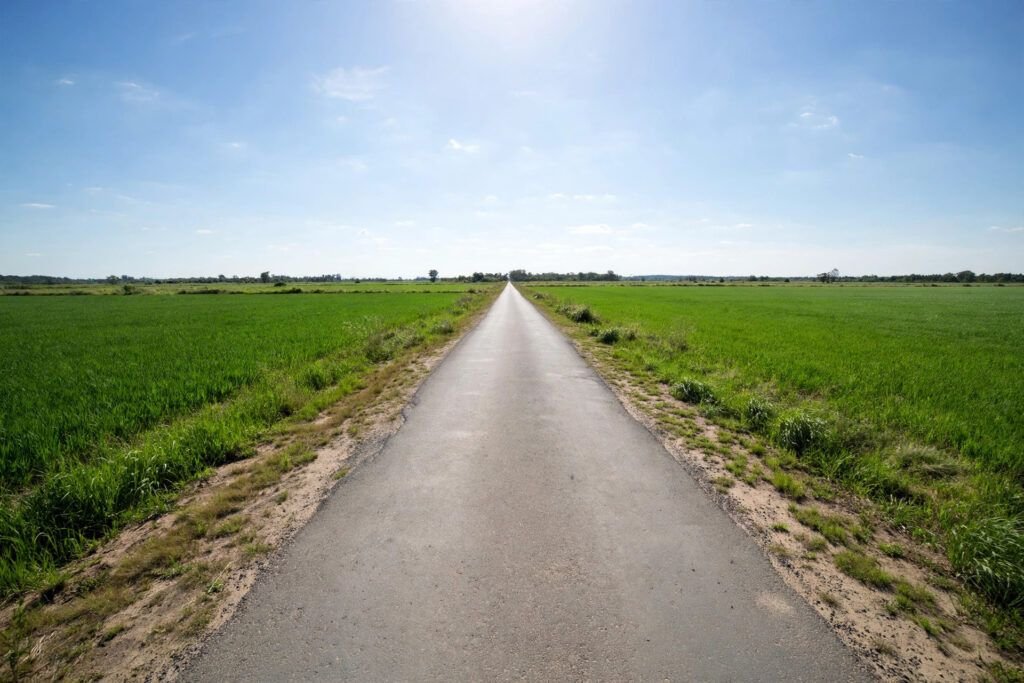
1,000 meters is 0.62 miles (1,000 ÷ 1,609.344 = 0.621371). That is the kilometer-to-miles answer, and it is the single most useful figure in this guide.
One thousand meters is exactly 1 kilometer, and a kilometer is only about six-tenths of a mile. So if a race or a road is listed as 1 km, picture a little more than half a mile — not a full mile. Three kilometers is about 1.86 miles, and five kilometers is 3.11 miles.
1,500 Meters to Miles

1,500 meters is 0.93 miles (1,500 ÷ 1,609.344 = 0.932057). That is just short of a full mile — about 93% of it.
The 1,500 meters is the classic metric mile, the standard middle-distance race on the track: three and three-quarter laps. It is only about 109 meters short of a full mile, so a runner who finishes a 1,500-meter race has covered almost exactly a mile.
2,000 Meters to Miles

2,000 meters is 1.24 miles (2,000 ÷ 1,609.344 = 1.242742). That is one full mile plus another quarter mile.
Two thousand meters is exactly 2 kilometers, and it is a common rowing and running benchmark distance. On a standard track it is five laps. Walking 2,000 meters takes about 25 minutes at an average pace.
4,000 Meters to Miles

4,000 meters is 2.49 miles (4,000 ÷ 1,609.344 = 2.485485). That is just under two and a half miles — and exactly 4 kilometers.
Four thousand meters is ten laps of a running track, and it is a standard distance in track training. Walking 4,000 meters takes about 45 to 50 minutes at an average pace of 5 kilometers per hour.
5,000 Meters to Miles

5,000 meters is 3.11 miles (5,000 ÷ 1,609.344 = 3.106856). That is the 5K race distance — the most popular road race in the world.
A 5K is 5 kilometers, and 5 kilometers is 3.11 miles, so when someone says they ran a 5K, they ran just over three miles. On a track, 5,000 meters is twelve and a half laps. Walking it takes about an hour at an average pace.
10,000 Meters to Miles

10,000 meters is 6.21 miles (10,000 ÷ 1,609.344 = 6.213712). That is the 10K race distance — ten kilometers, or just over six miles.
A 10K is double the 5K, and it is the next step up for most road runners: 10 kilometers is 6.21 miles. On a track, 10,000 meters is twenty-five laps. Walking 10 kilometers takes about two hours at an average pace.
42,195 Meters to Miles — the Marathon

42,195 meters is 26.22 miles (42,195 ÷ 1,609.344 = 26.218757). That is the marathon distance — 42.195 kilometers, or 26 miles and about 385 yards.
The marathon is the longest standard road race, and its distance is fixed: 42,195 meters, no more and no less. In miles that is 26.22, which is why marathon times are always quoted as “26.2 miles.” Running it takes elite athletes a little over two hours; most finishers take between three and five hours.
Converting Miles to Meters
The reverse direction uses the same exact factor, the other way around. Since 1 mile is exactly 1,609.344 meters:
Meters = miles × 1,609.344
Worked examples:
- 1 mile = 1 × 1,609.344 = 1,609.344 meters
- 0.25 miles = 0.25 × 1,609.344 = 402.336 meters
- 0.5 miles = 0.5 × 1,609.344 = 804.672 meters
- 3 miles = 3 × 1,609.344 = 4,828.032 meters
- 5 miles = 5 × 1,609.344 = 8,046.72 meters
- 26.2188 miles = 26.2188 × 1,609.344 = 42,195 meters (the marathon)
A quick check ties the two directions together: 5,000 meters is 3.11 miles, and converting back, 3.11 × 1,609.344 = 5,005 meters — the small gap is only the rounding of 3.11. If your round trip lands far from the number you started with, you divided when you should have multiplied, or the other way around.
The most common mix-up is using 1,609 in the wrong direction. Remember: meters to miles makes the number smaller (divide by 1,609.344), because a mile is much longer than a meter and you need fewer of them. Miles to meters makes the number bigger (multiply by 1,609.344), because a meter is shorter and you need more of them.
What Does a Mile Look Like in Real Life?

Numbers are easier to picture when you compare them with familiar things. Here is what the meters to miles conversion results look like in everyday terms.
Against a running track

A standard running track is 400 meters around, so one lap is 0.25 miles and four laps is almost exactly one mile — 1,600 meters, just 9.344 meters short. If you run four laps, you have run a mile, for practical purposes. Ten laps is 4,000 meters, or 2.49 miles.
Against a race course

Road races are named by their kilometer distance, and the miles follow from this guide: a 5K is 3.11 miles, a 10K is 6.21 miles, a half marathon (21,097.5 meters) is 13.11 miles, and a full marathon is 26.22 miles. If you know the K number, you know the miles — just divide by 1,609.344 or check the chart above.
Against a road and a map

On the road, a mile is a long stretch: about 1,609 meters of highway, or roughly 20 city blocks in many American cities (blocks vary, but a mile is a good walking distance). A kilometer, by contrast, is only 0.62 miles — so when a map or a sign says 1 km, picture a little more than half a mile. A 5-kilometer drive is 3.11 miles, and a 10-kilometer drive is 6.21 miles.
Longer distances in this guide

The bigger values in the chart are distances, not heights: 1,000 meters is 0.62 miles — a short walk of about 12 minutes; 5,000 meters is 3.11 miles — a 5K race; 10,000 meters is 6.21 miles — a 10K race; and 42,195 meters is 26.22 miles — the full marathon.
Common Mistakes When Converting Meters to Miles

The conversion is simple, but a few mistakes show up again and again.
Multiplying when you should divide. Meters to miles means dividing by 1,609.344, and the answer must be smaller than the number you started with. If your miles answer is bigger than your meters number, you multiplied by mistake.
Using 1,600 instead of 1,609.344 for exact work. For a quick estimate, 1,600 is fine. But over longer distances the small difference adds up: 42,195 meters ÷ 1,600 = 26.37 miles, while the exact figure is 26.22 miles. Use the full 1,609.344 when the measurement matters.
Mixing up miles and kilometers. A kilometer is 1,000 meters (0.62 miles), while a mile is 1,609.344 meters. They are not the same unit: 5 kilometers is 3.11 miles, not 5 miles. Always check whether the number in front of you is kilometers or miles before converting.
Confusing meters with yards. A yard is 0.9144 meters, so 1,609.344 meters is 1,760 yards — that is why a mile is 1,760 yards. Yards and meters are different units, and only the 1,609.344 factor converts meters to miles.
Forgetting the unit in the answer. A bare “3.11” means nothing — 3.11 miles and 3.11 kilometers are very different distances. Always write the unit with the number.
FAQs
How many miles is 1,000 meters?
1,000 meters is 0.62 miles (exactly 0.621371 miles). That is 1 kilometer, and a kilometer is a little more than half a mile.
How do you convert meters to miles?
Divide the number of meters by 1,609.344. For a meters to miles conversion, 1,000 ÷ 1,609.344 = 0.62 miles, and 5,000 ÷ 1,609.344 = 3.11 miles. The factor comes from 1 mile being exactly 1,609.344 meters.
How do you convert miles to meters?
Multiply the number of miles by 1,609.344. For example, 1 mile × 1,609.344 = 1,609.344 meters, and 3 miles × 1,609.344 = 4,828.032 meters.
How many miles is 5,000 meters?
5,000 meters is 3.11 miles (5,000 ÷ 1,609.344 = 3.106856). That is the 5K race distance — 5 kilometers.
How many miles is a marathon?
A marathon is 42,195 meters, which is 26.22 miles (42,195 ÷ 1,609.344 = 26.218757). That is 42.195 kilometers.
Is 1,500 meters the same as 1 mile?
No, not quite. The meters to miles conversion for 1,500 meters is 0.93 miles, which is just short of a full mile — about 109 meters short. One mile is 1,609.344 meters.
Conclusion
So, what is the meters to miles conversion? The answer is one division: miles = meters ÷ 1,609.344, because one mile is exactly 1,609.344 meters.
The one formula to remember for meters to miles conversion — and every other value — is miles = meters ÷ 1,609.344. With it, every value in this guide follows: 400 meters is 0.25 miles, 500 meters is 0.31 miles, 1,000 meters is 0.62 miles, 1,500 meters is 0.93 miles, 2,000 meters is 1.24 miles, 4,000 meters is 2.49 miles, 5,000 meters is 3.11 miles, 10,000 meters is 6.21 miles, and the marathon is 26.22 miles. Going the other way, meters = miles × 1,609.344 — 1 mile is 1,609.344 meters and 5 miles is 8,046.72 meters.
The best way to keep the answer in your head is to picture it. One kilometer is 0.62 miles, a 5K race is 3.11 miles, and four laps of a running track is almost exactly one mile. Once you have that picture, the meters to miles conversion follows on its own: divide by 1,609.344.
Related Guides

Hi, I’m Michael Carter, I write simple, everyday size guides so you can picture any measurement in seconds.