

A .243 Winchester rifle is typically 42 to 44 inches (106.7 to 111.8 cm) long overall, with a 22-inch (55.9 cm) barrel on most standard hunting models. Some models use a longer 24-inch (61.0 cm) barrel, which stretches the overall length to 44 inches (111.8 cm), while compact and youth models are shorter at 38.5 to 40.4 inches (97.8 to 102.6 cm) with a 20-inch (50.8 cm) barrel.
In weight, a standard .243 Winchester rifle is 6.31 to 7.8 pounds (2.86 to 3.54 kg) without a scope. The lightest factory models dip to 4.9 pounds (2.22 kg), and rifles sold with a scope fitted weigh more — up to about 9.35 pounds (4.24 kg) for heavy scoped packages.
The .243 Winchester is a short-action bolt-action cartridge, introduced by Winchester in 1955. It is a .308 Winchester case necked down to take a 6 mm bullet, which is why .243 rifles are the same size as other short-action hunting rifles — but the cartridge itself is one of the lightest-kicking deer rounds ever made, at about 9 to 11 ft-lbs of recoil. That is roughly half the recoil of a .308 Winchester, and it is the main reason the .243 is the most recommended first deer rifle in America.
| Model | Barrel Length | Overall Length | Weight (bare rifle) |
|---|---|---|---|
| Browning X-Bolt Hunter | 22 in (55.9 cm) | 42 in (106.7 cm) | 6 lb 5 oz (2.86 kg) |
| Weatherby Vanguard | 24 in (61.0 cm) | 44 in (111.8 cm) | 7.5 lb (3.40 kg) |
| Mossberg Patriot | 22 in (55.9 cm) | 42.75 in (108.6 cm) | 6.5 lb (2.95 kg) |
| Howa 1500 | 22 in (55.9 cm) | 42 in (106.7 cm) | 7.8 lb (3.54 kg) |
| Savage 110 Apex Hunter XP | 22 in (55.9 cm) | 42.5 in (108.0 cm) | 7.5 lb (3.40 kg) |
.243 Winchester Rifle Length by Model

The table below gives the standard hunting configuration of five popular .243 Winchester rifles. Barrel length is the steel barrel only; overall length is measured from the butt of the stock to the muzzle.
Browning X-Bolt Hunter — 42 inches

The Browning X-Bolt Hunter in .243 Winchester has a 22-inch (55.9 cm) barrel and measures 42 inches (106.7 cm) overall. It weighs 6 pounds 5 ounces (2.86 kg), making it one of the lighter full-size .243 rifles. The X-Bolt uses a short 60-degree bolt lift and a detachable rotary magazine, and the standard model holds 4+1 rounds.
Weatherby Vanguard — 44 inches
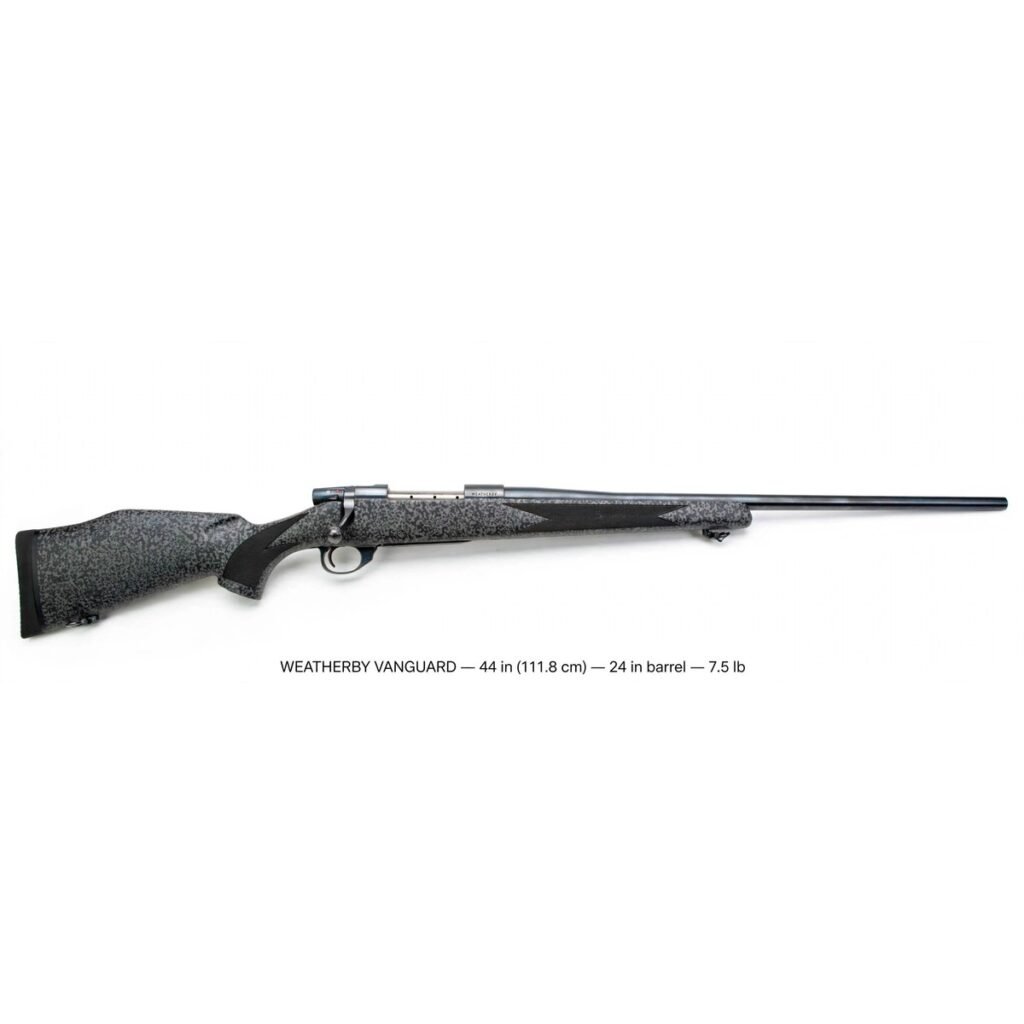
The Weatherby Vanguard is the longest of the five, at 44 inches (111.8 cm) overall with a 24-inch (61.0 cm) barrel. It weighs 7.5 pounds (3.40 kg). The extra 2 inches (5.1 cm) of barrel over the 22-inch models gives the .243 a small velocity gain, and the Vanguard is built on the Howa 1500 action with a guaranteed sub-MOA accuracy standard.
Mossberg Patriot — 42.75 inches

The Mossberg Patriot in .243 Winchester has a 22-inch (55.9 cm) fluted barrel and measures 42.75 inches (108.6 cm) overall. The synthetic-stock model weighs 6.5 pounds (2.95 kg), while walnut-stock and scoped versions weigh 7 to 7.5 pounds (3.18 to 3.40 kg). It holds 5+1 rounds and has an adjustable trigger.
Howa 1500 — 42 inches

The Howa 1500 in .243 Winchester has a 22-inch (55.9 cm) barrel and measures 42 inches (106.7 cm) overall, weighing 7.8 pounds (3.54 kg) in the standard configuration. Howa also sells the 1500 in scoped packages, which weigh more — 8.4 to 9.35 pounds (3.81 to 4.24 kg) with the scope and mounts fitted — so check whether the weight you see listed is the bare rifle or the scoped package.
Savage 110 Apex Hunter XP — 42.5 inches

The Savage 110 Apex Hunter XP in .243 Winchester has a 22-inch (55.9 cm) barrel and measures 42.5 inches (108.0 cm) overall. It weighs 7.5 pounds (3.40 kg) with the factory-fitted Vortex Crossfire II 3-9×40 scope, and holds 4+1 rounds. The 110 is known for its adjustable AccuTrigger and is one of the most common .243 rifles sold in America.
Shorter and Lighter .243 Winchester Rifles

Not every .243 rifle is full size. Compact and youth models use a 20-inch (50.8 cm) barrel, which shortens the rifle by about 2 to 4 inches (5.1 to 10.2 cm) and makes it easier to carry in thick brush or for a smaller shooter.
- Browning X-Bolt Micro — 20-inch (50.8 cm) barrel, 38.8 inches (98.6 cm) overall, 6.06 pounds (2.75 kg).
- Weatherby Vanguard Carbine — 20-inch (50.8 cm) barrel, 40 inches (101.6 cm) overall, 7 pounds (3.18 kg).
- Mossberg Patriot Super Bantam (youth) — 20-inch (50.8 cm) barrel, 38.5 inches (97.8 cm) overall, 7.5 pounds (3.40 kg) with the included scope.
- Howa 1500 Superlite Gen2 — 20-inch (50.8 cm) barrel, 38.75 inches (98.4 cm) overall, 4.9 pounds (2.22 kg), the lightest .243 rifle in this guide.
- Savage 110 Lightweight Storm — 20-inch (50.8 cm) barrel, 40.38 inches (102.6 cm) overall, 5.6 pounds (2.54 kg).
The shortest factory .243 rifle here is the Mossberg Patriot Super Bantam at 38.5 inches (97.8 cm), and the lightest is the Howa 1500 Superlite Gen2 at 4.9 pounds (2.22 kg). A shorter barrel costs a little velocity — roughly 25 to 30 fps per inch of barrel — so a 20-inch barrel gives up about 50 to 60 fps against a 22-inch barrel, which is a small price for the handier size.
The .243 Winchester Cartridge
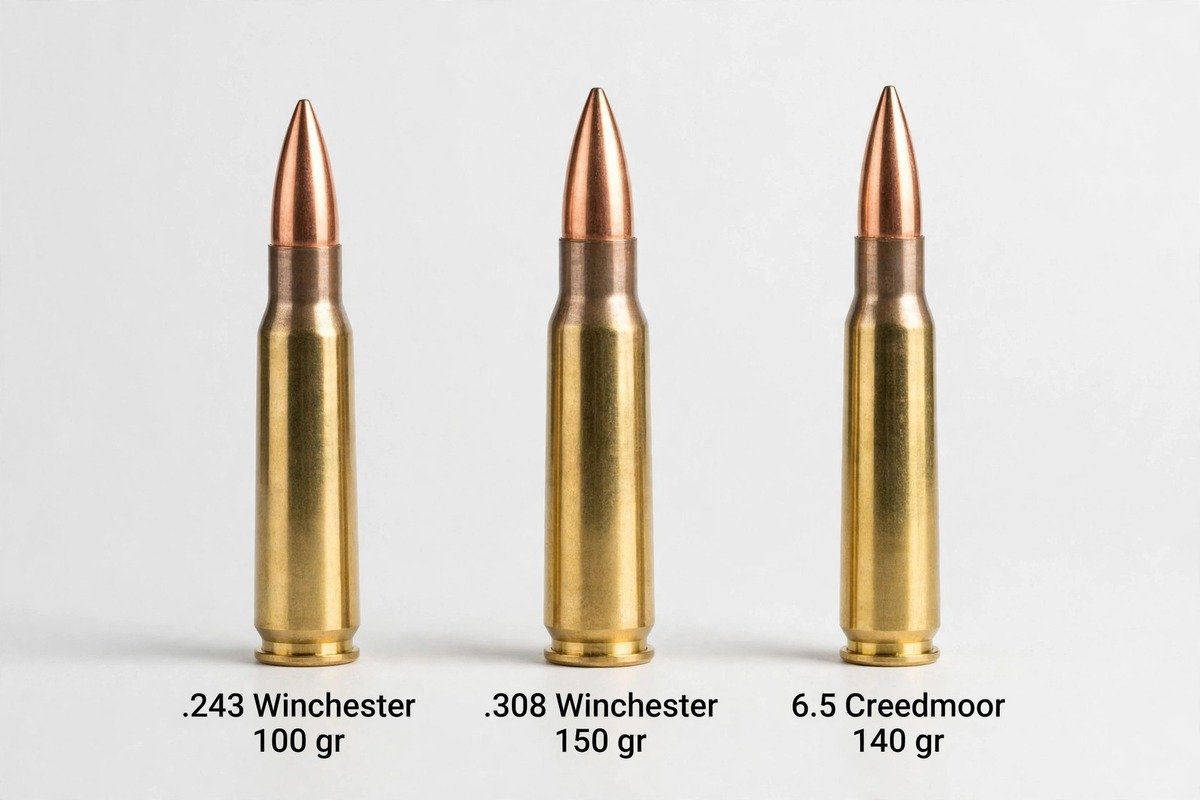
The .243 Winchester was introduced in 1955 as a dual-purpose cartridge: light, fast bullets for varmints and heavier bullets for deer. It is based on the .308 Winchester case necked down to accept a 6 mm bullet, with a bullet diameter of .243 inches (6.17 mm). It fits in the same short-action rifles as the .308 Winchester, the 7mm-08 Remington and the 6.5 Creedmoor.
Factory .243 Winchester ammunition is loaded with bullets from 55 grains (3.6 g) to 115 grains (7.5 g). The light 55 to 70 grain (3.6 to 4.5 g) loads are varmint bullets, and the heavier 90 to 105 grain (5.8 to 6.8 g) loads are deer bullets. That split matters: a varmint bullet is built to break apart on impact and should never be used on deer.
| Bullet weight | Muzzle velocity | Muzzle energy |
|---|---|---|
| 55 gr (3.6 g) | 3,910 fps (1,192 m/s) | 1,867 ft-lbs (2,531 J) |
| 95 gr (6.2 g) | 3,025 fps (922 m/s) | 1,930 ft-lbs (2,617 J) |
| 100 gr (6.5 g) | 2,960 fps (902 m/s) | 1,945 ft-lbs (2,637 J) |
| 105 gr (6.8 g) | 2,920 fps (890 m/s) | 1,987 ft-lbs (2,694 J) |
The most common deer load is the 100-grain bullet at about 2,960 fps (902 m/s). At 300 yards (274.3 m) it is still travelling at about 2,380 fps (725 m/s) and carries about 1,250 ft-lbs (1,695 J) of energy — well above the 1,000 ft-lbs figure many ballistics authorities cite as the minimum for an ethical deer shot. At 400 yards (365.8 m) the same load keeps roughly 900 to 1,000 ft-lbs, which is the edge of its comfortable deer range.
Recoil is the .243’s biggest advantage. In a 7 to 7.5 pound (3.18 to 3.40 kg) rifle, a .243 Winchester produces about 9 to 11 ft-lbs of recoil — roughly half the recoil of a .308 Winchester. Light recoil means less flinching, faster follow-up shots, and a rifle that youth shooters and smaller-framed adults can shoot accurately.
Is the .243 Winchester Good for Deer Hunting?
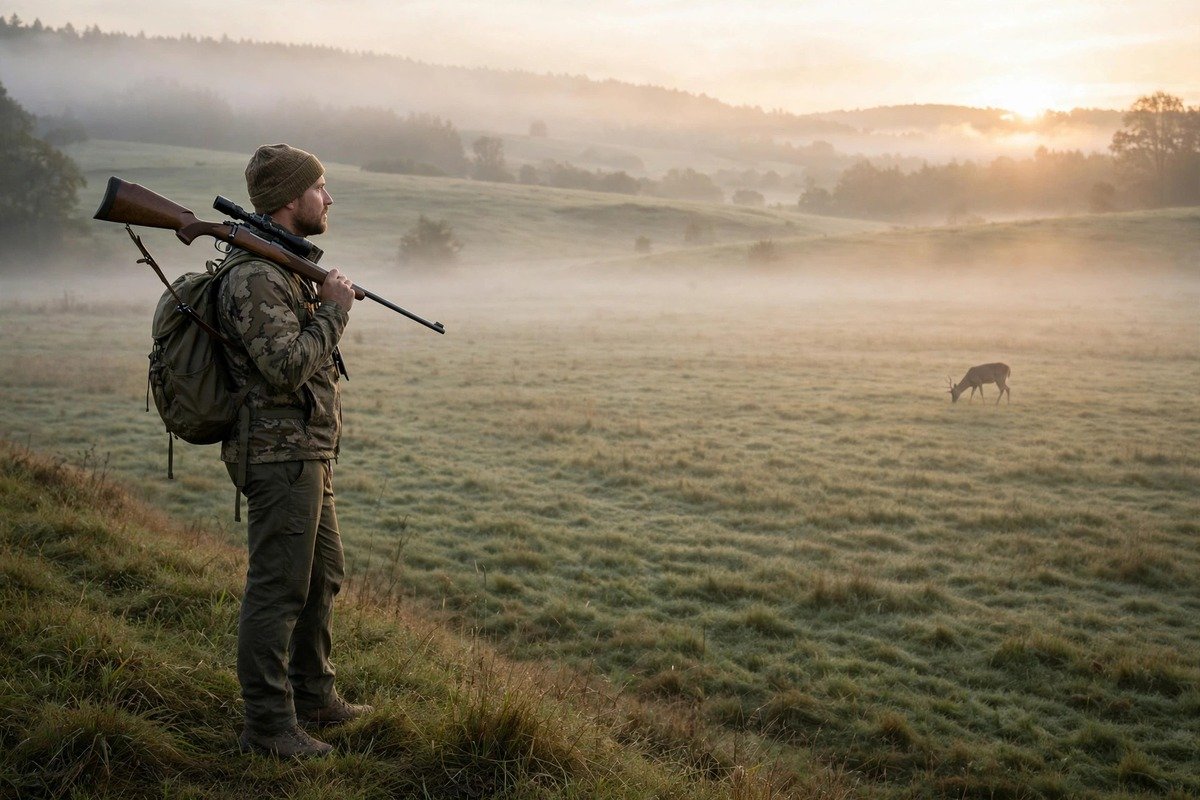
Yes — with the right bullet and the right distance. The .243 Winchester has been killing whitetail deer cleanly since 1955, and it is the cartridge most often recommended as a first deer rifle. The conditions are simple: use a proper deer bullet, put the shot in the vital area, and keep the distance inside 300 yards (274.3 m).
Is the 243 a good deer rifle?

Yes, the .243 is a good deer rifle. The consensus among experienced hunters and ballistics experts is that the .243 Winchester is effective for whitetail deer within 200 to 300 yards (182.9 to 274.3 m) with the right bullet and shot placement. Use a premium hunting bullet of 90 to 100 grains (5.8 to 6.5 g) — a bonded or controlled-expansion bullet, not a light varmint bullet. A 55 to 70 grain varmint bullet can wound a deer without enough penetration, so it should never be used for deer. The .243 is also the smallest bore cartridge that is legal for deer hunting in at least ten U.S. states and in the United Kingdom, which is a useful sign of how widely it is trusted for the job.
What is a 243 rifle good for?

A .243 rifle is good for whitetail deer, mule deer, pronghorn antelope, coyotes and other predators, varmints such as groundhogs and prairie dogs, and target shooting. The light bullets (55 to 70 grains) are flat-shooting varmint loads, and the heavy bullets (90 to 105 grains) are deer loads — one rifle covers both jobs. It is also a good choice for youth hunters and recoil-sensitive shooters because of its light recoil. What it is not good for is large game: the .243 is not an elk, moose or bear cartridge. Its 100-grain bullet carries about 900 to 1,000 ft-lbs at 500 yards, which is adequate for deer with good shot placement but marginal for anything larger.
.243 Winchester vs .308 Winchester vs 6.5 Creedmoor
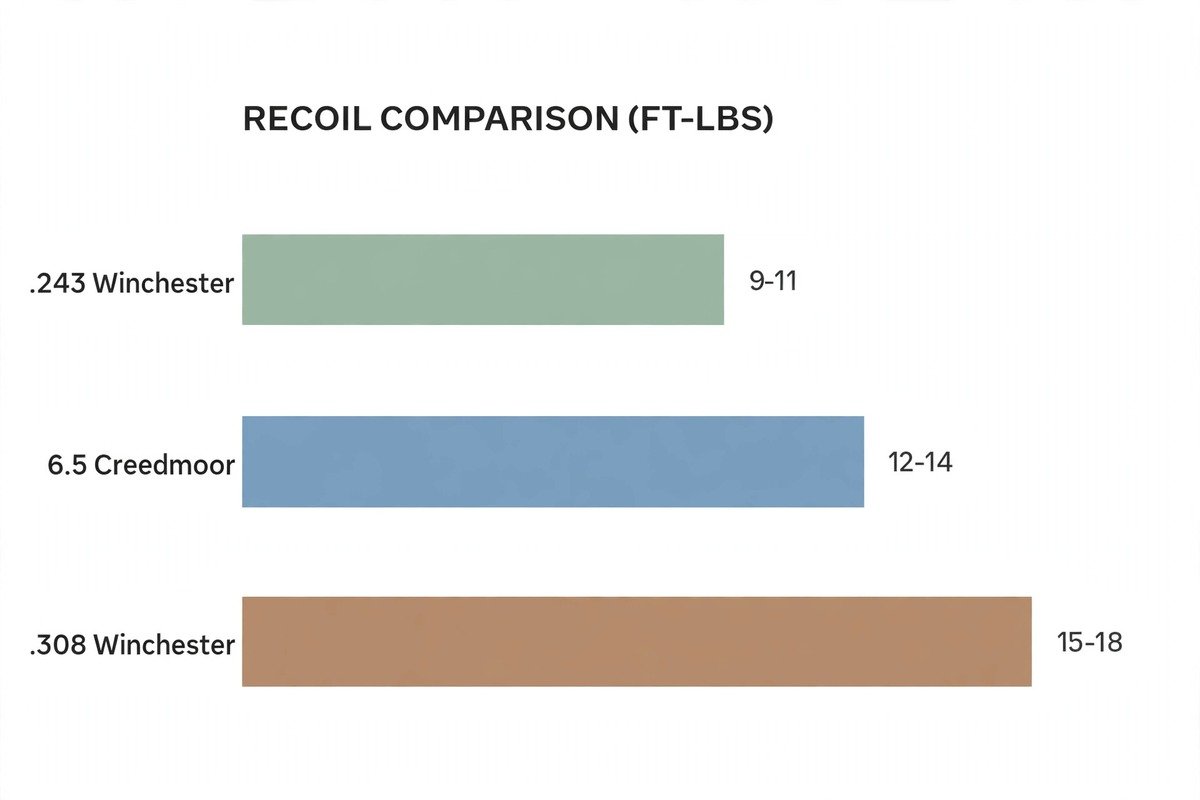
The .243 is most often compared with the two other popular short-action deer cartridges. The figures below use the same factory load family (Federal Premium Fusion) so the comparison is apples to apples.
| Cartridge | Bullet diameter | Typical deer bullet | Muzzle energy | Energy at 300 yd | Recoil |
|---|---|---|---|---|---|
| .243 Winchester | .243 in (6.17 mm) | 100 gr (6.5 g) | 1,873 ft-lbs | 1,085 ft-lbs | 9–11 ft-lbs |
| .308 Winchester | .308 in (7.82 mm) | 150 gr (9.7 g) | 2,555 ft-lbs | 1,536 ft-lbs | 15–18 ft-lbs |
| 6.5 Creedmoor | .264 in (6.71 mm) | 140 gr (9.1 g) | 2,351 ft-lbs | 1,455 ft-lbs | 12–14 ft-lbs |
The .308 Winchester hits harder — about 2,555 ft-lbs at the muzzle against the .243’s 1,873 ft-lbs in these loads — but it also kicks about twice as hard. The 6.5 Creedmoor sits in the middle: it delivers about 400 to 500 ft-lbs more energy than the .243 at 400 to 500 yards, with recoil of 12 to 14 ft-lbs, close to the .243’s 9 to 11 ft-lbs. For deer inside 300 yards, all three work. The .243 wins on recoil and cost per round, the 6.5 Creedmoor wins on long-range energy, and the .308 wins on raw power and ammunition availability.
FAQs
How long is a .243 Winchester rifle in cm?
A standard .243 Winchester rifle is 106.7 to 111.8 cm long overall (42 to 44 inches), with a barrel of 55.9 to 61.0 cm (22 to 24 inches). Compact models are 97.8 to 102.6 cm long (38.5 to 40.4 inches).
What is the most common barrel length for a .243 rifle?
22 inches (55.9 cm) is the most common barrel length. Four of the five rifles in this guide use a 22-inch barrel; the Weatherby Vanguard is the exception at 24 inches (61.0 cm). Compact and youth models use a 20-inch (50.8 cm) barrel.
How far can a .243 kill a deer?
A .243 Winchester is effective on whitetail deer out to 200 to 300 yards (182.9 to 274.3 m) with a 90 to 100 grain hunting bullet. At 400 yards (365.8 m) it keeps roughly 900 to 1,000 ft-lbs of energy, which is the lower edge of ethical deer range — the shot has to be well placed. Beyond 400 yards, a larger cartridge is a better choice.
Is a .243 enough for elk?
No. The .243 Winchester is not recommended for elk, moose or bear. It is a deer, pronghorn and varmint cartridge. For elk, a larger cartridge such as the .308 Winchester, 6.5 Creedmoor or a magnum is the standard choice.
Is the .243 good for beginners?
Yes. The .243 Winchester is the most recommended first centerfire rifle cartridge in America. Its recoil of about 9 to 11 ft-lbs is light enough for youth shooters and new hunters, it is accurate, ammunition is widely available, and it is genuinely capable on deer — not just a starter round that has to be replaced.
Conclusion
A .243 Winchester rifle is 42 to 44 inches (106.7 to 111.8 cm) long with a 22 to 24 inch (55.9 to 61.0 cm) barrel and weighs 6.31 to 7.8 pounds (2.86 to 3.54 kg) in its standard form. Shorter 20-inch barrel models run 38.5 to 40.4 inches (97.8 to 102.6 cm) and can weigh as little as 4.9 pounds (2.22 kg).
And yes, it is a good deer rifle. With a 90 to 100 grain hunting bullet inside 300 yards (274.3 m), the .243 Winchester kills whitetail deer cleanly, with about half the recoil of a .308 Winchester. It is not a big-game cartridge, and it will not forgive a varmint bullet or a bad shot — but for deer, pronghorn and varmints, there is hardly a more practical rifle.
Related Guides
- How Long Is a Full-Size AK-47? Length, Weight & Size Guide
- How Long Is a Hunting Rifle? 14 Common Lengths Explained
- AK-47 at the Firing Range: What It’s Like to Shoot One
- How Long Is an HK416 Rifle?
- How Long Is an FN SCAR Rifle?

Hi, I’m Michael Carter, I write simple, everyday size guides so you can picture any measurement in seconds.
[…] How Long Is a .243 Winchester Rifle? Is It Good for Deer Hunting? […]