
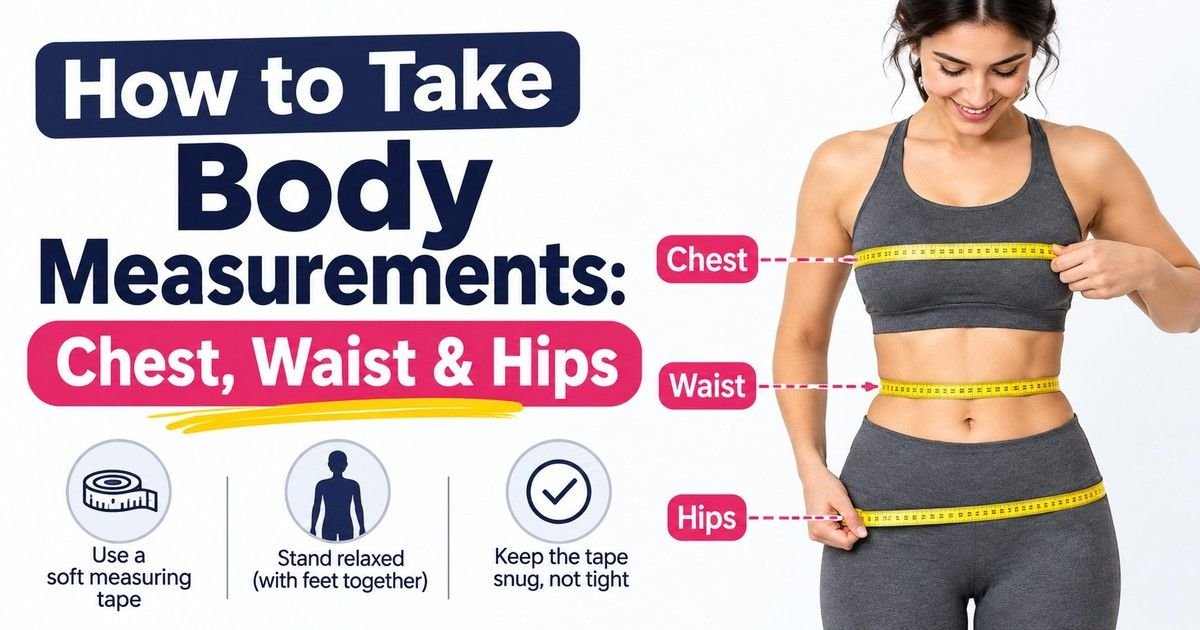
Learning how to take body measurements is a simple skill that saves time, money, and guesswork. With a soft tape measure and five minutes, you can find your chest, waist, hips, inseam, shoulder, and sleeve measurements at home — no tailor visit needed. These numbers help you buy clothes that fit online, track fitness progress, and follow sewing patterns with confidence.
To take body measurements correctly, stand up straight in light clothing, wrap a soft tape around each part of your body at the right spot, and keep the tape level and snug but not tight. You should be able to slide one finger under the tape. Write down each number, measure twice, and use the average if the two tries differ. Whether you call it how to measure body size or how to measure body measurements, the steps below cover every measurement in inches and centimeters.
What You Need to Measure Your Body

You do not need special tools to learn how to take body measurements at home. A few basic items are enough.
A soft tape measure. Use a flexible tailor’s tape, not a stiff metal tape from a toolbox. A soft tape bends around your body and follows its curves. If you do not have one, use a piece of string and a ruler: wrap the string around your body, mark the spot, then lay the string flat next to a ruler to read the length.
A mirror or a helper. A full-length mirror helps you check that the tape is level, especially for chest and hip measurements, where it can slope down at the back. A helper is even better for shoulder and sleeve measurements.
Light clothing and a relaxed stance. Wear thin clothing or measure over underwear. Thick sweaters and jeans add bulk and make every number too large. Stand with your feet flat, arms relaxed, and weight spread evenly. Breathe normally and do not suck in your stomach.
A notepad. Write down each measurement at once, with the unit. Measuring twice takes only a few extra seconds and catches most errors before they cause a wrong size.
How to Take Chest Measurements

The chest measurement, sometimes called the bust measurement, is taken around the fullest part of your chest. It is one of the most used numbers in size charts for shirts, jackets, dresses, and coats.
Stand straight with your arms relaxed at your sides. The tape goes around the fullest part of your chest, usually at nipple level. For women, this is the fullest part of the bust, measured while wearing a normal, non-padded bra. Wrap the tape under your armpits and across your shoulder blades at the back. It must sit level all the way around — use a mirror to check that it is not riding up or sliding down at the back, because a sloping tape gives a number that is too large.
Pull the tape snug against your body, but not tight. You should be able to slide one finger between the tape and your body. Breathe out normally, then read the number where the tape meets the zero mark. Do not hold your breath or puff out your chest. For example, a chest measurement of 36 inches equals 91.44 cm. For sewing patterns, use your exact body measurement — the pattern already includes room to move. For shop-bought clothes, check the brand’s size chart, because some brands add extra room on top of your body measurement.
How to Measure Your Waist

The waist measurement is taken at your natural waist, the narrowest part of your torso. It is the number used for trousers, skirts, dresses, and belts — but it is also the measurement people get wrong most often, because the natural waist is not always where your trousers sit.
Stand up straight and bend gently to one side. The crease that forms in your side is your natural waistline. It sits between the bottom of your ribs and the top of your hip bones, usually at or just above the belly button. Wrap the tape around this spot, keeping it level all the way around and flat against your skin without digging in. Do not pull it tight, and do not suck in your stomach — a waist measurement taken while holding your breath can be an inch or more too small, and clothes sized from that number will feel tight.
Breathe out normally and read the number. For example, a waist of 32 inches equals 81.28 cm. Write it down, then measure a second time. If the two numbers differ, take the average. A difference of half an inch (1.27 cm) between tries is normal.
Note that your natural waist and your trouser waist are often different numbers. Many trousers sit lower, on the hips, so your jeans waistband may measure 2 to 3 inches more. When a size chart asks for your waist, it almost always means your natural waist.
How to Measure Your Hips

The hip measurement is taken around the fullest part of your hips and seat. It matters for trousers, jeans, skirts, dresses, and swimwear, and it decides whether bottoms fit comfortably when you sit and walk.
Stand with your feet together and your weight spread evenly, legs straight but relaxed. Measuring with your feet apart changes the shape of your hips and gives a smaller number. Wrap the tape around the fullest part of your hips and buttocks, usually about 7 to 9 inches (17.78 to 22.86 cm) below your natural waist. Slide the tape up and down a little to find the widest point, then hold it there.
Keep the tape level all the way around — check in a mirror, because the tape tends to dip at the back. Keep it snug but not tight, with one finger of room underneath. Read the number, write it down, and measure a second time. If you are between sizes, trust the hip measurement for bottoms: a loose waist can be fixed with a belt, but hips that are too tight cannot be fixed at all.
How to Measure Your Inseam

The inseam is the length of the inner leg, from the crotch to the ankle bone. It decides the length of trousers and jeans, and it is the most error-prone body measurement, because it is hard to take on your own body.
Take off your shoes — inseam is always measured barefoot, because shoe height changes the result. Stand straight with your feet slightly apart. Place the end of the tape at the highest point of your inner leg, right at the crotch, and run it down the inside of your leg to the ankle bone. This is much easier with a helper, so ask someone to read the number at the ankle if you can.
If measuring your own leg feels awkward, use your best-fitting trousers instead. Lay them flat, smooth out wrinkles, and measure from the crotch seam straight down the inner leg to the hem. This is often more accurate than measuring your leg directly.
Inseam numbers are usually given in whole or half inches: 30, 31, 32, and 33 inches are the most common for adults. If your measurement falls between two numbers, round to the nearest half inch. For jeans you plan to wear with boots, add about half an inch.
How to Measure Shoulder Width and Sleeve Length

Shoulder width and sleeve length decide whether a shirt or jacket fits across the top. Both are hard to take alone, so a helper or a mirror makes a real difference.
Shoulder width runs across your back, from one shoulder point to the other. The shoulder point is the bony bump at the top of each arm, where a shirt seam would naturally sit. Stand straight with your arms relaxed, and have a helper hold the tape at one shoulder point, run it straight across the back, and read it at the other shoulder point. Keep the tape flat — do not let it dip down your back. A typical adult shoulder width is 16 to 19 inches (40.64 to 48.26 cm).
Sleeve length is measured from the shoulder point, down the arm, to the wrist bone, with the elbow slightly bent. Some charts ask for a longer version: from the center of the back of your neck, over the shoulder, to the elbow, then to the wrist. Check which version your chart uses. Getting these right is the difference between a shirt that looks made for you and one that looks borrowed.
How to Measure Body Measurements in Inches and Centimeters
When you learn how to take body measurements, you will meet both units: many size charts list sizes in inches, while sewing patterns and European brands often use centimeters. The conversion is exact: 1 inch equals 2.54 centimeters, always. To change inches to centimeters, multiply by 2.54. To change centimeters to inches, divide by 2.54. For example, a 34-inch waist is 34 × 2.54 = 86.36 cm, and a 100 cm hip measurement is 100 ÷ 2.54 = 39.37 inches. Never round before you convert — convert the exact number first, then round to one decimal place if needed.
Inches to Centimeters Conversion Chart
Use this chart to change common body measurements from inches to centimeters. Every value uses the exact conversion of 1 inch = 2.54 cm.
| Inches | Centimeters | Common Use |
|---|---|---|
| 24 in | 60.96 cm | Small waist |
| 26 in | 66.04 cm | Waist / hips (small) |
| 28 in | 71.12 cm | Waist / inseam (short) |
| 30 in | 76.20 cm | Waist / inseam |
| 32 in | 81.28 cm | Waist / inseam |
| 34 in | 86.36 cm | Chest / waist / inseam |
| 36 in | 91.44 cm | Chest / hips |
| 38 in | 96.52 cm | Chest / hips |
| 40 in | 101.60 cm | Chest / hips |
| 42 in | 106.68 cm | Chest / hips |
| 44 in | 111.76 cm | Chest / hips |
| 46 in | 116.84 cm | Chest / hips |
| 48 in | 121.92 cm | Chest / hips |
| 50 in | 127.00 cm | Chest / hips |
Quick tip: If your measurement falls between two rows, multiply the exact inch number by 2.54. For example, 35 inches × 2.54 = 88.90 cm.
Body Measurements Quick Reference
This table sums up where to place the tape for each measurement and what each number is used for. Keep it open while you measure, and check off each row as you finish it.
| Measurement | Where to Place the Tape | Used For |
|---|---|---|
| Chest / Bust | Around the fullest part of the chest, under the armpits, level across the back | Shirts, jackets, dresses, coats |
| Waist | Around the natural waist, the narrowest point between ribs and hips | Trousers, skirts, dresses, belts |
| Hips | Around the fullest part of the hips and seat, feet together | Trousers, jeans, skirts, swimwear |
| Inseam | Inner leg, from the crotch to the ankle bone, barefoot | Trousers, jeans, leggings |
| Shoulder width | Across the back, shoulder point to shoulder point | Shirts, jackets, coats |
| Sleeve length | Shoulder point to wrist bone, elbow slightly bent | Shirts, jackets, coats |
Common Mistakes When Measuring Your Body
Most wrong measurements come from a few simple mistakes. Avoid these, and your numbers will be accurate enough for any size chart or sewing pattern. If your two tries differ by more than half an inch, take a third measurement — a third try almost always shows which of the first two was wrong.
| Mistake | Why It Matters | Fix |
|---|---|---|
| Tape pulled too tight | Squeezes the body and gives a number up to an inch too small | Keep one finger of room under the tape |
| Tape sloping at the back | Adds extra length and gives a number that is too large | Check the tape is level in a mirror |
| Measuring at the trouser waistband line | The waistband often sits lower than the natural waist, so the number is too large | Find the natural waist by bending to one side |
| Holding your breath or sucking in | Makes the waist and chest read smaller than they really are | Breathe out normally and read the number |
| Measuring over thick clothing | Adds bulk and makes every number too large | Wear thin clothing or measure over underwear |
| Measuring only once | A single reading can be off without you noticing | Measure twice and use the average |
| Using a stiff metal tape | Cannot follow body curves, so the reading is unreliable | Use a soft tailor’s tape or string plus a ruler |
Frequently Asked Questions
How do I take body measurements by myself?
You can take chest, waist, hip, and inseam measurements alone with a soft tape and a mirror. Stand straight, keep the tape level, and check the back view. Shoulder width and sleeve length are harder alone — ask a helper, or measure a shirt that already fits well.
Should I measure over clothes or underwear?
Measure over thin clothing or underwear for the most accurate numbers. Thick sweaters, jeans, and belts add bulk and make every measurement too large. For chest measurements, women should wear a normal, non-padded bra.
What is the difference between waist and hip measurements?
The waist is measured at the natural waist, the narrowest point of your torso between the ribs and the hip bones. The hips are measured around the fullest part of your hips and seat, usually 7 to 9 inches (17.78 to 22.86 cm) below the natural waist. The waist number is almost always smaller than the hip number.
How do I convert body measurements from inches to cm?
Multiply the inch number by 2.54, because 1 inch is exactly 2.54 centimeters. For example, a 30-inch inseam is 30 × 2.54 = 76.20 cm. To go the other way, divide centimeters by 2.54: 90 cm ÷ 2.54 = 35.43 inches. Use the conversion chart in this guide for common sizes.
Why do my measurements differ from the size chart?
Size charts vary by brand and country, so the same measurement can mean a different size in two shops. Some charts use body measurements, others use garment measurements, which include extra room. Always read the brand’s own chart. Between sizes, pick the smaller for a snug fit or the larger for a relaxed fit.
Conclusion
Now you know how to take body measurements at home: chest, waist, hips, inseam, shoulder width, and sleeve length, all with a soft tape and a few minutes. The method is the same every time — find the right spot, keep the tape level and snug, breathe normally, measure twice, and write the number down. With accurate numbers, you can order clothes online with confidence. The next time a size chart asks for your measurements, you will already have the answers.
Related Guides
- Inches to CM Converter – Convert Inches to Centimeters
- How Many Centimeters Are in an Inch? Easy Conversion Guide
- 30 cm in Inches: Exact Conversion & Everyday Examples
- How Tall Is 170 cm in Feet and Inches?
- How to Measure for Roman Shades (2027 Guide)

Hi, I’m Michael Carter, I write simple, everyday size guides so you can picture any measurement in seconds.