

Sight height is the vertical distance from the centerline of your rifle’s bore to the centerline of your sight or scope. It is the one number every ballistic calculator asks for, and getting it wrong throws off your zero and your holdovers. Most bolt-action rifles measure 1.5 to 1.8 inches (38.10 to 45.72 mm), while a standard AR-15 measures about 2.6 inches (66.04 mm). This guide shows you three ways to measure it yourself — with calipers, from the top of the rail, or with a dowel rod through the bore — and explains what the number does to your shooting.
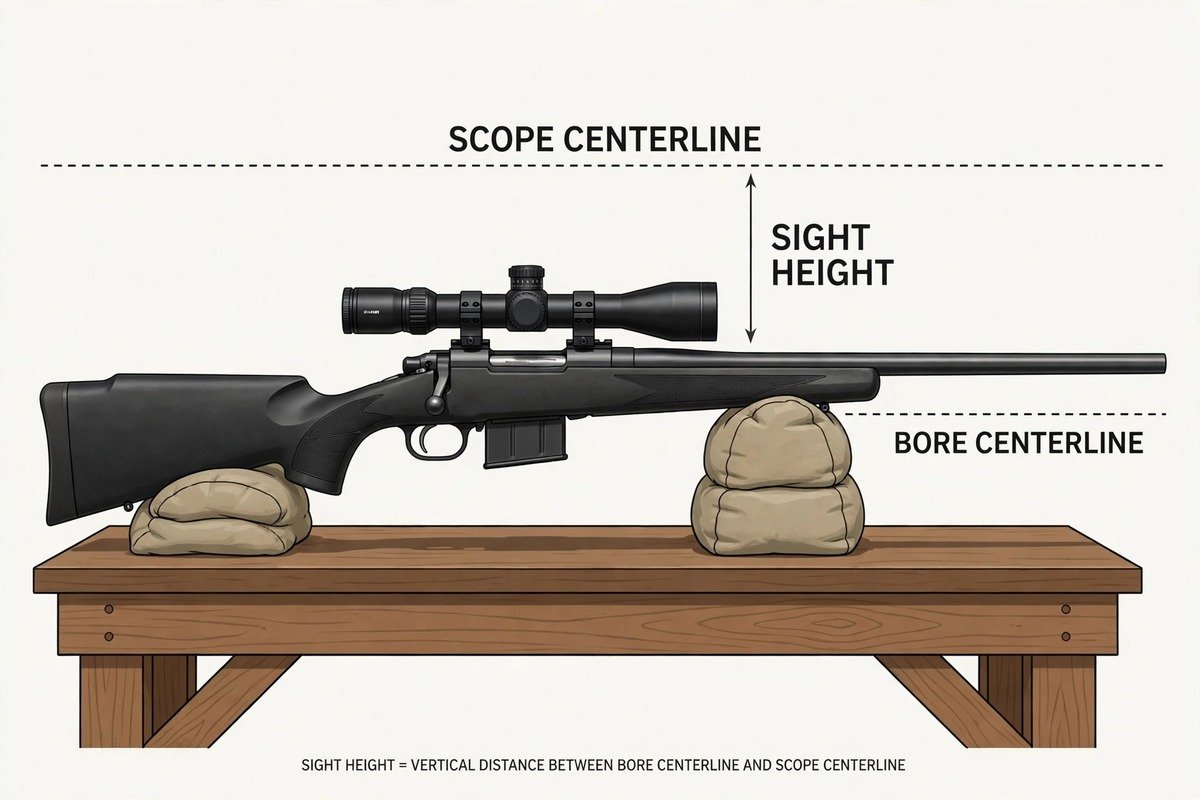
Typical Sight Heights by Rifle and Mount
Use this table as a starting point. Every rifle is different, so always measure your own setup before you type a number into a ballistic calculator.
| Rifle / Mount Type | Typical Sight Height | Millimeters |
|---|---|---|
| Bolt-action rifle, low rings | 1.5–1.8 inches | 38.10–45.72 mm |
| Bolt-action rifle, medium or high mounts | 1.75–2.0 inches | 44.45–50.80 mm |
| AR-15, iron sights / absolute co-witness | 2.6 inches | 66.04 mm |
| AR-15, lower 1/3 co-witness mount | 2.8 inches | 71.12 mm |
| AR-15, rough value for a ballistics program | 2.5 inches | 63.50 mm |
| Long-range precision setup | Up to 3.0 inches or more | 76.20 mm or more |
Quick tip: Sources give the AR-15 figure as 2.5, 2.6, or 2.7 inches depending on the sight and the manufacturer. The standard figure is 2.5–2.6 inches (63.50–66.04 mm) — close enough for a ballistic calculator, but measure your own rifle for the exact number.

Tools You Need

- Digital calipers — the most accurate tool for this job. A ruler works for a rough number, but calipers get you within a hundredth of an inch.
- A dowel rod or cleaning rod — for Method 3. It must fit snugly inside the bore without wobbling.
- A flat, stable surface or gun vise — to hold the rifle still while you measure.
- A notepad — to write down each measurement before you add them up.
Before you start, make sure the rifle is unloaded and the bolt is open. Every method below assumes a safe, empty rifle.
Method 1: Measure With Calipers (Most Accurate)
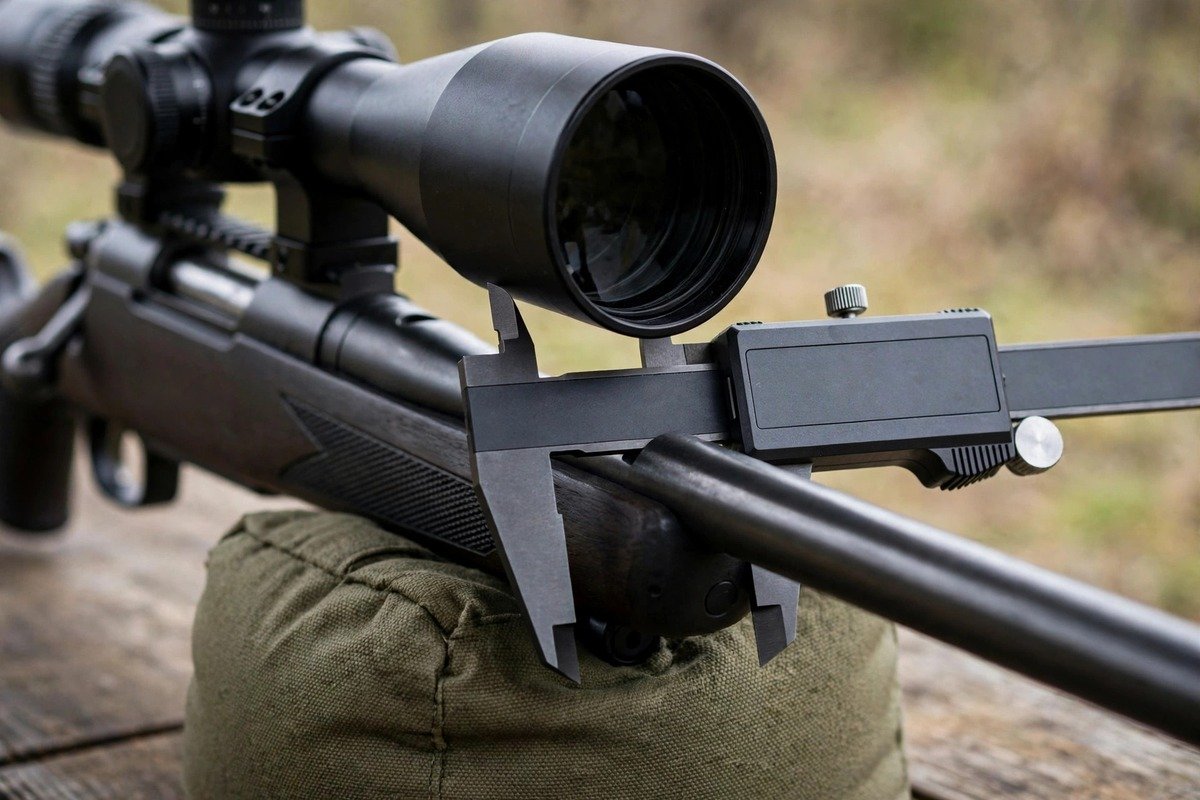
This is the standard method gunsmiths use. It works on almost any scoped rifle, and on a bolt-action rifle you use the bolt diameter instead of the barrel diameter for the most accurate result. The formula is simple:
Sight Height = (Bolt or Barrel Diameter ÷ 2) + (Scope Objective Bell Diameter ÷ 2) + Gap Between Barrel and Scope
Step 1: Find the Center of the Bore
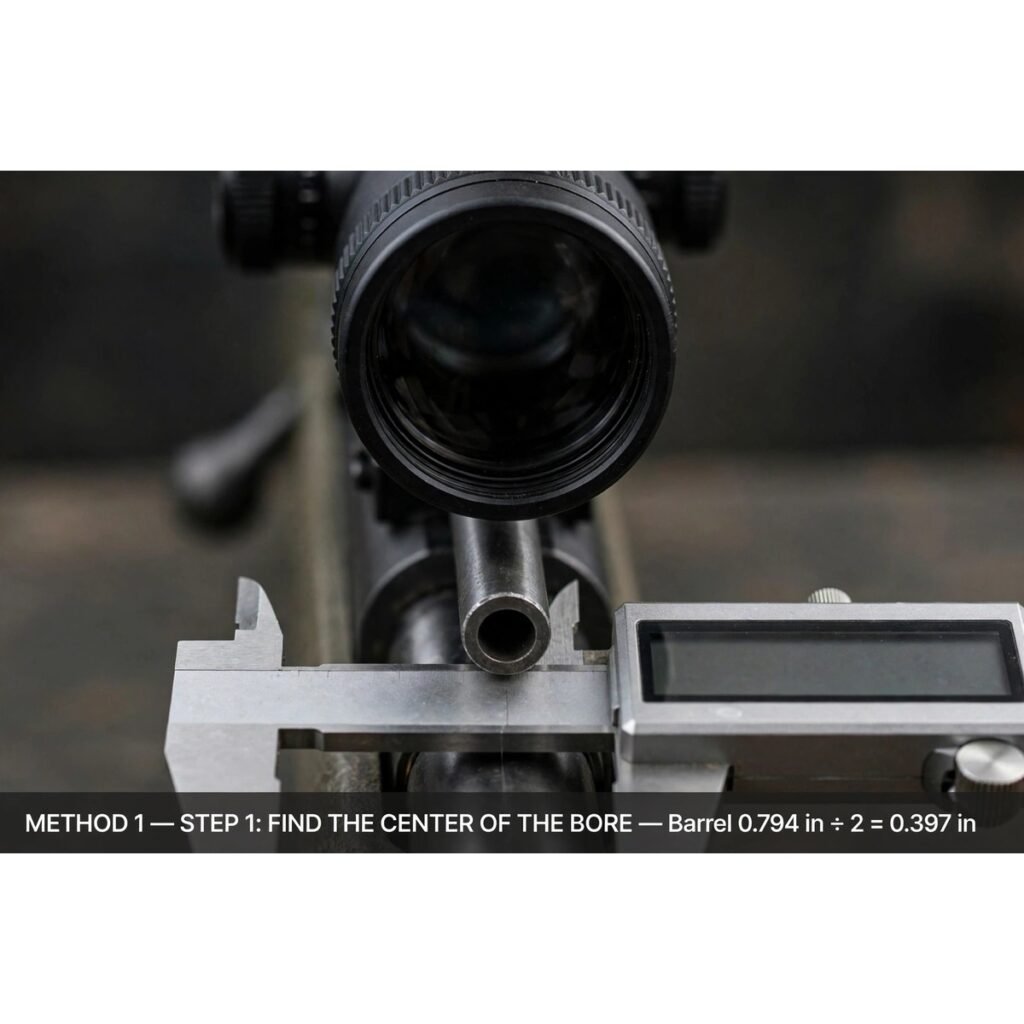
Measure the diameter of your barrel directly underneath the scope’s objective bell (the wide front part of the scope) and divide it by two. On a bolt-action rifle, measure the bolt diameter instead — the bolt sits on the same centerline as the bore, and it is easier to measure accurately.
Example: a barrel diameter of 0.794 inches (20.17 mm) divided by 2 gives a bore center of 0.397 inches (10.08 mm).
Step 2: Find the Center of the Scope
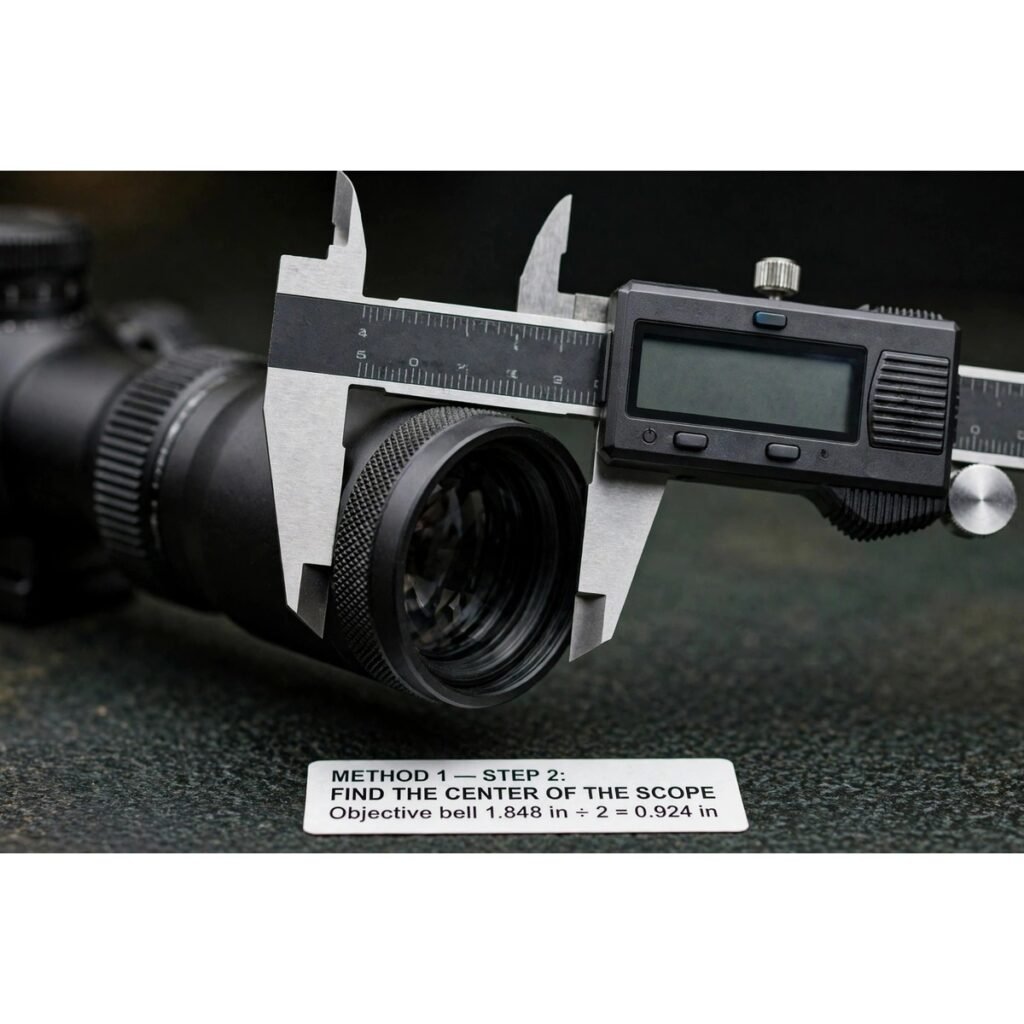
Measure the diameter of the objective bell — the front lens housing of the scope — and divide it by two. This gives you the center of the scope, which is where your crosshairs sit.
Example: an objective bell diameter of 1.848 inches (46.94 mm) divided by 2 gives a scope center of 0.924 inches (23.47 mm).
Step 3: Measure the Gap
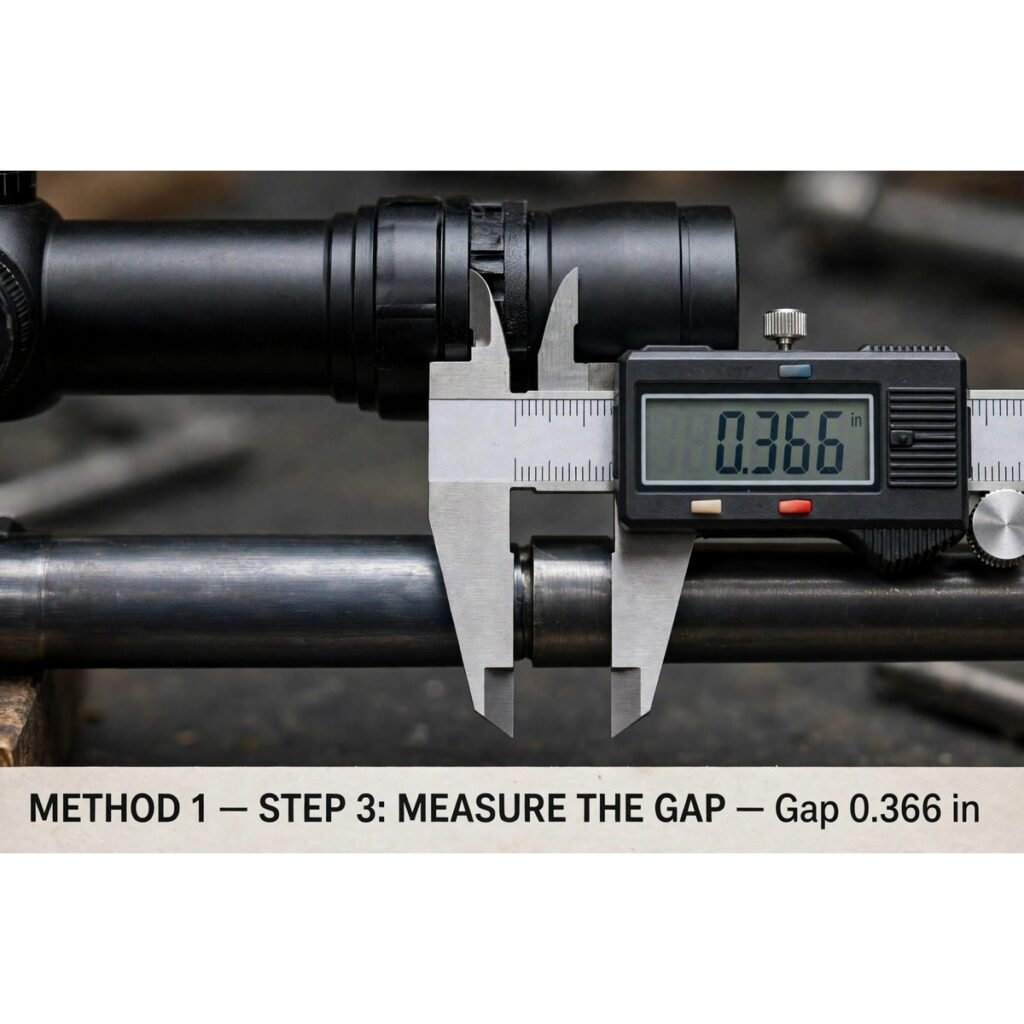
Measure the gap from the top of the barrel (or the top of the bolt, if you used the bolt in Step 1) to the bottom of the scope tube. Take this measurement at the exact same spot where you measured the barrel or bolt diameter.
Example: a gap of 0.366 inches (9.30 mm).
Step 4: Add the Three Numbers Together
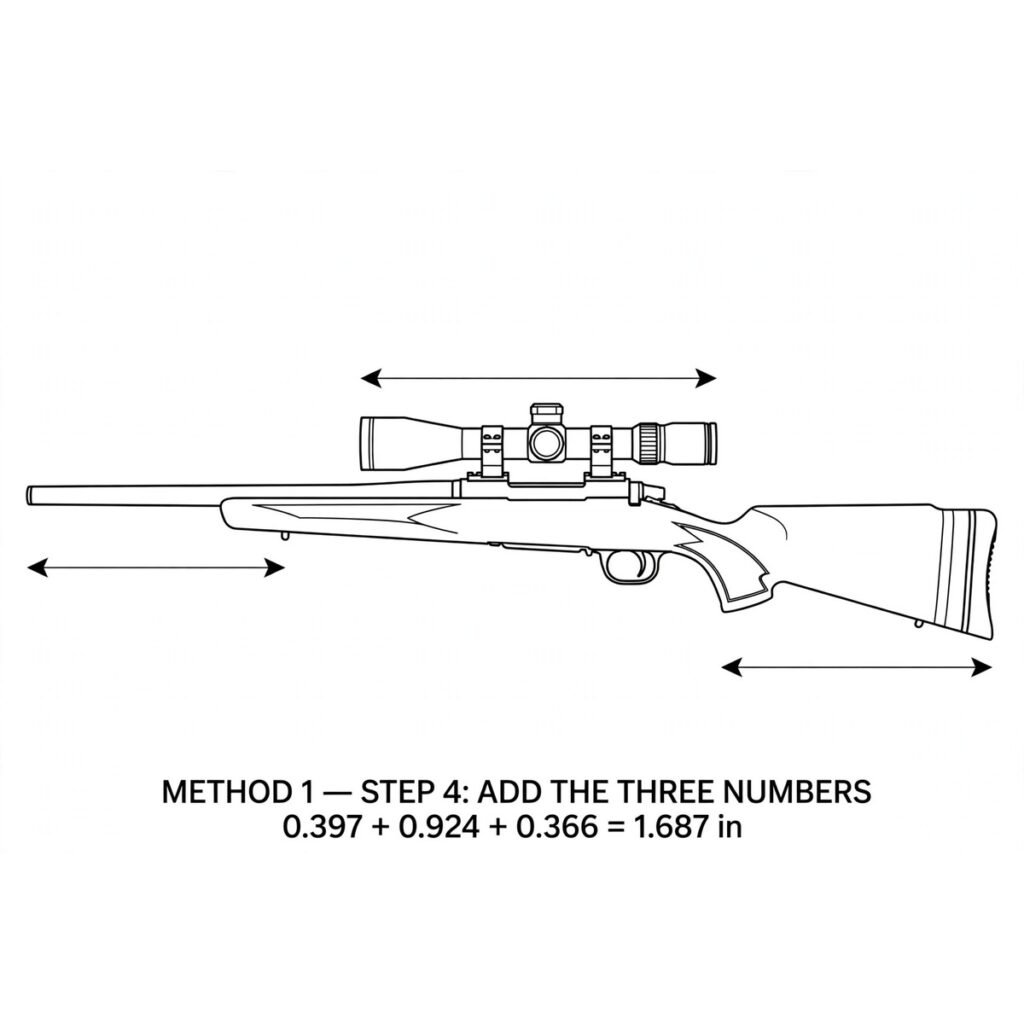
Add the bore center, the scope center, and the gap:
0.397 inches + 0.924 inches + 0.366 inches = 1.687 inches (42.85 mm)
That 1.687 inches is the sight height of this rifle — the distance from the center of the bore to the center of the scope.

Tip: If your scope sits on a canted (angled) rail, measure at the windage turret, where the reticle actually adjusts. That is the point ballistic programs such as Applied Ballistics use, and it keeps the measurement honest on a sloped mount.
Method 2: Measure From the Top of the Rail
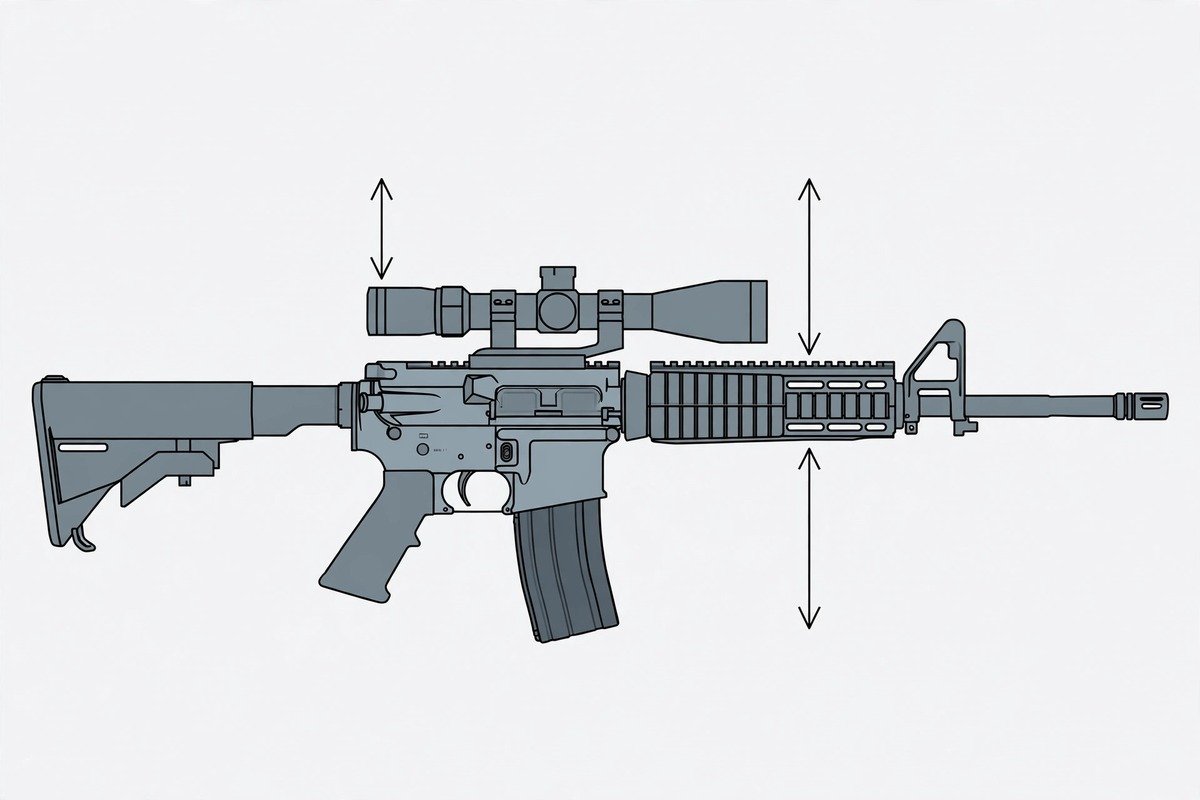
This method is faster and works well on rifles with a flat-top Picatinny rail, such as an AR-15. Instead of measuring the barrel and the scope separately, you measure two distances from the same starting point — the top of the rail — and add them together.
Step 1: Measure From the Rail to the Center of the Scope
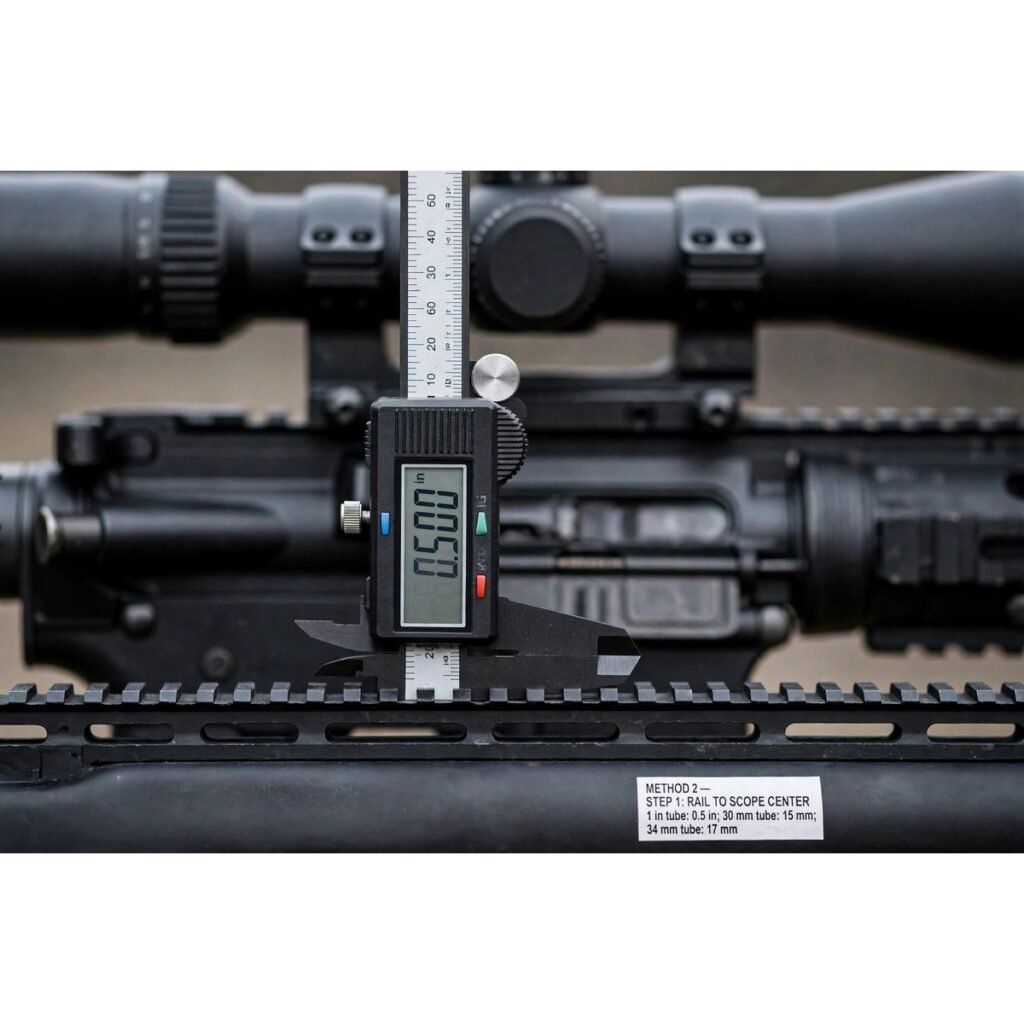
Place one end of your calipers on top of the rail and measure straight up to the center of the scope tube. You can find the scope center by measuring the outside diameter of the scope tube and dividing it by two: a 1-inch tube (25.4 mm) has a center 0.5 inches (12.70 mm) above its bottom edge, a 30 mm tube has a center 15 mm (0.59 inches) above its bottom edge, and a 34 mm tube has a center 17 mm (0.67 inches) above its bottom edge. Add that half-diameter to the distance from the rail to the bottom of the tube.
Step 2: Measure From the Rail Down to the Center of the Bore
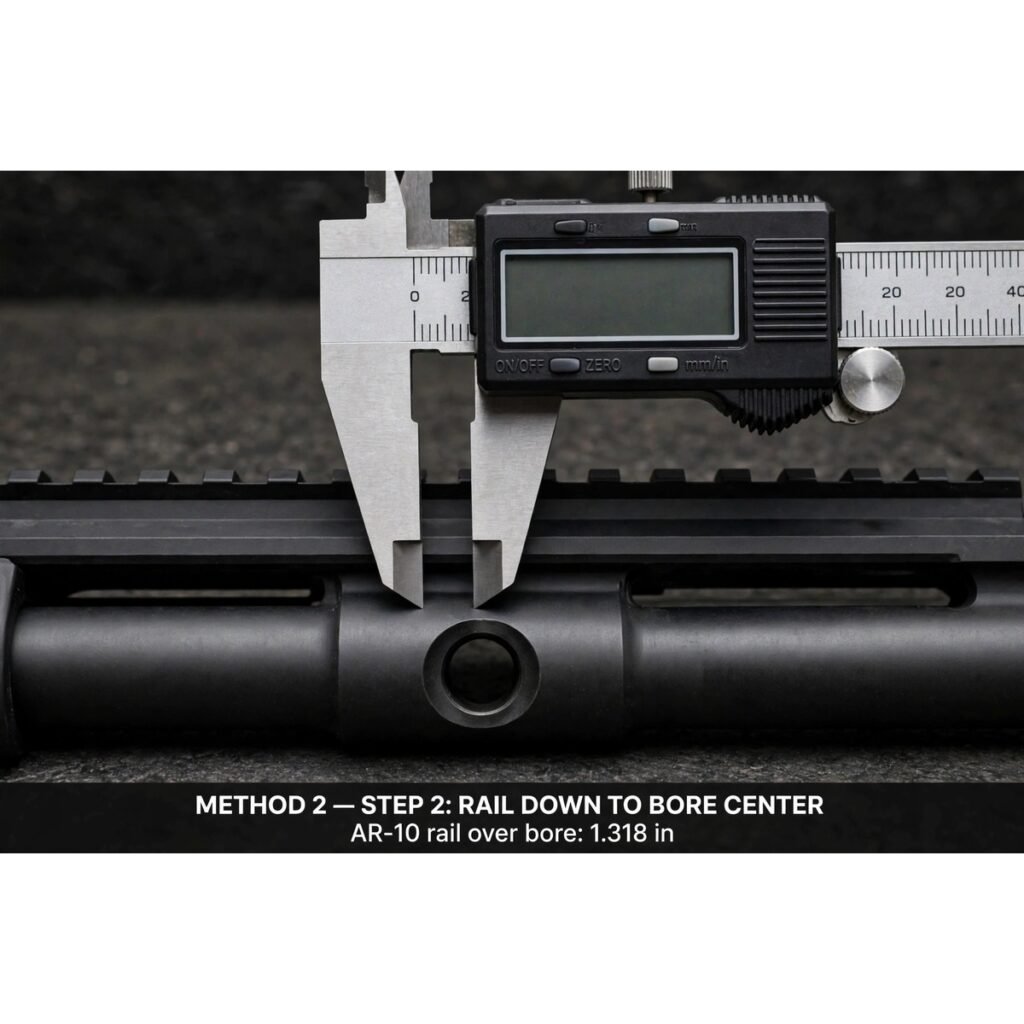
Now measure from the top of the rail down to the center of the bore. On an AR-15 the bore center sits below the flat-top rail; the rail height over the bore on an AR-10, for example, is 1.318 inches (33.48 mm). On a bolt-action rifle the bore center is usually 0.4 to 0.8 inches (10.16 to 20.32 mm) below the top of the receiver. If you can remove the bolt, you can measure this directly; otherwise, use the receiver-to-bore offset in your rifle’s manual or measure it with the caliper method in Method 1.
Step 3: Add the Two Numbers Together
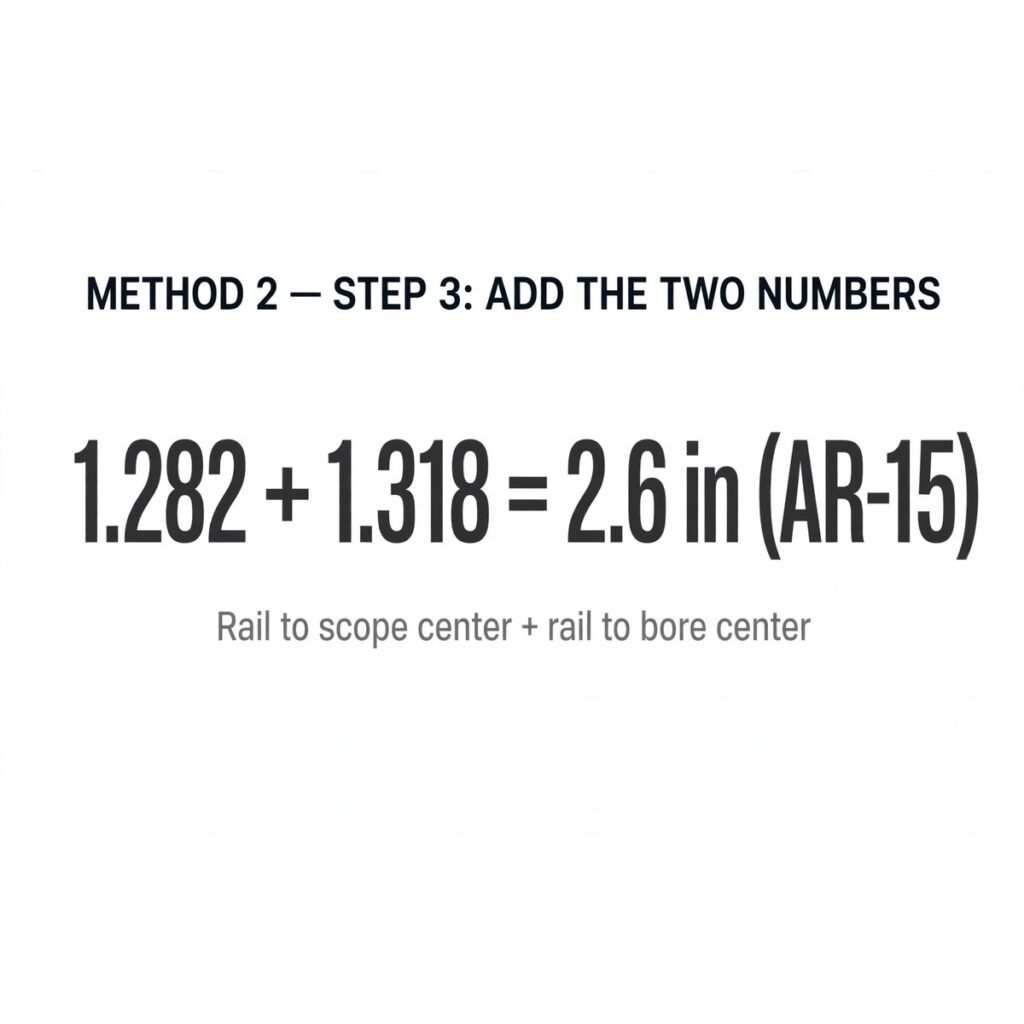
Sight Height = (Rail to Scope Center) + (Rail to Bore Center)
For example, if the scope center sits 1.282 inches above the rail and the bore center sits 1.318 inches below the rail, the sight height is 1.282 + 1.318 = 2.6 inches (66.04 mm) — exactly the standard AR-15 figure.
Method 3: Use a Dowel Rod Through the Bore

This is the simplest method when you do not want to take the scope off or do any adding up. It gives you the bore centerline directly, so you only need one measurement.
Step 1: Remove the Bolt

Take the bolt out of the rifle. This opens a straight path from the muzzle through the action.
Step 2: Run a Rod Through the Bore
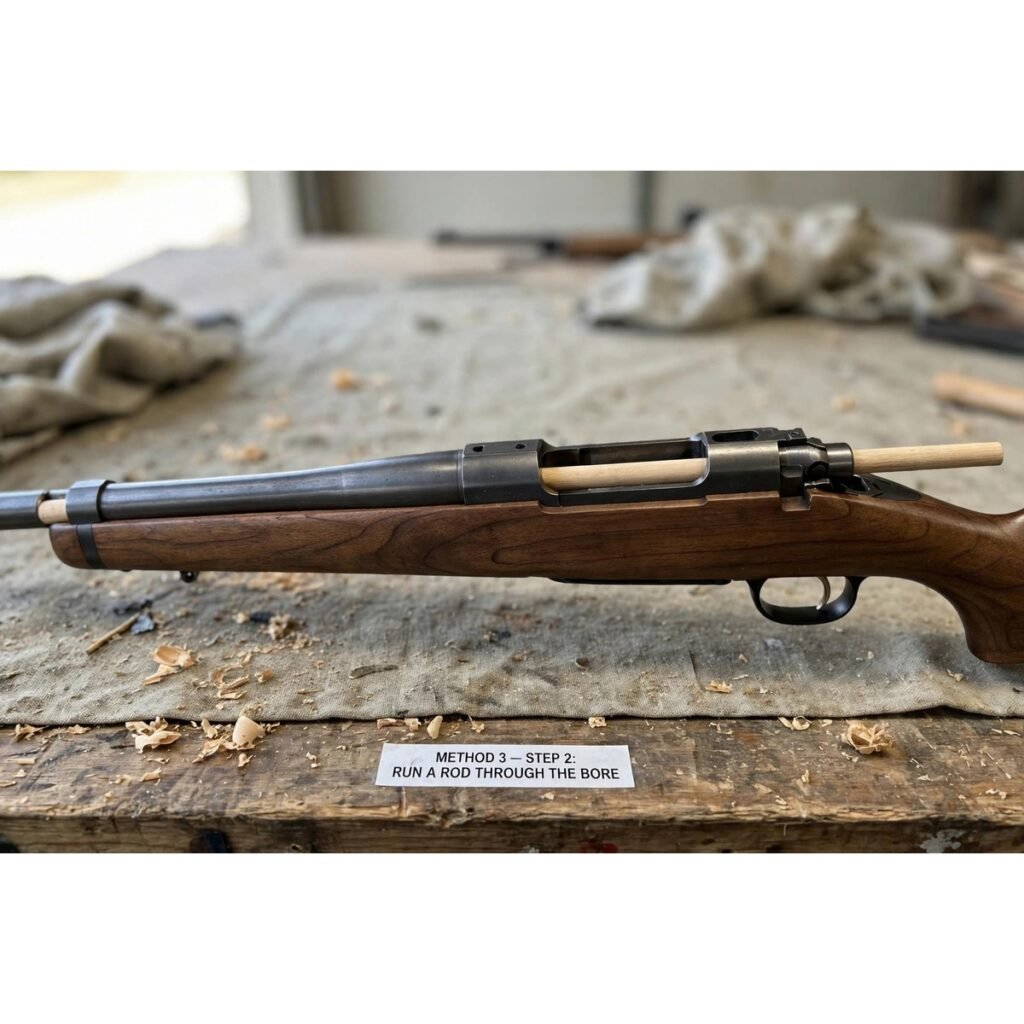
Slide a dowel rod or a cleaning rod in through the muzzle so it runs through the bore and out the back of the action. The rod now sits exactly on the bore centerline. A bore guide makes this more precise, but a snug-fitting rod works fine.
Step 3: Measure From the Rod to the Center of the Scope
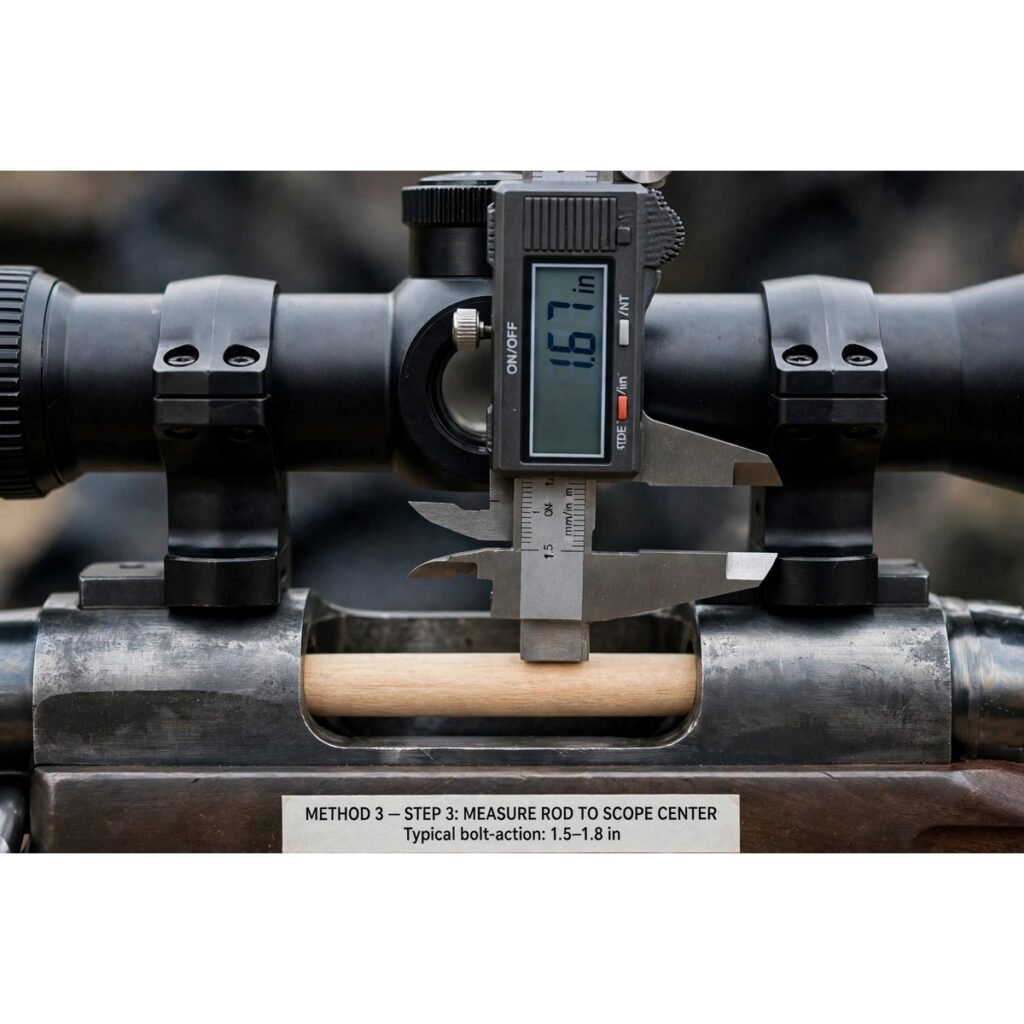
Measure straight up from the center of the rod to the center of the scope. To find the center of the rod, measure to the top of the rod and subtract half its diameter. To find the center of the scope, measure to the center of the scope tube or the objective bell, just as in Method 1.
That single measurement is your sight height. On a typical bolt-action hunting rifle it will read about 1.5 to 1.8 inches (38.10 to 45.72 mm).
Tip: A laser bore sighter works the same way — put it in the muzzle, mark where the laser dot lands on a wall, and measure from the center of the dot to the center of your scope.
Why Sight Height Matters (and What Happens If It Is Wrong)

Sight height is not just a number for a spec sheet. It changes where your bullet actually goes, for three reasons:
1. It is a required input for ballistic calculators. Every ballistic program asks for sight height before it can predict your trajectory. The calculator uses it to work out the angle between your line of sight and the bore. If you enter 1.5 inches when the real number is 2.6 inches, every drop figure it gives you will be wrong.
2. It moves your near zero and your far zero. Your line of sight and the bullet’s path cross twice — once close to the muzzle and once at your zero distance. A taller sight height pushes the near zero farther out and changes the far zero too, which changes every holdover in between.
3. It matters most at close range. Inside 25 yards (22.86 meters), the bullet leaves the barrel well below your line of sight — by roughly the full sight height. With a 2.6-inch (66.04 mm) AR-15 sight height, a shot at very close range will hit about 2.6 inches below where your crosshairs point. Hunters and home-defense shooters who forget this miss low at close range.
If the number is wrong, the practical result is simple: your rifle will be zeroed at one distance and off at every other distance, and your ballistic app will give you bad holdovers. The error is small when the wrong number is close to the real one — using 2.5 inches instead of 2.6 inches (a 0.1-inch, or 2.54 mm, difference) barely matters — but entering 1.5 inches for a rifle that actually measures 2.6 inches will cost you hits.
Frequently Asked Questions
What is a good sight height?
There is no single best number. A good sight height is the lowest one that clears everything and still lets you shoot comfortably. On a classic bolt-action hunting rifle, that usually means 1.5 to 1.8 inches (38.10 to 45.72 mm) with low rings. On an AR-15, the straight-line stock forces a taller setup, about 2.5 to 2.6 inches (63.50 to 66.04 mm). Mount the scope as low as it will go without touching the barrel, the bolt handle, or the objective bell — and leave at least 0.1 inches (2.54 mm) of clearance between the objective bell and the barrel.
Does sight height affect zero?
Yes. Sight height changes the angle between your line of sight and the bore, so it changes where the bullet crosses your line of sight. A taller sight height moves your near zero farther away and changes your far zero. That is why you must re-zero if you change mounts or rings, and why your ballistic calculator needs the real measured number, not a guess.
Can I just use 1.5 inches if I cannot measure?
For a bolt-action hunting rifle with low rings, 1.5 inches (38.10 mm) is the standard guess and it is close enough for normal range shooting. For an AR-15, use 2.5 inches (63.50 mm) instead — 1.5 inches would be a full inch off. But for long-range shooting or a ballistic calculator, always measure your own rifle. Guessing is fine for a 100-yard zero; it is not fine for a 500-yard shot.
Where on the scope should I measure?
Measure at the windage turret — the middle of the scope where the adjustment dials sit. That is where the reticle is, and it is the point ballistic programs use. On a scope mounted on a canted rail, measuring at the objective bell instead can give you a slightly different number, because the scope is tilted. The difference is small, but the turret is the correct reference point.
Does sight height change with different rings?
Yes. Taller rings raise the scope and increase sight height; lower rings reduce it. Changing from low rings to high rings on the same rifle can add 0.25 to 0.5 inches (6.35 to 12.70 mm) to your sight height. Any time you change rings, bases, or mounts, measure again and update your ballistic calculator.
Conclusion
Sight height is the distance from the center of your bore to the center of your sight — usually 1.5 to 1.8 inches (38.10 to 45.72 mm) on a bolt-action rifle and about 2.6 inches (66.04 mm) on an AR-15. The most accurate way to measure it is with calipers: half the bolt or barrel diameter, plus half the objective bell diameter, plus the gap between them. The rail method and the dowel-rod method get you the same number with less adding up. Whatever method you use, write the number down and enter it in your ballistic calculator — it is the difference between a zero that holds at every distance and one that only works at one.
Related Guides
- How Long Is a Full-Size AK-47? Length, Weight & Size Guide
- How Long Is a Hunting Rifle? 14 Common Lengths Explained
- AK-47 at the Firing Range: What It’s Like to Shoot One
- How Long Is an HK416 Rifle?
- How Long Is an FN SCAR Rifle?

Hi, I’m Michael Carter, I write simple, everyday size guides so you can picture any measurement in seconds.